Using Calculators to Solve Equations (Cambridge International IGCSE Maths)
Using Calculators to Solve Equations
How do I find points of intersection using my graphic display calculator?
-
You can use your graphic display calculator to draw two graphs on the same axes, and , then find the coordinates of the points of intersection
- These are the points where the two graphs meet
-
First draw the graph of on your graphic display calculator
- Read the revision note on Using Calculators to Sketch Graphs to see how
-
Then add a second graph, , on to the same axes of the graph above
- You may find the tab button is a shortcut for adding a second graph
-
Now navigate to ****"analyze graph" and select "intersection"
-
On some models, press G-Solv and then INTSECT instead
-
This finds the coordinates of the points of intersection
- You may have to click before and after the intersection to help the calculator search for it
- You may have to use the left and right buttons to select which intersection point you are finding
-
How do I solve equations using my graphic display calculator?
You can solve equations of the form using a graphic display calculator
-
straight f_ 1 (x)is the left-hand side of the equation,straight f_ 2 (x)is the right-hand side -
The solutions to the equation are the x-coordinates of the points of intersection of the two graphs and
-
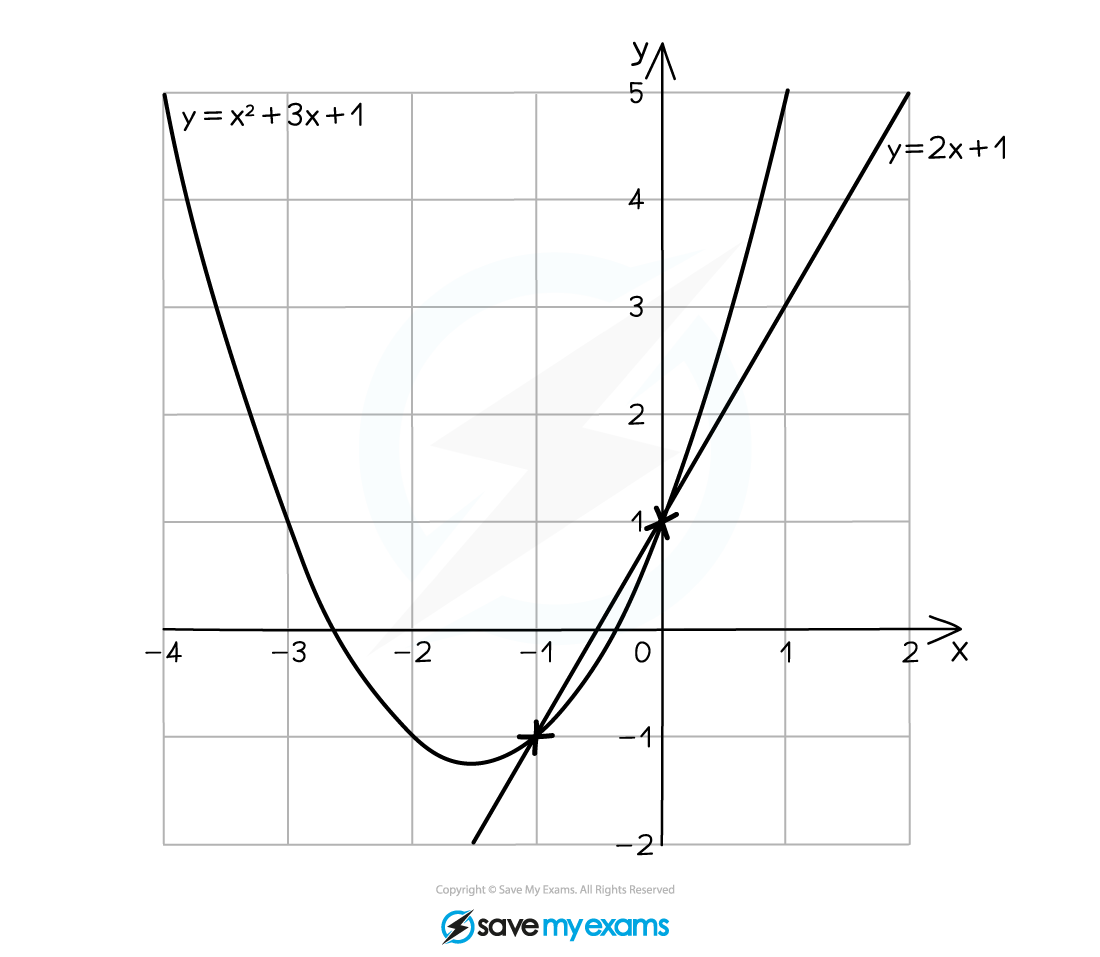
For example, to solve using a graphic display calculator
-
draw on your calculator and add on
-
Find the two points of intersection, which are (-1, -1) and (0, 1)
-
The solutions to are the x-coordinates of these points
-
so or are the solutions
-
-
What situations should I be familiar with?
-
Whilst you may be asked to solve any equation of the form , there are a few familiar situations that you should recognise
-
Solving a function equal to zero:
straight f_ 1 (x)=0-
For example, to solve
- Using above, the solutions are the x-coordinates of the points of intersection of and (since
straight f_ 2 (x)=0) - You need to recognise as the x-axis , so the solutions are the x-intercepts of
- Using above, the solutions are the x-coordinates of the points of intersection of and (since
-
-
Solving a function equal to a constant (number):
straight f_ 1 (x)=k-
For example, to solve
- The solutions are the x-coordinates of the points of intersection of and (since
straight f_ 2 (x)=1) - You need to recognise as a **horizontal line **that cuts the y-axis at 1
- The solutions are the x-coordinates of the points of intersection of and (since
-
-
To solve a** different equation** like using the original graph you need to rearrange the different equation to get "graph = ..."
-
Add / subtract terms to both sides
- For example, add 5 to both sides of
- giving which can now be done as above
-
Is this method the same as using the equation solver on my graphic display calculator?
-
The method above for solving equations of the form using the x-coordinate of intersection is called a graphical method
-
However, the equation can be rearranged by bringing all terms to one side
-
(or )
- E.g. becomes
-
If this forms a quadratic or cubic equation, you can use the equation solver on your calculator
- This is no longer a graphical method but now an algebraic method
- Look for the option for solving a polynomial
-
Select the degree (or order) of the equation you are solving
- When solving a quadratic, the degree (or order) is 2
- When solving a cubic, the degree (or order) is 3
-
-
Type in the coefficients of the equation you are solving
-
This is usually in the format (or )
-
Then press enter (or solve) and view the solutions
- This will give the same solutions as those from the graphical method
-
Exam Hint If asked to solve an equation using a graphical method, you must do it by finding points of intersections between two graphs (not by using the equation solver).
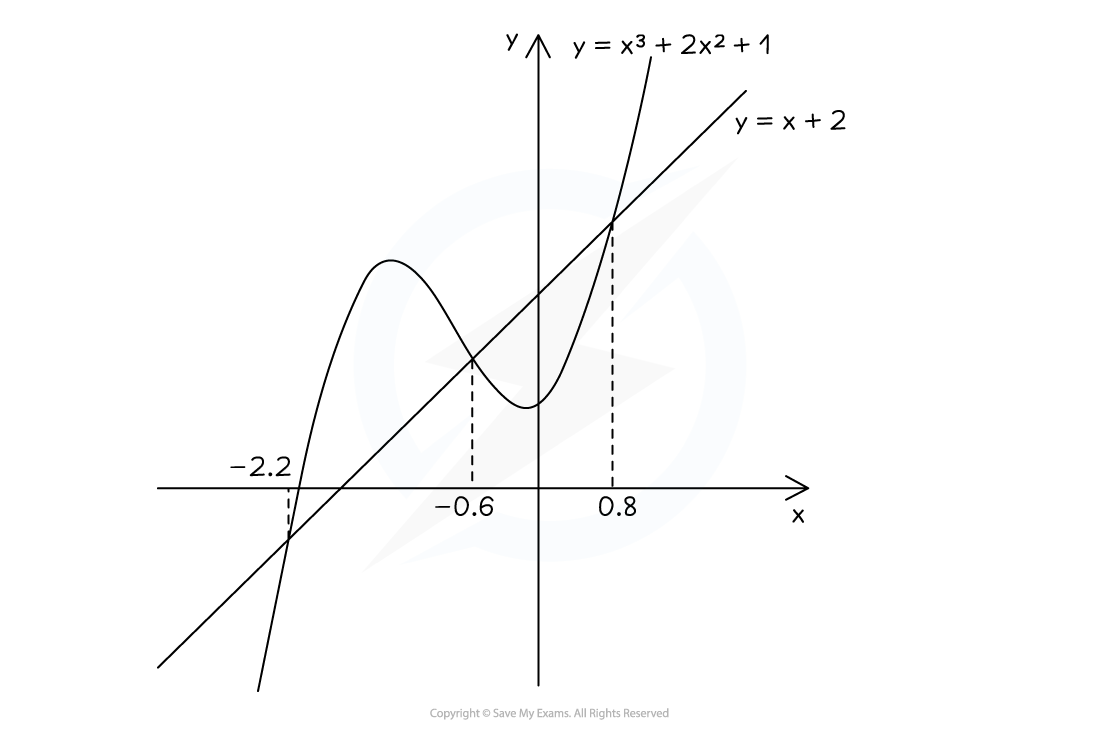
Worked Example Draw the graph of on your calculator.
Use a graphical method to solve the equation , giving your answers correct to 1 decimal place.
Start a new graph on your calculator and enter
straight f_ 1 (x)=x³+2x²+1to generate the graph Add on the second graph ofstraight f_ 2 (x)=x+2Select the option to "analyze" the graph (this may be labelled as G-Solv) Choose the option "intersections" to find the coordinates of the 3 points of intersection
The solutions to the equation are the x-coordinates of the points of intersection
Final answer: ,orto 1 d.p.
Was this revision note helpful?
Build on this topic