Angles of Elevation & Depression (Cambridge International IGCSE Mathematics)
Elevation & Depression
What are angles of elevation and depression?
-
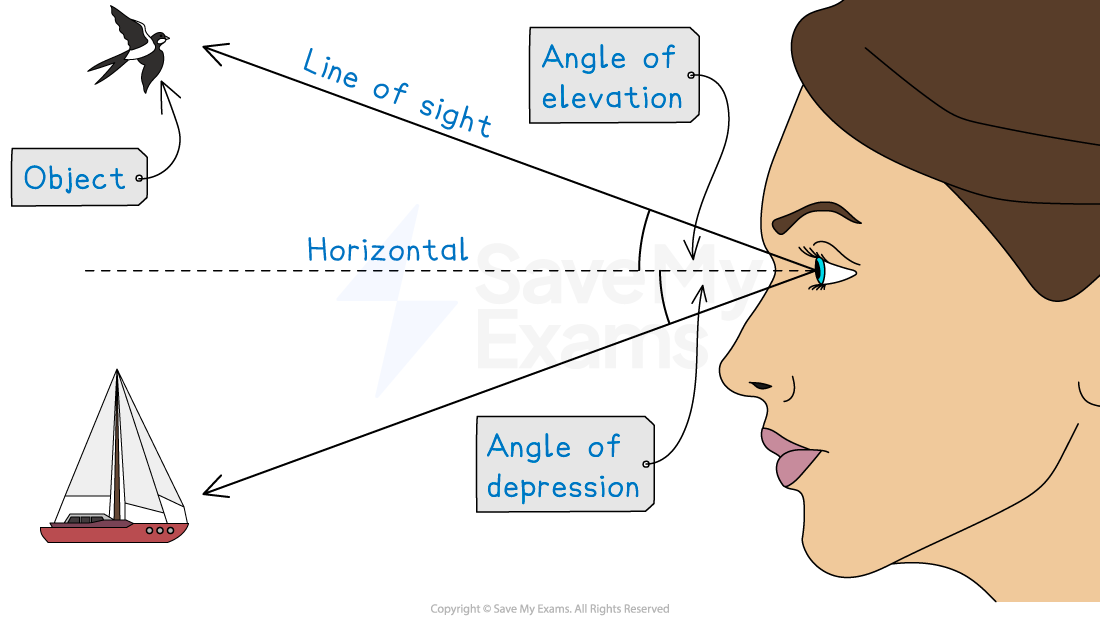
An angle of elevation or depression is the angle measured between the horizontal and the line of sight
- Looking up at an object creates an angle of elevation
- Looking down at an object creates an angle of depression
-
Right-angled trigonometry can be used to find
- an angle of elevation or depression
- or a missing distance
-
The tan ratio is often used in real-life scenarios
- You may know the height of an object and want to find the distance you are from it
- You may know the distance you are from an object and want to find its height
Exam Hint It may be useful to draw more than one diagram if the triangles that you are interested in overlap one another.
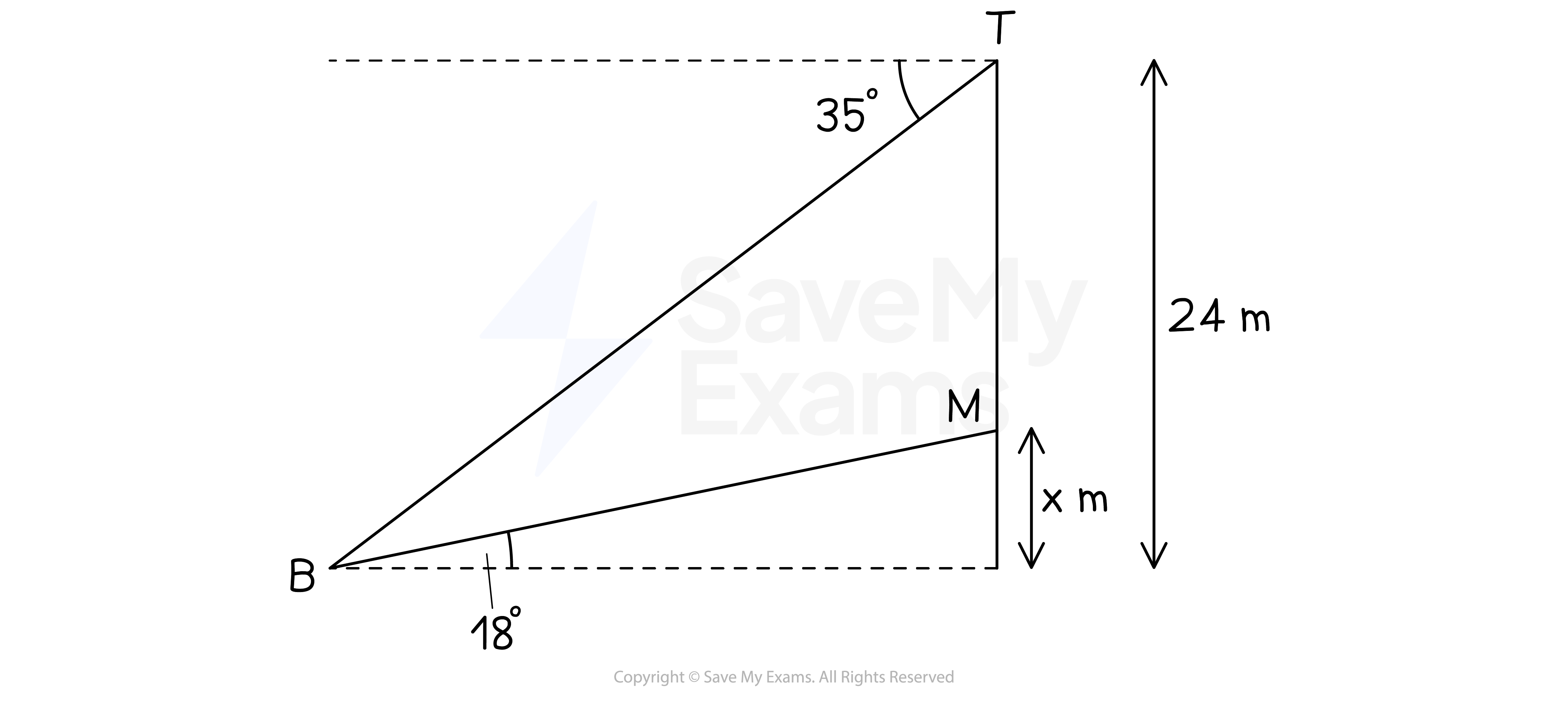
Worked Example A cliff is perpendicular to the sea and the top of the cliff, T, stands 24 metres above the level of the sea.
The angle of depression from the top of the cliff to a boat at sea is 35°.
At a point metres vertically up from the foot the cliff is a flag marker, M.
The angle of elevation from the boat, B, to the flag marker is 18°.
(a) Draw a diagram of the situation. Label all the angles and distances given above.
Answer:
(b) Find the distance from the boat to the foot of the cliff.
Answer:
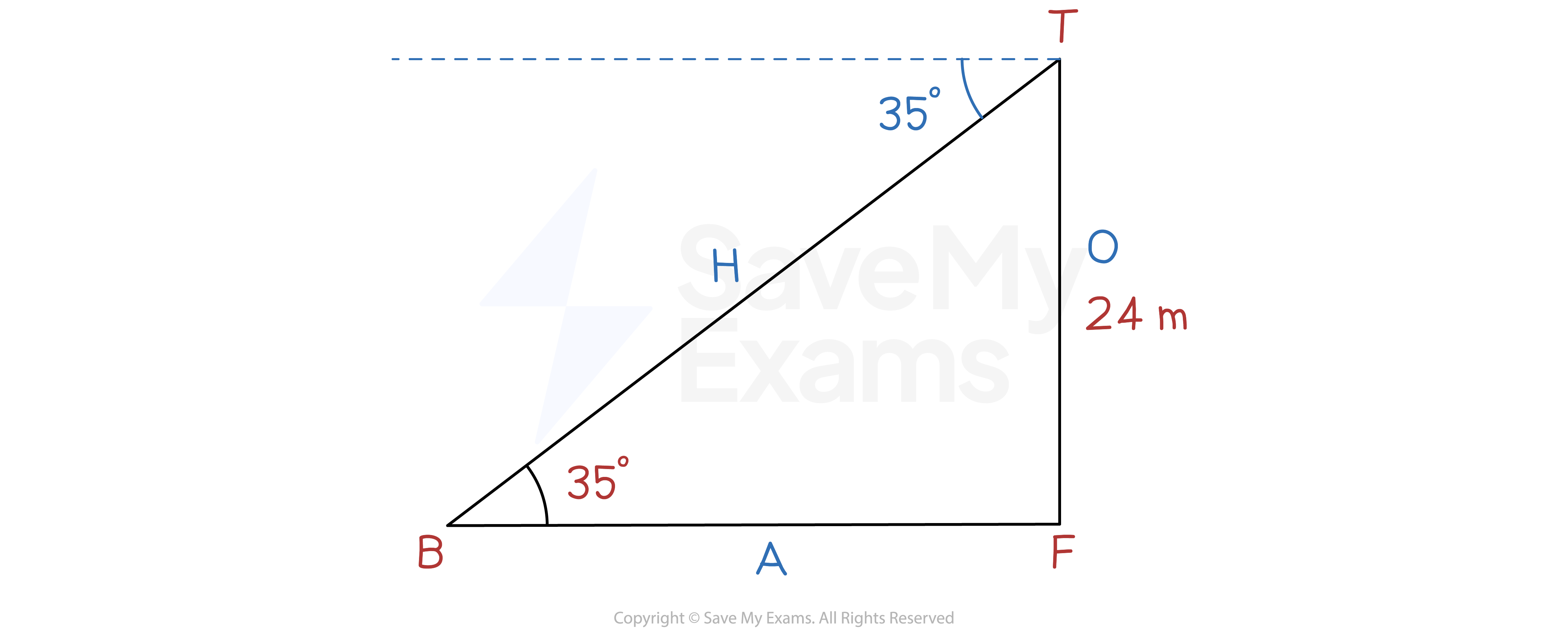
Consider triangle TBF where F is the foot of the cliff Angle TBF = 35º because of alternate angles
Use SOHCAHTOA to find the missing distance *We know the opposite (TF) and we want to find the adjacent (BF), so use *
Final answer: BF = 34.3 m (3 s.f.)
(c) Find the value of .
Answer:
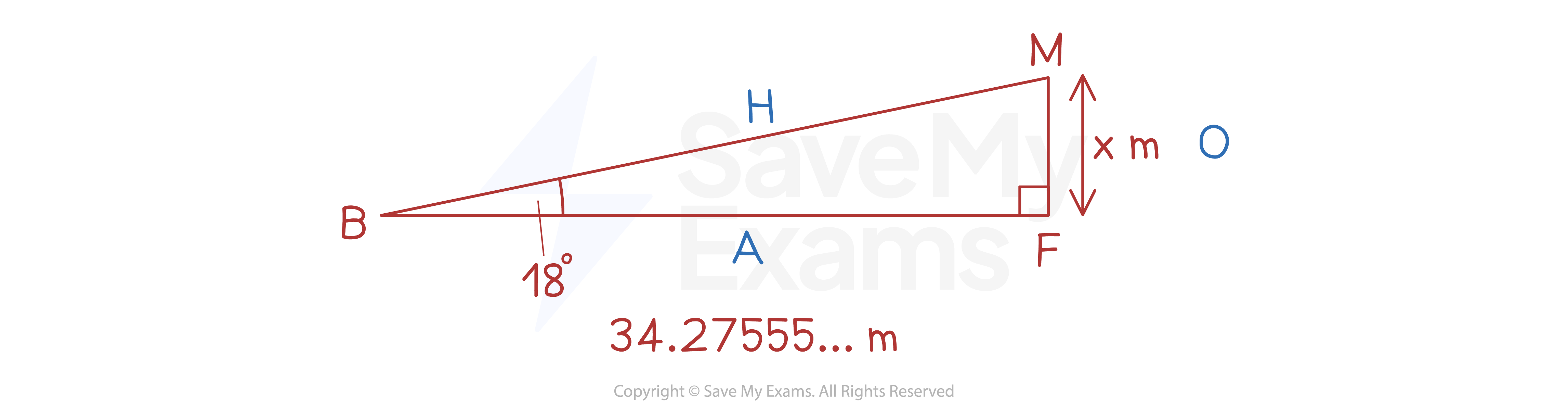
Consider triangle MBF
Use SOHCAHTOA to find the missing distance *We know the adjacent (BF) and we want to find opposite (MF), so use *
Final answer: (3 s.f.)
Was this revision note helpful?