The Sine Rule (Cambridge International IGCSE Mathematics)
Sine Rule
What is the sine rule?
-
The sine rule is used in non right-angled triangles
- It allows us to find missing side lengths or angles
-
It states that for any triangle with angles A, B and C
-
Where
- * *is the side opposite angle A
- * *is the side opposite angle B
- * *is the side opposite angle C
How do I use the sine rule to find missing lengths?
-
Use the sine rule
-
when you have opposite pairs of sides and angles in the question
- a and A, or b and B, or c and C
-
-
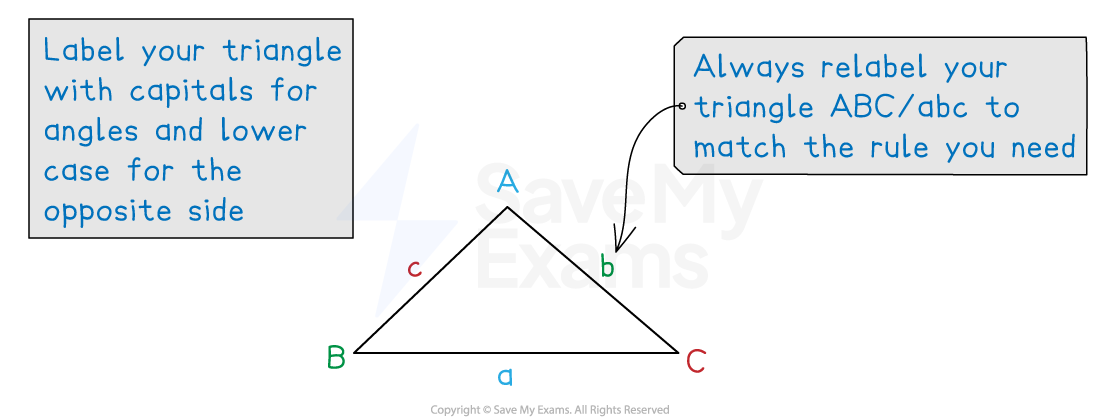
Start by labelling your triangle with the angles and sides
- Angles have upper case letters
- Sides opposite the angles have the equivalent lower case letter
-
To find a missing length, substitute numbers into the formula
-
You only need to have two parts equal to each other (not all three)
- Then solve to find the side you need
-
How do I use the sine rule to find missing angles?
-
To find a missing angle, it is easier to rearrange the formula first by flipping each part
-
The angles are now in the numerators of the fractions
-
Substitute the values you have into the formula and solve
- You will need to use inverse sine in your calculation,
-
Exam Hint You are given the formula in your exam.
You are not given the formula . However, you can derive it by flipping each fraction in the formula you are given.
What is the ambiguous case of the sine rule?
-
Given information about a triangle, there may be two different ways to draw it
-
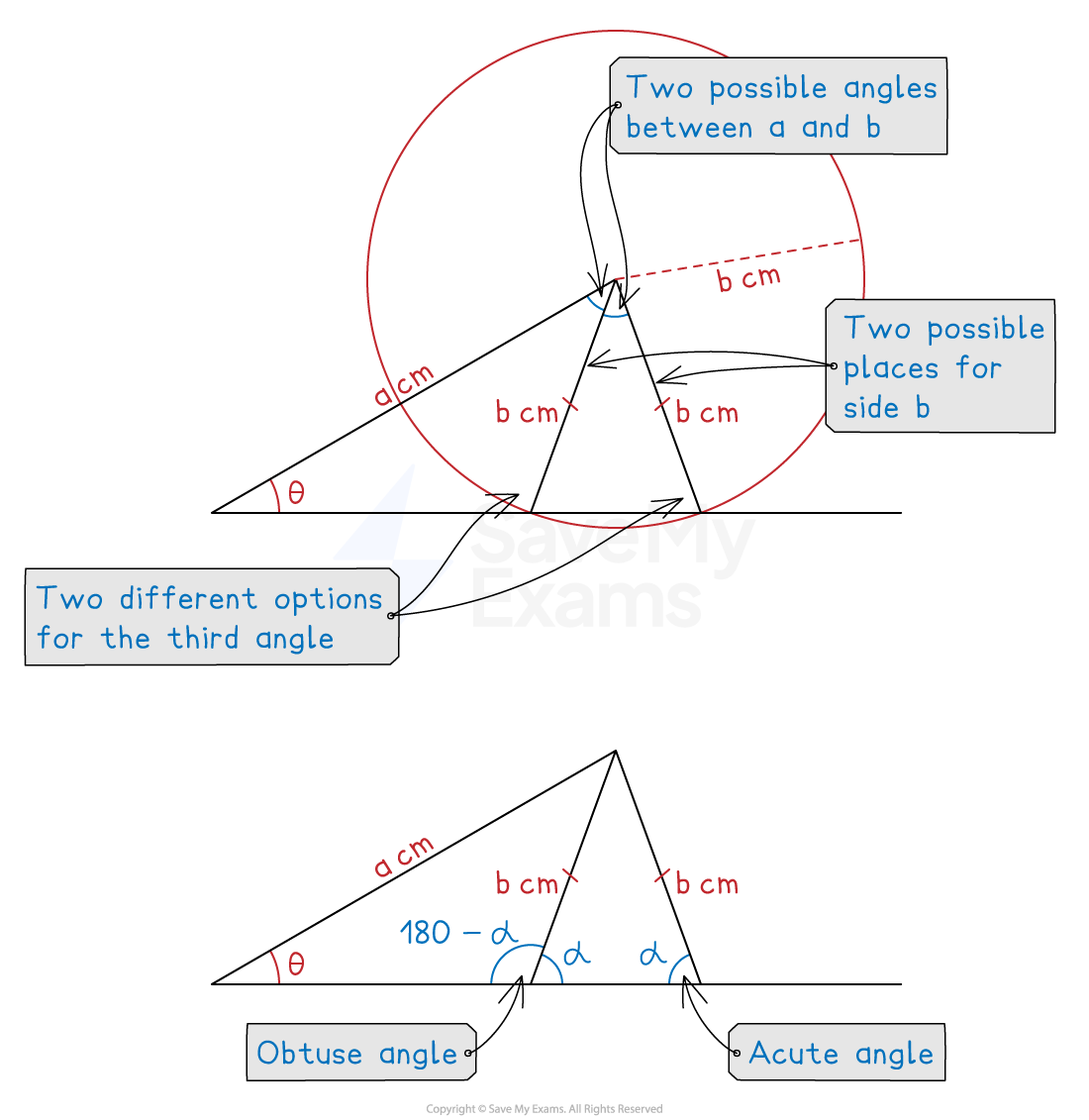
In the diagram below, the lengths of two sides are given, a and b
-
A base angle is also given, , but no angle near b is given
-
It turns out that there are two possible ways to arrange b to complete the triangle!
- Both triangles have the correct values of a, b and
-
-
The other base angle could either be obtuse or acute
-
The sine rule only gives the acute answer on your calculator
- You need to check the diagram to see if the angle you need is actually obtuse
- If it is, use this rule: obtuse angle = 180 - acute angle
-
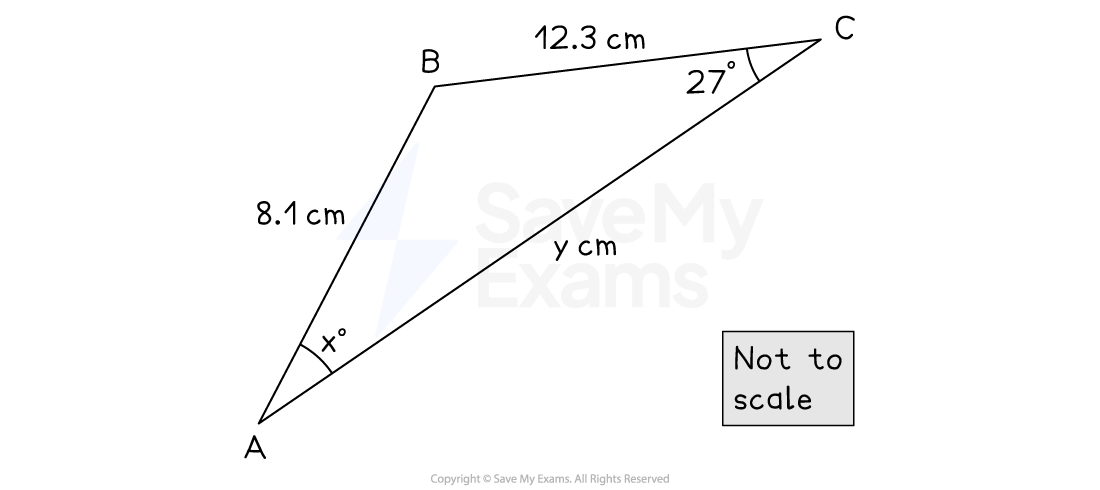
Worked Example The following diagram shows triangle ABC.
, and angle .
(a) Calculate the value of .
Answer:
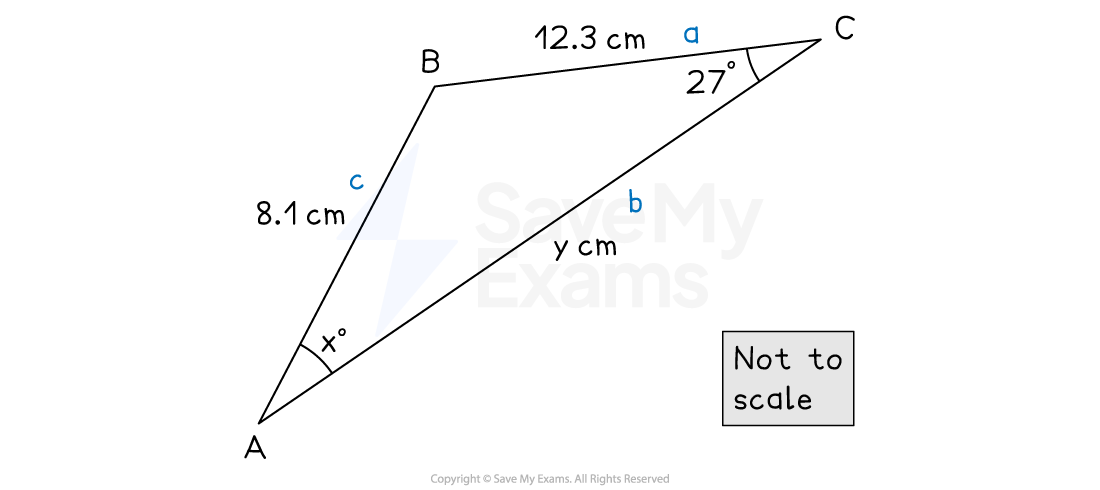
Label the sides of the diagram
*x is an angle so use the sine rule with the angles on top *
In practice, you only need to equate two of these three parts
Final answer: (to 1 d.p)
(b) Calculate the value of .
Answer:
To find y you need to know the angle opposite (angle ABC) You know 27 and x from above, so subtract these from 180
y* is a length so use the sin rule with the sides on the top*
Final answer: (to 3 s.f.)
Was this revision note helpful?
Build on this topic