Finding Vector Paths (Cambridge International IGCSE Mathematics)
Finding vector paths
How do I find the vector between two points?
-
A vector path is a path of vectors taking you from a start point to an end point
-
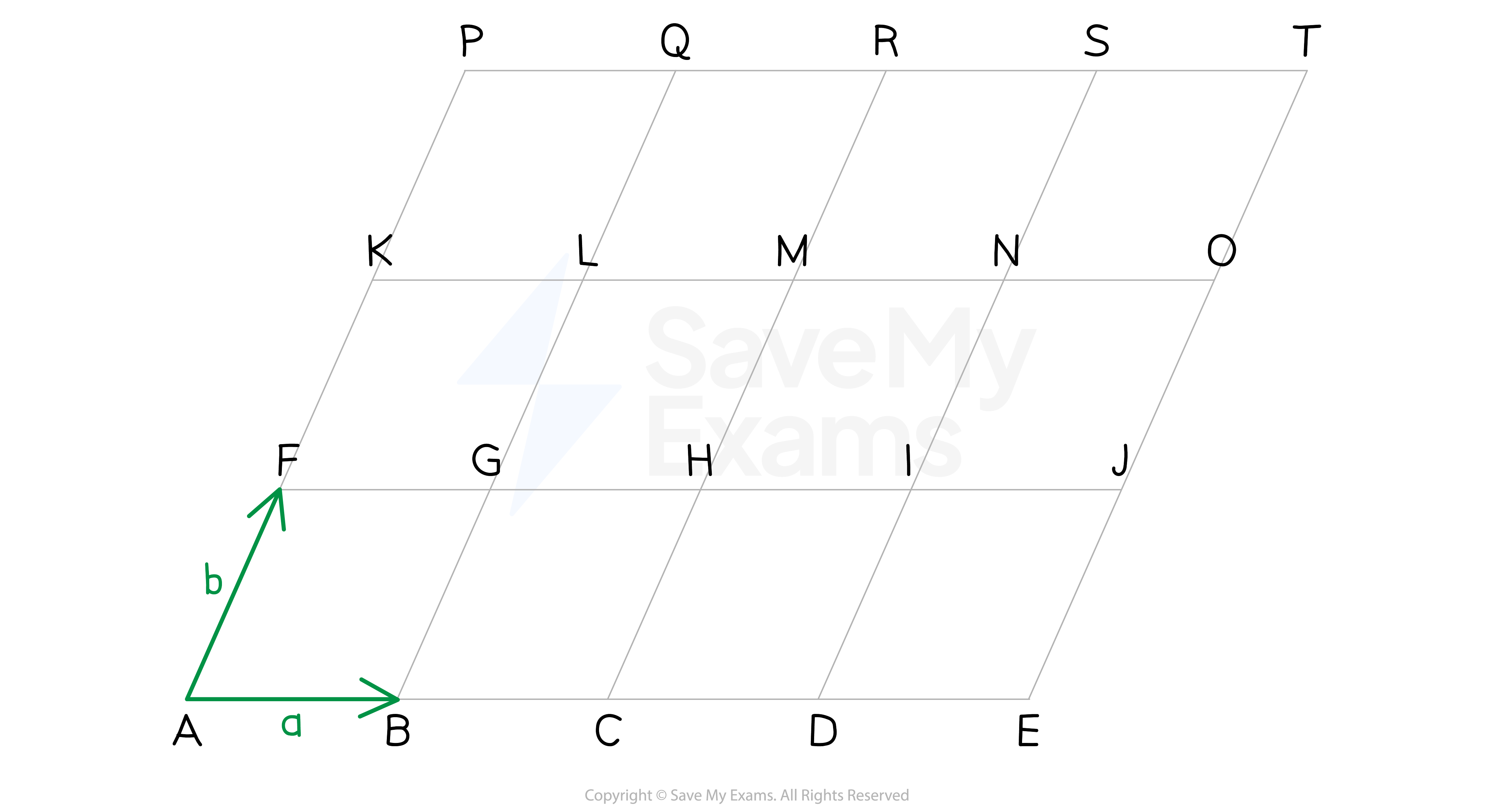
The following grid is made up entirely of parallelograms
-
The vectors a and b defined as marked in the diagram:
- Any vector that goes horizontally to the right along a side of a parallelogram will be equal to a
- Any vector that goes up diagonally to the right along a side of a parallelogram will be equal to b
-
-
To find the vector between two points
-
Count how many times you need to go horizontally to the right
- This will tell you how many a's are in your answer
-
Count how many times you need to go up diagonally to the right
- This will tell you how many b's are in your answer
-
Add the a's and b's together
- E.g.
-
-
You will have to put a negative in front of the vector if it goes in the opposite direction
-
-a is one length horizontally to the left
-
-b is one length down diagonally to the left
- E.g. or
- Likewise,
-
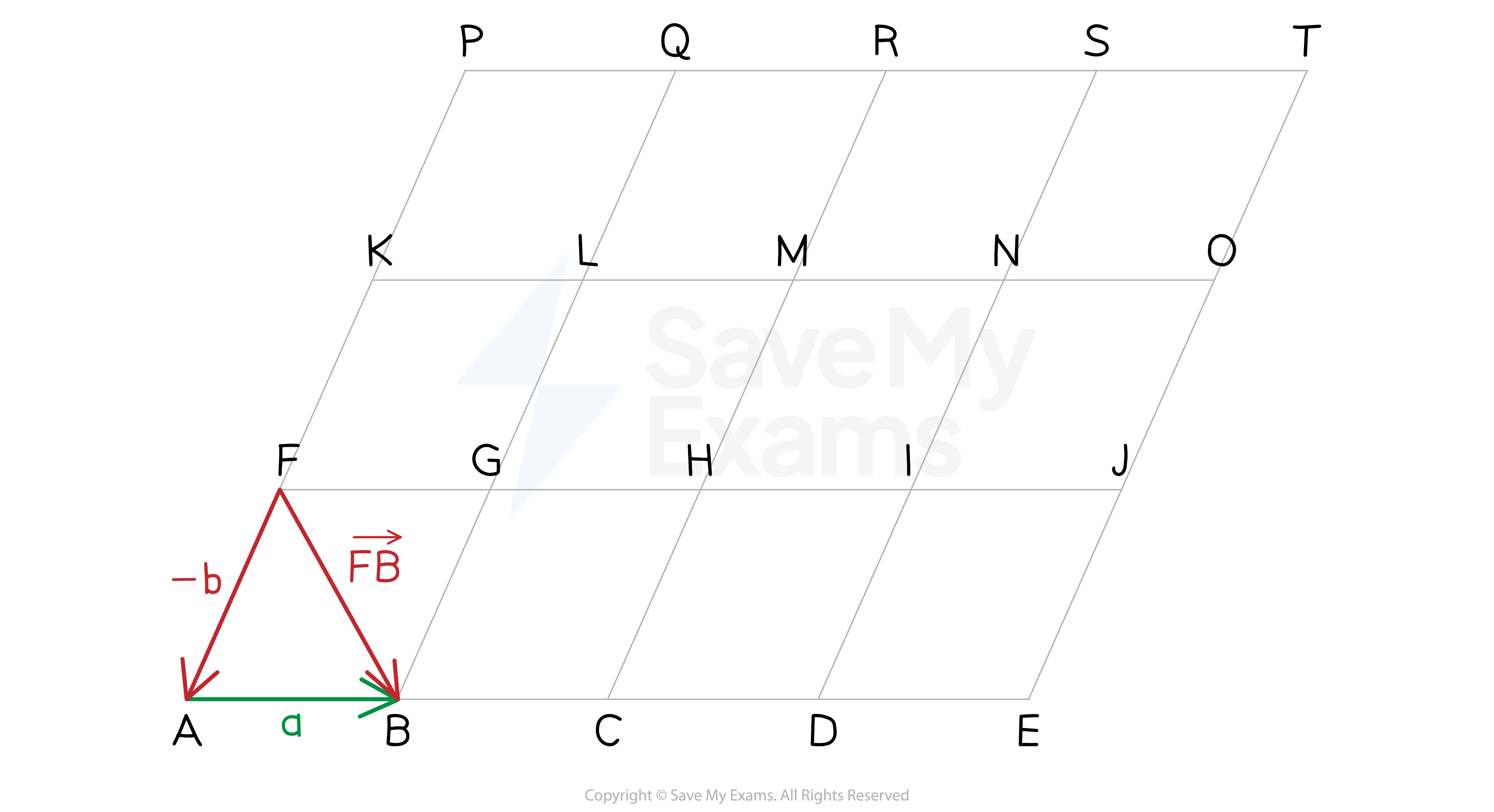
- It is possible to describe any vector that goes from one point to another in the above diagram in terms of a and b
Exam Hint
- Mark schemes will accept different correct paths, as long as the final answer is fully simplified
- Check for symmetries in the diagram to see if the vectors given can be used anywhere else
Worked Example The following diagram consists of a grid of identical parallelograms.
Vectors a *and b are defined by and .
Write the following vectors in terms of a and b.
(a)
Answer:
To get from A to E we need to follow vector a four times to the right
Final answer:
(b)
Answer:
There are many ways to get from G to T One option is to go from G to Q (b twice), and then from Q to T(a three times)
(c)
Answer:
*There are many ways to get from E to K * One option is to go from E to O(b twice), and then from O to K ( -a four times)
Was this revision note helpful?
Build on this topic