Domain & Range (Cambridge International IGCSE Mathematics)
Domain & range
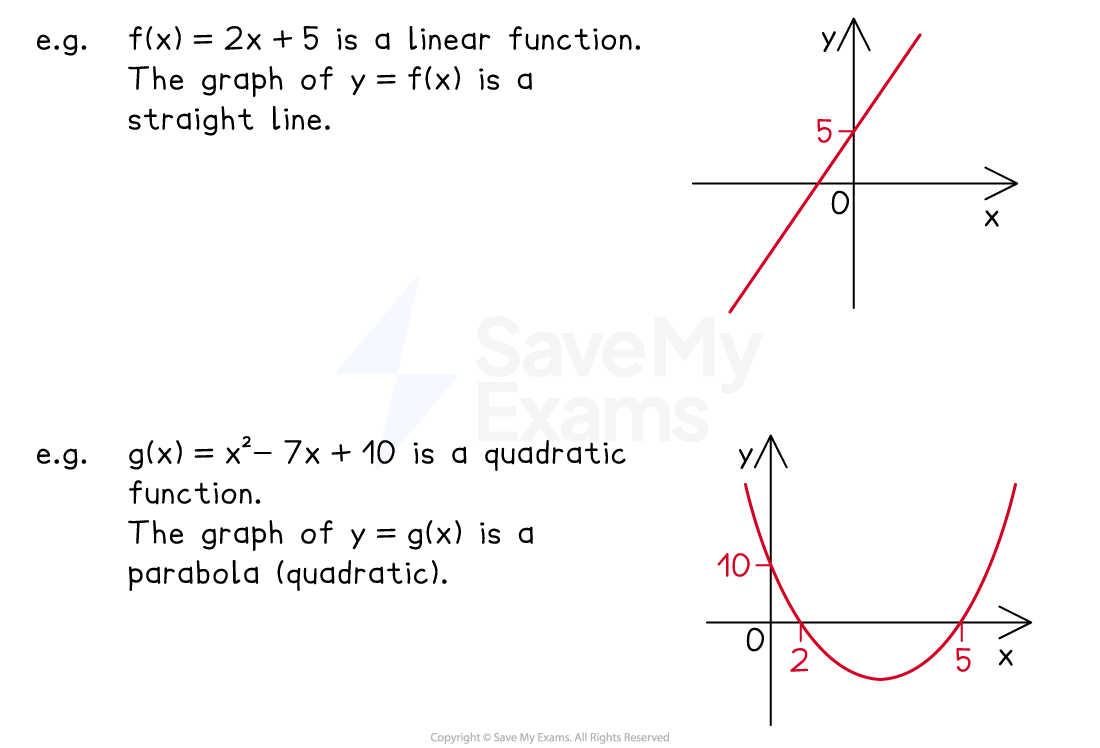
How are functions related to graphs?
-
Functions can be represented as graphs on x and y axes
- The x-axis values are the inputs
- The *y-*axis values are the outputs
-
To see what graph to plot, replace with
What is the domain?
-
The domain of a function is the set of all inputs that the function is allowed to take
-
Domains can be described in words
-
Domains must refer to x
- not y or f(x)
-
You can use "not equal to" ≠ if needed
-
You can use inequality signs if needed
-
What are examples of domains?
-
Examples of domains are below:
-
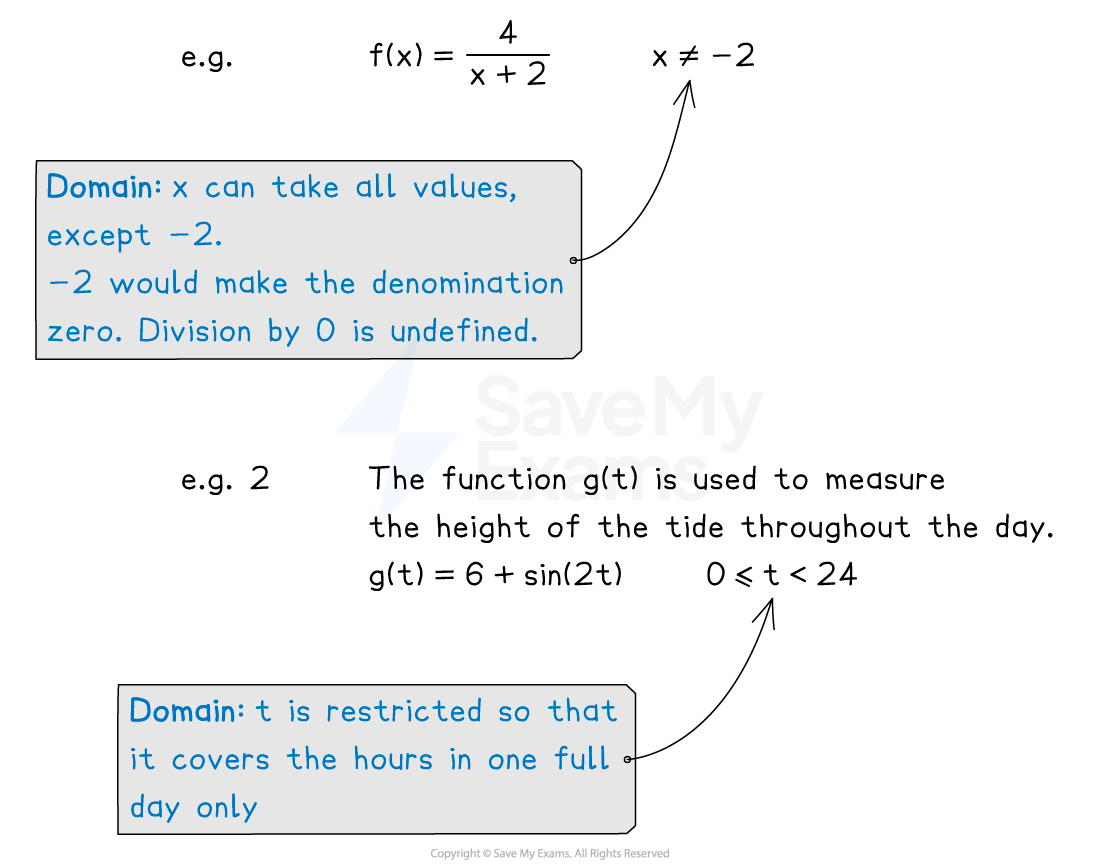
takes any x value except 0 (you cannot divide by 0)
- The domain is "all values of x except 0", or simply "x ≠ 0"
-
takes any x value that is not negative (you cannot take the square root of a negative)
- The domain is "x ≥ 0"
-
takes any x value (negative x values are fine as inputs)
- The domain is "all values of x"
-
takes any x value
- The domain is "all values of x"
-
What are restricted domains and values excluded from domains?
-
Some domains are restricted by choice
-
with the domain 0 < x < 5
- This question wants to concentrate on that domain only (even though bigger domains exist)
-
-
Some domains must exclude certain values (or sets of values)
-
must exclude x = 1 and x = -7 from any domain
- These two inputs make the function undefined (dividing by zero)
-
must exclude x < 3 from any domain
- Any input in x < 3 leads to square-rooting a negative
-
What is the range?
-
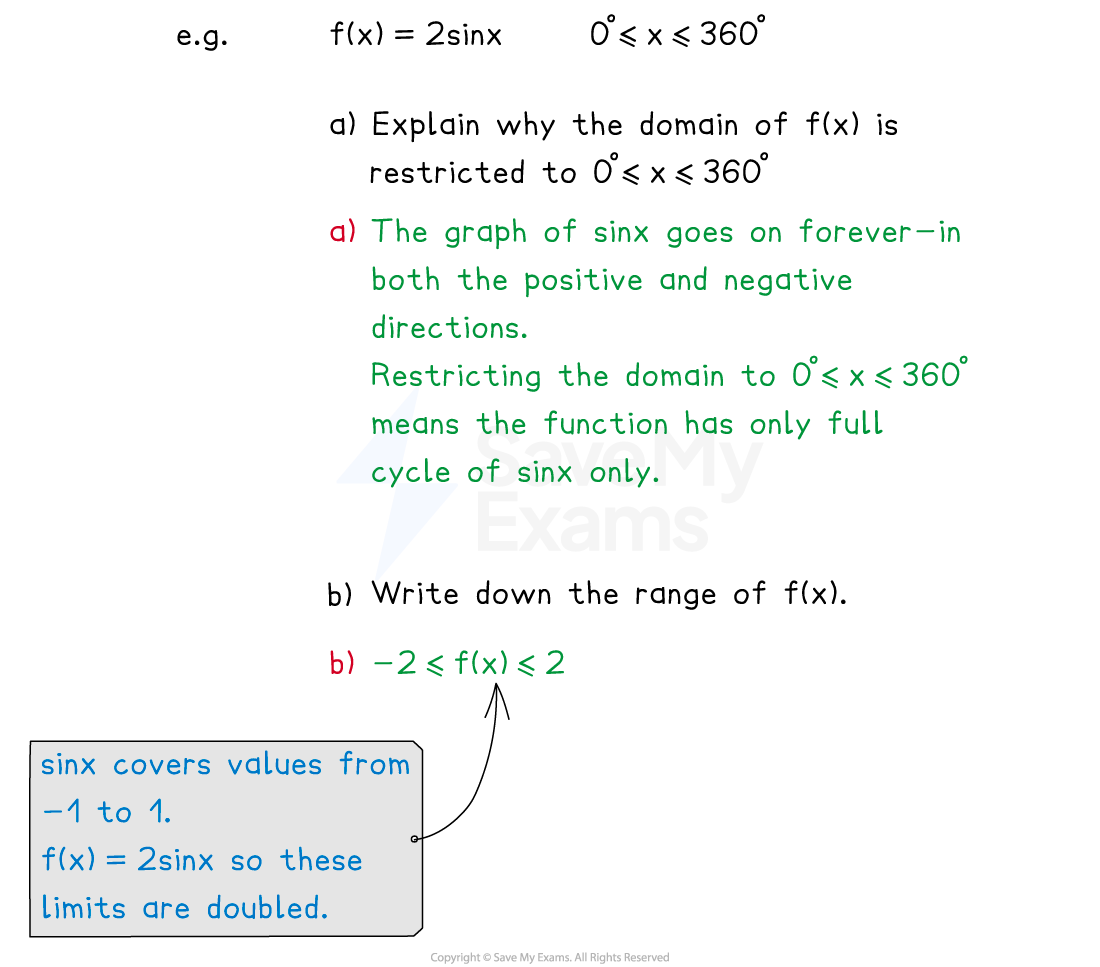
The range of a function is the set of all outputs that the function gives out
-
Ranges can be described in words
-
Ranges must refer to f(x)
- not x or y
-
You can use "not equal to" ≠ if needed
-
You can use inequality signs if needed
-
-
Ranges depend on domains
-
Examples of ranges are below:
-
with the domain x > 0
- If x = 0 then f(0) = 3(0) + 2 = 2
- The range is "f(x) > 2"
- This is because if all inputs are greater than 0, all outputs will be greater than 2
- This could be seen from a sketch or by substituting inputs of x > 0 into f(x)
-
with domain "all values of x"
- The range is f(x) ≥ 0
- This is because all values of x get squared (so no negative outputs are created)
- Any negative value that goes in comes out positive
- (0 goes in and comes out as 02 = 0)
-
How can I use graphs to find ranges?
-
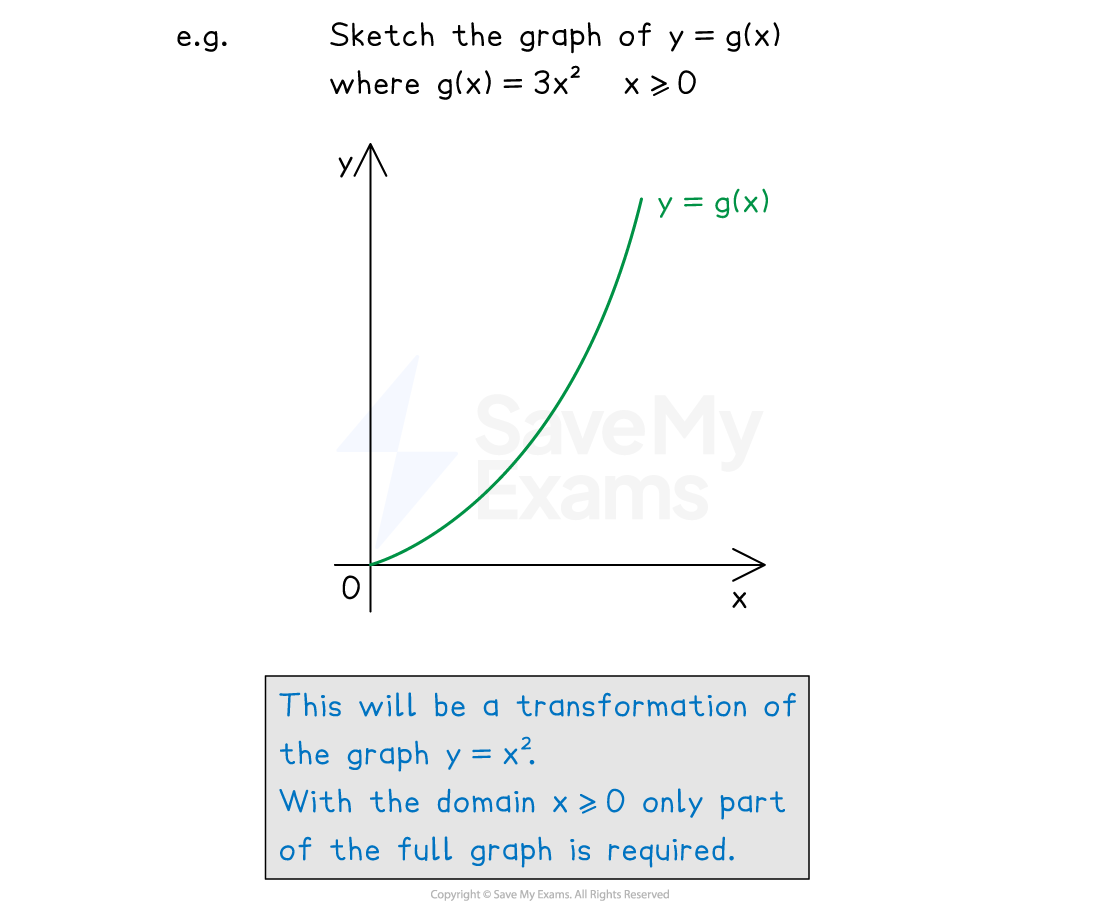
Ranges are easier if you know the shapes of different types of graphs
- For example, the shapes of , , , trig graphs, etc
- They may also involve graph transformations
Exam Hint
- Sketching a function in an exam can help to "see" both the domain and range of that function
Worked Example Two functions are given by
(a) If the domain of the function is , find the range.
Answer:
The domain is the set of inputs
Substitute x = 2 into f(x) to find its output
Substitute x = 4 into f(x) to find its output
Think of f(x) = 10 - x as a graph
the graph of
This straight-line graph has a negative gradient *Between x = 2 and x = 4 the graph decreases from a height of 8 to a height of 6 *
Relate this to outputs
all outputs are between 6 and 8
Write down the range using f(x)
Remember that the inequality is "equal to" at x = 4, f(x) = 6 (this is the opposite order of "equal to" in the domain)
Final answer: The range is
(b) Write down the value of that must be excluded from the domain of function .
Answer:
An input cannot cause the function to divide by zero Find out when "dividing by zero" would happen
Solve to find this value of x (the one that must be excluded)
Final answer: must be excluded from the domain
Was this revision note helpful?