Wireless Networks (Cambridge International IGCSE ICT)
What is a wireless network?
-
A wireless network is a network where connections are made using radio waves to transmit data through the air
-
The most common types of wireless connections are:
- Wi-Fi
- Bluetooth
Wi-Fi
What is Wi-Fi?
-
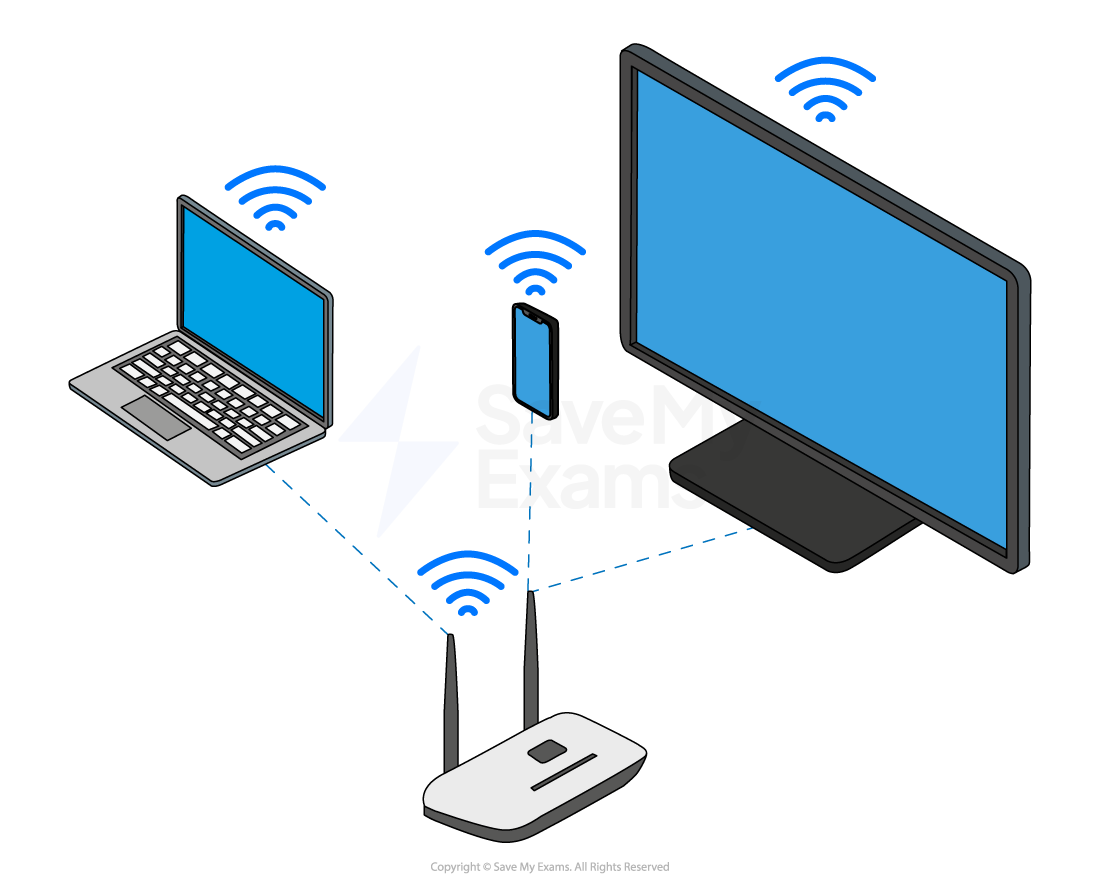
Wi-Fi is a common standard for wireless networks
-
Wi-Fi is common in most homes and offices to connect devices such as laptops, tablets& smart phones
-
Using Wi-Fi, devices communicate with a hotspot or a wireless access point (WAP), which can be a standalone device or built into a router or switch
-
Wi-Fi may be preferred over Bluetooth when:
- High speed data transfer is required
- Long range communication is required
- Many devices are needed to be connected at the same time
| Advantages | Disadvantages |
|---|---|
| Portability- Easy to move around, location is only limited by range | Speed- Slower data transfer than Ethernet |
| Cost- Less expensive to setup and add new devices | Security- Less secure than Ethernet |
| Compatibility- Most devices are manufactured with a built in Wi-Fi adapter | Range- Relies on signal strength to the WAP, signals can be obstructed (up to 100m) |
Bluetooth
What is Bluetooth?

- Bluetooth is another common standard for wireless networks
- Bluetooth is common in most homes and offices to connect devices such as headphones, controllers, keyboards& mice
- Bluetooth is used typically for a direct connection between two devices
- When two devices pair, they both exchange a cryptographic key
- The keys are used to generate a secret shared key which is used to encrypt the data between the two devices and create a Wireless Personal Area Network (WPAN)
- Connected devices continuously change their transmitting frequency between 79 different channels to avoid interference and improve the reliability of the connection
- This is known as the frequency hopping spread spectrum (FHSS)
| Advantages | Disadvantages |
|---|---|
| Compatibility- Ideal for personal devices and ad-hoc connections | Speed- Very slow transfer speeds |
| Power- Very low power consumption | Security- Data can be intercepted by anyone in range |
| Range- Short range (30m) |
Differences between Bluetooth and Wi-Fi
| Bluetooth | Wi-Fi | |
|---|---|---|
| Maximum number of connections | 7 | 30 |
| Transmission frequency | 2.4Ghz | 2.4Ghz, 5Ghz |
| Maximum range(meters) | 30 meters | 100 meters (depending on obstructions) |
| Maximum transfer speed (Depending on the standard being used) | 3 Mbytes / Sec | 75 Mbytes / Sec |
Worked Example A school IT team is trying to determine what technology they should use to connect students' tablets around the school for data transfer and are unsure whether to choose Wi-Fi or Bluetooth technology.
Consider the advantages and limitations of both and justify your answer
[7]
Answer
Final answer: WiFi offers significantly faster transfer rates compared to Bluetooth [1]
Final answer: so students will be able to upload and download files faster [1]
Final answer: WiFi coverage can be over a much larger area compared to Bluetooth [1]
Final answer: so that students will be able to access resources wherever they are in the school [1]
Final answer: Bluetooth however, is easy to set up [1]
Final answer: students can transfer data without the school having to invest in expensive infrastructure [1]
Final answer: Given the current situation, the school is in, the preferred choice for connecting student's tablets would be Wi-Fi [1]
Was this revision note helpful?
Build on this topic