The USA & Events in Korea, 1950–53 (Cambridge International IGCSE History)
Causes for the Korean War
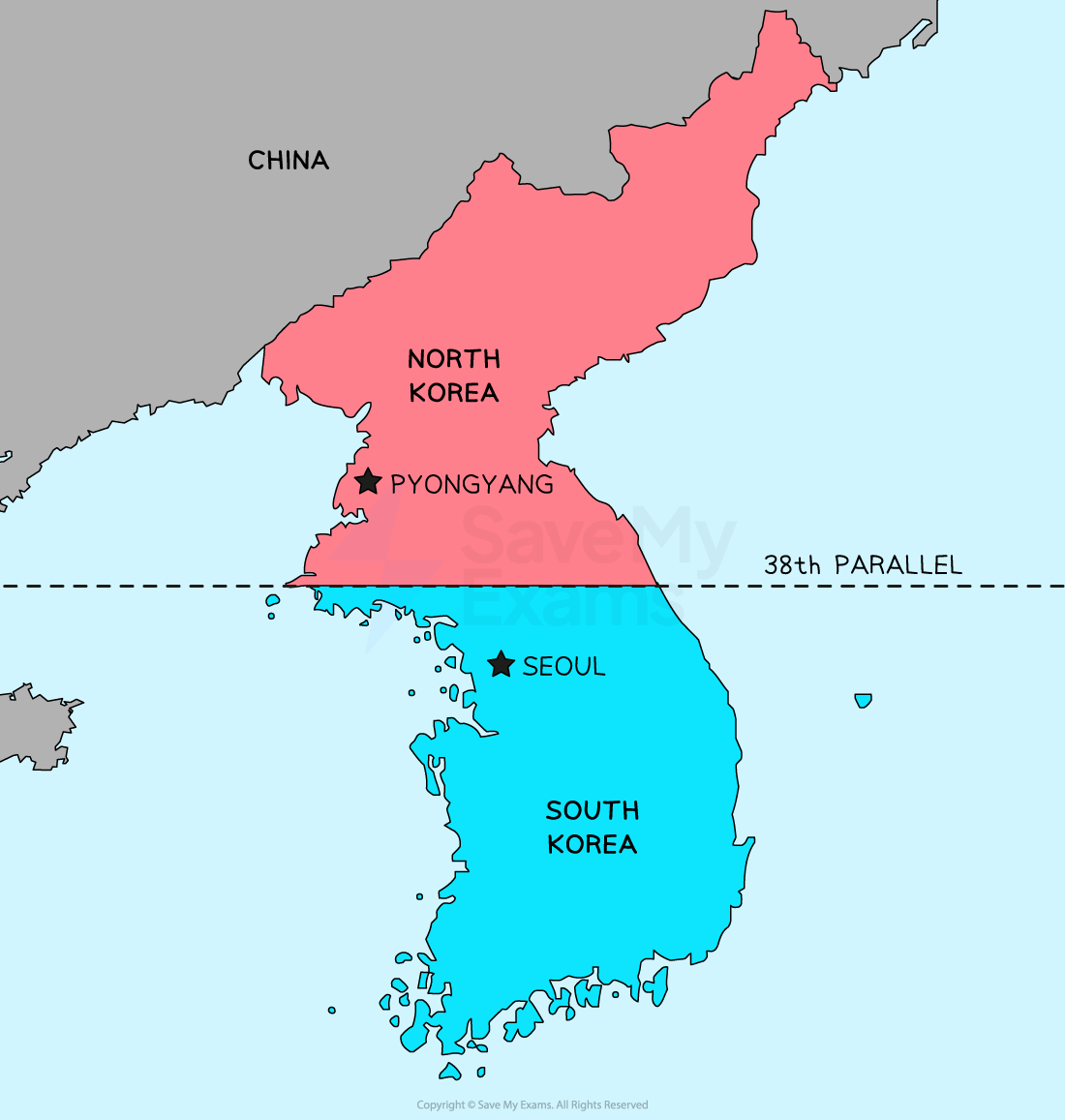
A map showing how Korea was divided in 1945
-
In 1905, Japan owned Korea
-
In 1945, Japan surrendered to the Allies, ending the Second World War
- Soviet troops were in the north of Korea
- US troops were in the south of Korea
-
The terms of Japan’s surrender included the division of Korea
-
The Allies split Korea into two territories along the 38th Parallel
- This divided Korea into two equal-sized zones
- Historians believe that Korea was divided to prevent the USSR **from taking the whole of Korea
-
The USSR monitored North Korea
-
The USA oversaw South Korea
-
-
Both the USA and the USSR** chose leaders for their sections of Korea:
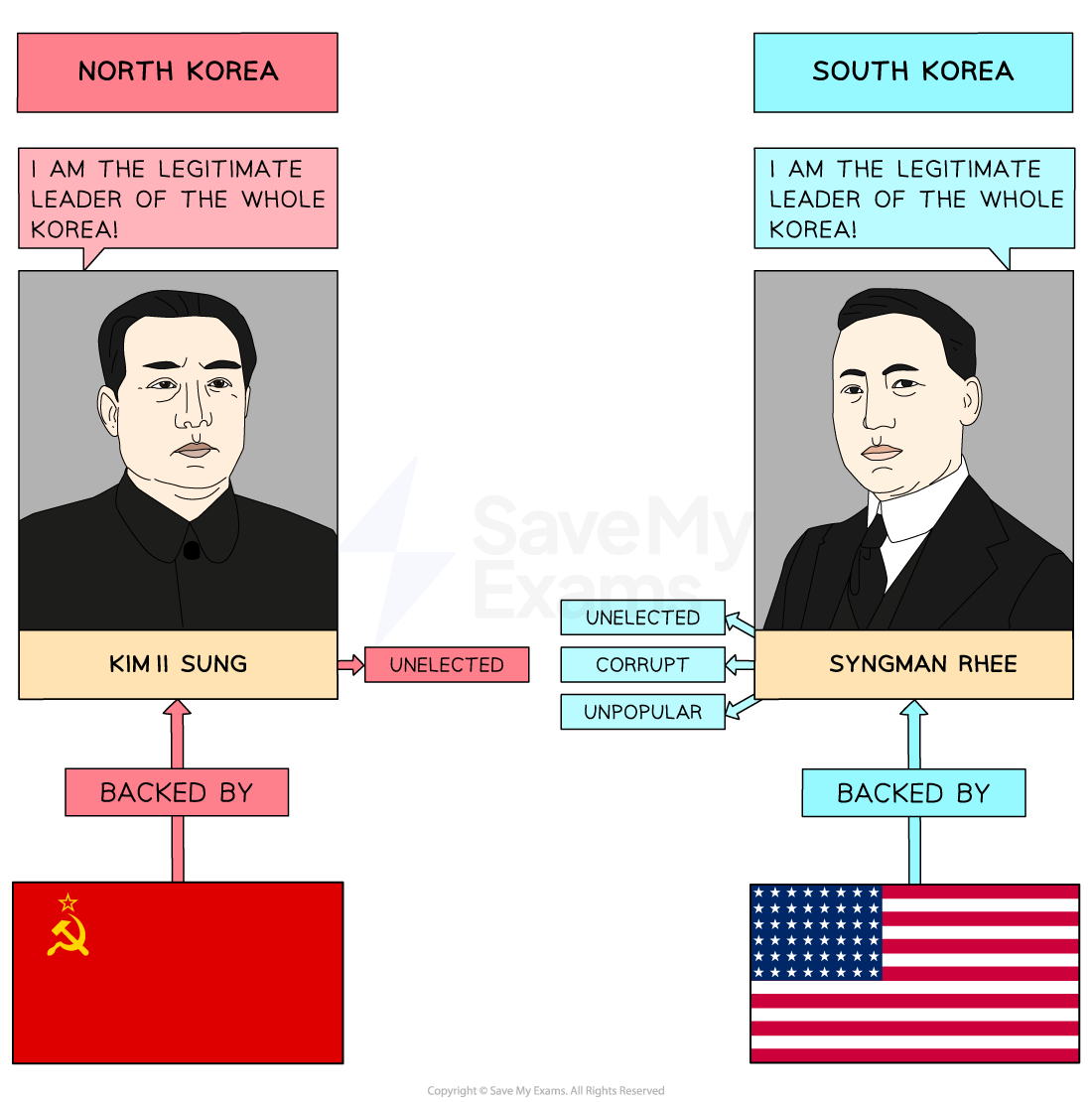
An illustration showing key information about the leaders of North and South Korea
-
In April 1950, many South Koreans voted in favour of the reunification of Korea
- Rhee was an unpopular leader
- Many Koreans wanted to reunite their country under the Communist Kim Il Sung
-
In June 1950, North Korea invaded South Korea
-
North Korea had the support of the USSR and China
- Both countries sent financial and military aid
- North Korea’s army was more powerful than South Korea’s
-
Why did the USA Get Involved in the Korean War?
| Reason | Why did this cause US intervention in Korea? |
|---|---|
| Domino Theory | The USA wanted to stop Korea from falling to Communism. They believed that if Korea fell, Japan would be next |
| Trade with Japan | Japan was an important market for US exports. The USA wanted to protect Japan’s capitalism |
| Truman Doctrine | In 1947, Truman declared that the USA would protect any country in threat of a Communist uprising. The US public put pressure on the government to protect South Korea |
| Distrust of the USSR | The USA blamed the USSR for North Korea’s actions. The USSR had acted aggressively in Eastern Europe and blockaded Berlin |
| Belief in victory | The US government believed that China would not react if they sent troops to Korea. They hoped that they could persuade the UN to provide military support to South Korea |
The UN Involvement in the Korean War
-
The USA persuaded the UN to intervene in the Korean War because:
-
Truman placed pressure on the UN Security Council
- The USA contributed the most money to the UN budget of any other country
- It could threaten to lower their contribution if the UN did not support South Korea
-
The USSR boycotted the UN in January 1950
- The USSR demanded representatives of the Communist People’s Republic of China in the UN Security Council. The UN refused
- The boycott meant that the USSR could not veto action against North Korea
-
-
The UN agreed to send troops to stop North Korea’s invasion
-
18 member states **provided troops
-
The USA sent the most troops under the command of** General McArthur. McArthur was:
- The commander of US troops in Japan in the Second World War
- Essentially in control of Japan from 1945 to 1951
-
-
UN forces landed in Inchon in September 1950
The Events of the Korean War
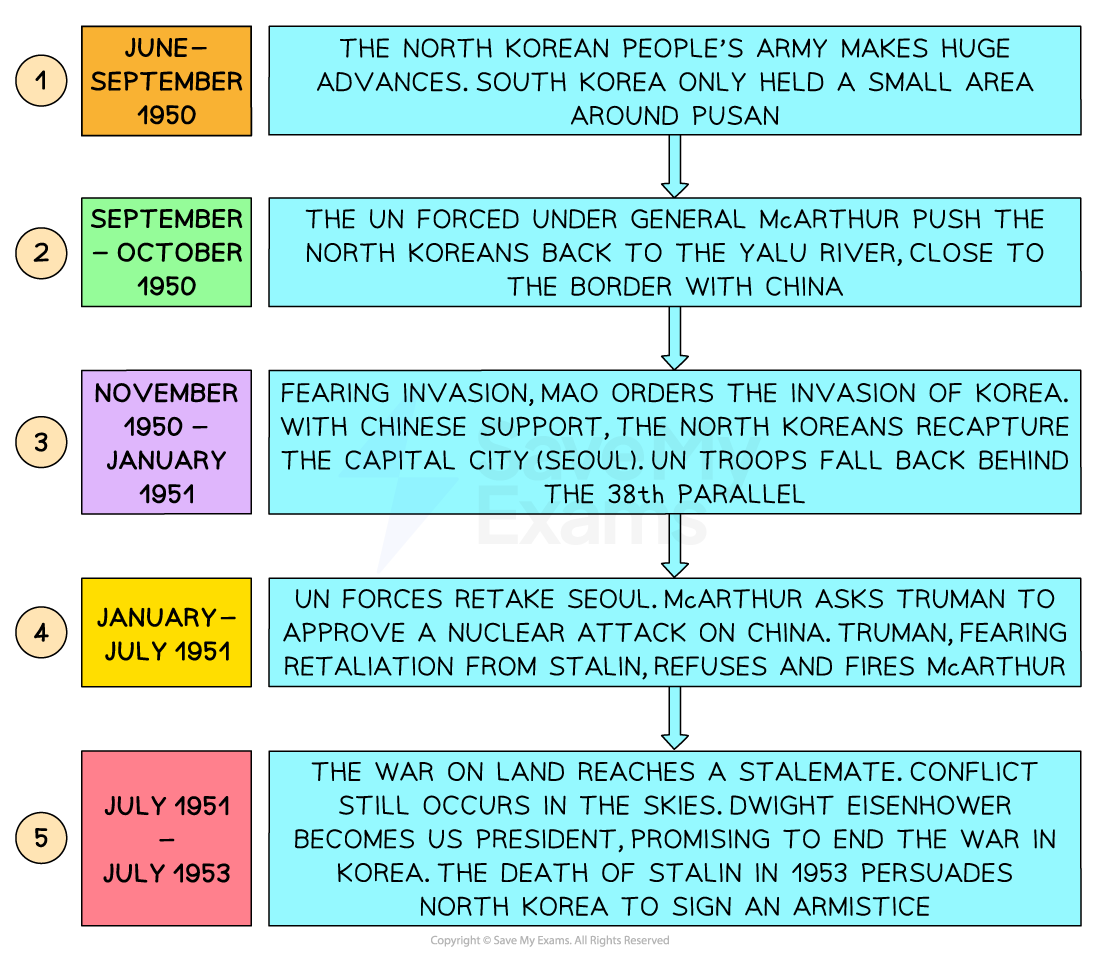
A flow diagram showing the key events in the Korean War, 1950-53
Worked Example Study Sources A and B.
How similar are these two sources? Explain your answer using details of the sources and your knowledge
8 marks
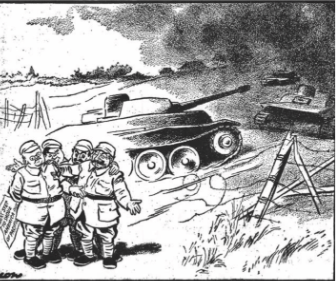
Source A: A cartoon by British cartoonist David Lowe on 28th June 1950. Stalin is saying, “Honest mister, there’s no one here but us Koreans.” The writing on the piece of paper on the left reads, ‘Next step to shove America out of Pacific’.
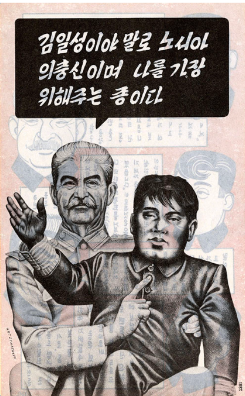
Source B: A leaflet distributed in Korea during the war. The figure on the left is Stalin and the figure he is holding is Kim Il Sung. The speech bubble roughly translates to: “Kim Il-Sung is a Russian loyalist who serves me the most”
Final answer: Partial answer:
Sources A and B are similar because they point to the key role of Stalin in the Korean War (1). When Korea was divided in 1945, Stalin supported Communist North Korea and chose Kim Il Sung to lead the country (1). Source A shows Stalin hiding his presence by stating “Honest mister, there’s no one here but us Koreans.” Similarly, in Source B, Stalin is presented as a puppet master of Kim Il Sung placing his hand over his voice box (1). Therefore both sources agree that the USSR had a significant role in starting and continuing the Korean War (1).
Exam Hint When answering this style of question on Paper Two, consider:
The event that the sources are depicting
- Spend five minutes looking each source
- Annotate the images and messages you get from each source
- Write some knowledge about the key event in both sources
How the sources agree
- Find an area in each source that is similar
- Refer to a section of the image to support your inference
How the sources disagree
- Find an area in each source that is different
- Refer to a section of the image to support your inference
The main message of the cartoonist
- What is each’s cartoonists opinion?
- Do the cartoonists’ attitudes match or are they different?
Consequences of the Korean War
- The Korean War had several positive and negative consequences for the USA
| Positive consequences | Negative consequences |
|---|---|
| The peace treaty kept Korea divided. The USA had ‘protected’ South Korea from Communism. This was a success for containment | North Korea remained Communist and formed closer ties to China. This shows that following containment could stop but not push back Communism |
| The UN stood up against North Korea’s aggressive actions. This made **the UN more successful than the League of Nations **had been before the Second World War | The Korean War caused four million casualties and the deaths of 50,000 US soldiers. The USA had underestimated the impact of fighting against Communism |
| The USA created anti-Communist alliances in Southeast Asia (SEATO) and Central Asia (CENTO). The USSR felt surrounded by enemies | |
| Tensions increased between the USA and the USSR**. Both began a** nuclear arms race, creating hydrogen bombs and ICBMs. This threatened world peace |
Worked Example Describe the consequences of the Korean War
4 marks
Final answer: Answers:
The Korean War showed the world that the USA was serious about following containment (1). The USA began to create anti-Communist alliances in Southeast Asia (SEATO) and Central Asia (CENTO) (1). The USSR felt surrounded by enemies, increasing Cold War tensions between the USA and the USSR (1). However, North Korea remained Communist, showing the limitations of the policy of containment (1).
Exam Hint This question in Paper One requires you to state information you know about the Korean War. The Cambridge IGCSE gives you a point for each relevant piece of information that you write. Therefore, do not spend any additional time trying to describe or explain each reason.
Was this revision note helpful?