Global Warming (Cambridge International IGCSE Geography)
Spec point —
3.7.2· Describe how economic activities may pose threats to the natural environment & people, locally & globally
Global Warming
Changes in the global climate
-
The global climate conditions of the Earth change over time, leading to colder and warmer periods
-
The last 2.6 million years are the Quaternary period, when there have been 60 cold periods and warmer interglacial periods
-
The last ice age ended approximately 25,000 years ago
-
The evidence supporting these changes can be found:
- Ice cores that trap ash, air bubbles and microbes
- Preserved pollen
- Historical sources such as diaries and art
- Tree rings
Natural causes of climate change
Milankovitch cycles
- These are long-term changes to the Earth's orbit and position
- This changes how much solar radiation the Earth receives
- The Earth's orbit changes every **100,000 years. **A more circular orbit leads to cooler periods and an elliptical orbit leads to warmer periods
- The Earth's tilt varies every** 40,000 years **and the greater the tilt, the hotter the summers and the colder the winters are
- Every** 24,000** years the Earth wobbles on its axis and this can affect the seasonal temperatures
Volcanic eruptions
- Large-scale eruptions lead to vast quantities of ash being ejected into the atmosphere
- Ash in the atmosphere blocks solar radiation, leading to a decrease in temperatures
Sunspot activity
- Increased sunspot activity is linked to higher average temperatures
Atmospheric dust
- Asteroids and meteors entering the Earth's atmosphere may increase the amount of dust, which decreases temperatures
The greenhouse effect
-
The greenhouse effect is essential to the survival of life on Earth
- Greenhouse gases in the atmosphere allow short-wave radiation from the sun through to the Earth's surface
- This is then radiated back into the atmosphere as long-wave radiation (heat)
- The greenhouse gases absorb some of the long-wave radiation (heat) and stop it from radiating out into space
- This maintains the Earth's average temperature
- Without the greenhouse effect, the average temperature would be -18°C
Greenhouse gases from natural sources
- Water vapour— evapouration from the oceans/seas and plants
- Carbon dioxide— volcanic eruptions, wildfires and respiration
- Methane is emitted from oceans and soils as part of decomposition; termites also emit methane
- Nitrous oxide— soils and oceans
The enhanced greenhouse effect
-
Human activity is increasing the number of greenhouse gases in the atmosphere
- Carbon dioxide (CO2) levels in the atmosphere have increased by more than 100 parts per million (ppm) to 420 ppm in 2020
-
Increased amounts of greenhouse gases have led to the enhanced greenhouse effect:
- Less long-wave radiation (heat) can escape the atmosphere
- Average global temperatures have increased over 1°C since pre-industrial times
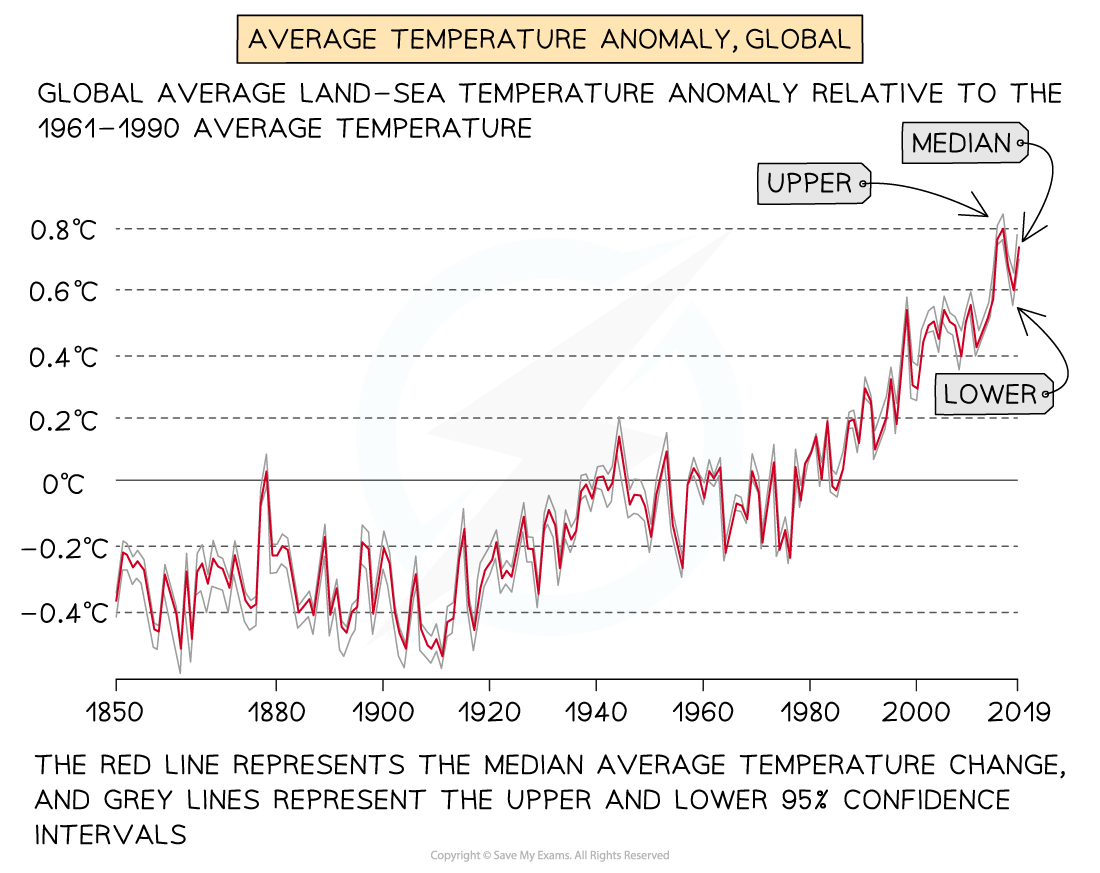
Average Global Temperatures
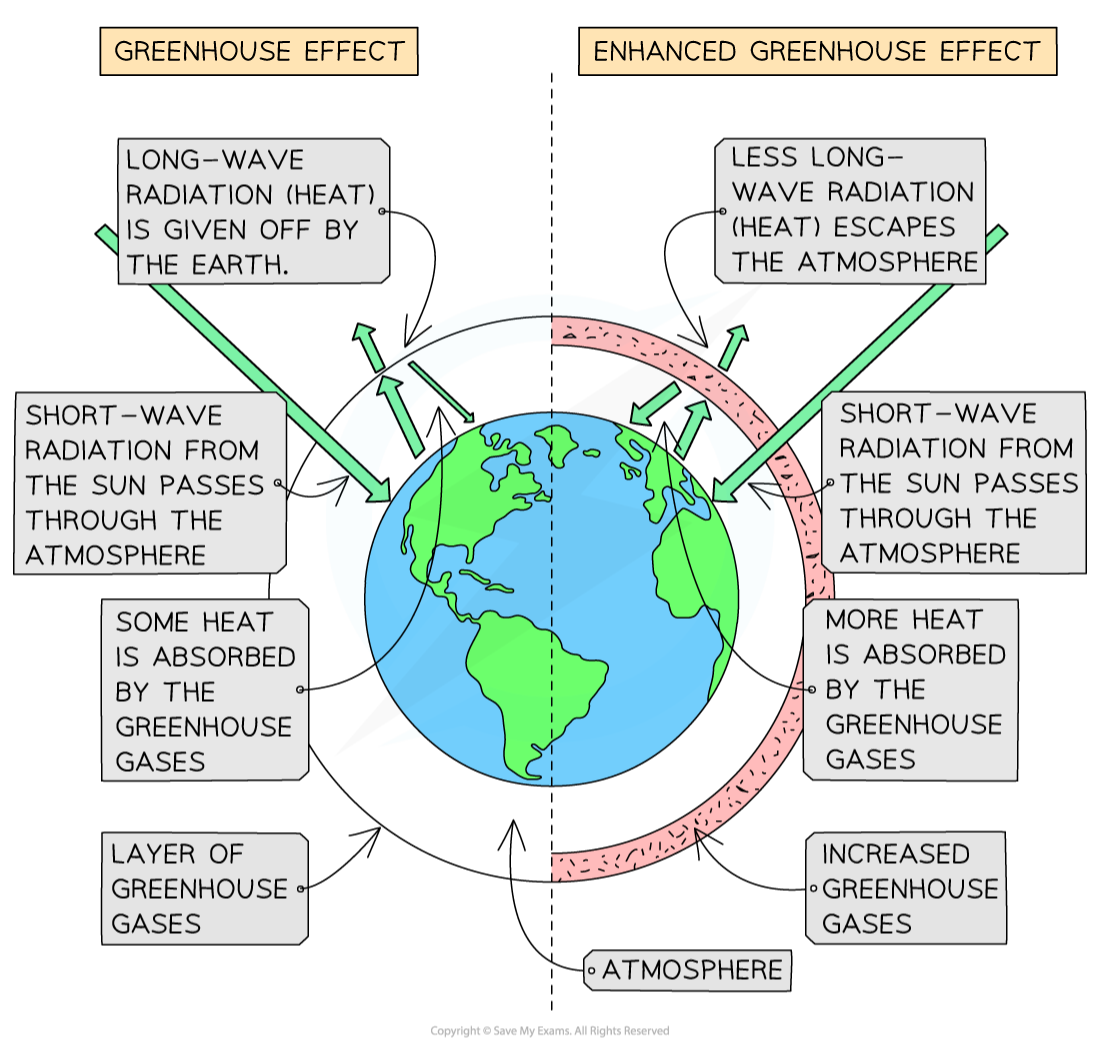
Human Sources of Greenhouse Gases
Greenhouse gases from human activity
- Carbon Dioxide (CO2)- the burning of fossil fuels, burning of wood and deforestation (less CO2 is removed from the atmosphere)
- Methane (CH₄)— decaying organic matter, including manure and waste in landfills, rice fields and livestock
- Nitrous Oxide (N2O)— artificial fertilisers and burning of fossil fuels
- Chlorofluorocarbons (CFCs)— aerosols, refrigeration, air conditioning
Worked Example Study Fig 1, which shows information about human influence on the greenhouse effect.
Using Fig 1 only, explain how humans are influencing the natural greenhouse effect.
[3 marks]
- Remember, when a question states 'Using Fig 1 only,' you will only be awarded marks for information that you have taken from the figure and not for information you have from elsewhere.
Final answer: Answer
- Greater/more/build-up of greenhouse gases [1]
- Named examples of greenhouse gases that have increased [1]
- More heat is trapped [1]
- Less heat escapes [1]
Exam Hint Remember, not all scientists agree about the causes of climate change. A few scientists argue that global warming is the result of the Earth's natural climate pattern and not the result of human activities.
Impacts of the enhanced greenhouse effect
Health
-
Increased temperatures and lack of precipitation may lead to the spread of diseases:
- Italy has experienced cases of malaria since 2017 when it was previously a malaria-free area
- An additional 280 million people may be affected by malaria
- Waterborne diseases are more likely to spread
-
Heat waves may become more frequent
-
Heat stroke, dehydration and sunburn increase during heat waves
-
Stagnant air during heat waves increases air pollution levels:
- Respiratory diseases increase and those suffering from respiratory illnesses such as asthma may be more affected
-
Increased temperatures negatively affect people with cardiopulmonary diseases
-
Diets may be restricted by food shortages leading to malnutrition and famine
Homes and settlements
-
Increased flooding due to sea level rise and increased frequency and severity of storms will lead to the displacement of large numbers of people
-
Settlements in low-lying areas may have to be abandoned or need additional defences against sea level rise
- Moving settlements or improving flood defences will be costly
Agriculture
- Farmers may need to change the crop they grow if climate conditions become unsuitable
- Coastal flooding may lead to salt intrusion
- Reduced availability of water will mean that irrigation is limited or impossible
- Food shortages will lead to malnutrition and famine
Employment
-
Job opportunities may change or decrease because:
- Tourism may decline in some areas; for example ski resorts may close due to the lack of reliable snow
- Coastal resorts may be at risk of flooding leading to the closure
- Farmers may have to change the crop they grow or livestock they raise or leave farming
- In some areas, agriculture may decline due to rising temperatures or changing rainfall patterns
Sea level rise
-
Warmer temperatures cause the water in seas and oceans to expand, increasing the sea level
-
Melting ice is adding to the increasing volume of water:
- Average sea levels have risen 23 cm since 1880
- Sea levels are forecast to increase a further 30 cm by 2050
-
Low-lying coastal areas and islands are at higher risk of flooding:
- The Maldives may be uninhabitable by 2050
-
Beach erosion will increase, leading to greater coastal erosion
-
Coastal ecosystems, including coral reefs and mangrove swamps, will be affected
-
Saltwater is contaminating freshwater supplies and affecting coastal agriculture
Ecosystem change
-
The location of biomes may shift to the north (Northern Hemisphere) and south (Southern Hemisphere) as they rely on specific climate conditions:
- Polar and tundra biomes are at risk of becoming extinct as they cannot shift any further north/south
-
Increasing sea temperatures and ocean acidification have resulted in coral bleaching
-
Migration and behaviour patterns of animals affected by changing temperatures:
- Fish species are moving north and south of their usual habitats to seek cooler water
- Reduced hibernation due to warmer winters
-
Melting of ice caps/glaciers leading to changing ocean currents
-
Mangrove swamps and coral reefs are threatened by rising sea levels
-
Loss of habitats through flooding, drought and wildfires
-
Food webs breaking as species numbers are reduced and food sources are decreased
-
Loss of plants and vegetation
Natural hazards
-
Changes in climate patterns are likely to increase the frequency and severity of storms:
- The 2020 Atlantic hurricane season was the first most active on record and 2021 was the third most active
-
The frequency and length of droughts are increasing
-
Dry conditions lead to the increased risk of wildfires:
- In 2021, Australia, Greece, South Africa, Brazil and the USA were just some of the places to experience severe wildfires
- In September 2021, the USA National Fire Centre reported 44,647 wildfires that had burnt 5.6 million acres
-
Rising sea levels together with increased storms lead to increased flooding risk
Responses to climate change
- Global warming and climate change require an international response because they affect the entire globe
- Responses can involve either adaptation or mitigation
- In 1988 the Intergovernmental Panel on Climate Change (IPCC) was set up to assess the 'risks of human-induced climate change
- This was followed by several international agreements
Earth Summit, Rio 1992
- Set out aims to stabilise greenhouse gas levels
Kyoto Protocol 1997
- Delegates from 150 countries agreed to reduce greenhouse gas emissions
- It stated that industrialised countries would reduce emissions to below the levels in 1990
- Developing countries, including China and India, were exempt from the agreement
- The USA did not sign up for the treaty
- Canada withdrew in 2011, stating that without China and the USA, the treaty would not work
Paris Agreement 2015
- Global agreement to limit global warming to 2°C (preferably 1.5°C) above pre-industrial levels
- The agreement also includes reducing CO2 emissions by at least 60% by 2050
- Signed by 196 countries, including the USA and China (the USA withdrew in 2020 and rejoined in 2021)
Conference of the Parties (COP)
-
The United Nations (UN) holds an annual (every year) meeting to discuss climate change.
-
COP29 was held in Baku, Azerbijan
-
All nations agreed to:
- continue to take action to further reduce greenhouse gas emissions
- triple financial aid to developing countries
Reducing emissions
-
Emissions can be reduced in several ways, including
- reducing deforestation
- increasing afforestation
- improving energy efficiency in industry and domestic appliances
- reducing emissions from industry
- improving public transport
- electric vehicles
- use of renewable energy and nuclear power
Worked Example Explain why global warming is a threat to the natural environment.
[4 marks]
- Remember this question is asking about the natural environment so you should not include impacts on humans
Final answer: Answer
- Melting of ice caps/glaciers [1]
- Loss of natural habitat [1]
- Rising sea/water levels [1]
- Flooding of low-lying islands/countries leads to habitat loss [1]
- Loss of food sources for wildlife [1]
- Loss of species/extinction/animals die (or example) [1]
- Breaking of food chains/threats to predators [1]
- Diversion of cold ocean currents [1]
- Warming of seawater can destroy/bleach coral [1]
- Increasing aridity/drought/desertification [1]
- Forest fires [1]
- Vegetation loss/trees die etc. [1]
Was this revision note helpful?