Structure & Composition of the Atmosphere (Cambridge International IGCSE Environmental Management)
Composition of the atmosphere
-
50% of the atmosphere is held within 5.6 km of the Earth's surface due to gravitational force and compression
-
The composition of clean air in the atmosphere is:
-
Nitrogen (about 78%)
-
Oxygen (about 21%)
- These two gases make up the majority of the atmosphere and play vital roles in supporting life on Earth
-
-
The atmosphere also contains smaller amounts of other gases, including carbon dioxide, argon, water vapour, and trace gases
-
Carbon dioxide is present in small amounts (about 0.04%)
-
Argon is an inert gas that makes up 0.96% of the atmosphere
-
Water vapour content varies depending on temperature and pressure and can exceed 4% in the tropical rainforests and be below 0.2% at the poles
- Water vapour is essential to Earth's weather, cloud formation, rain, and photosynthesis
- Air that has no water vapour is classified as dry, clean air
-
Trace gases, like methane, ozone, and nitrous oxide, are even less common but have significant impacts on the weather and the chemistry of the atmosphere
-
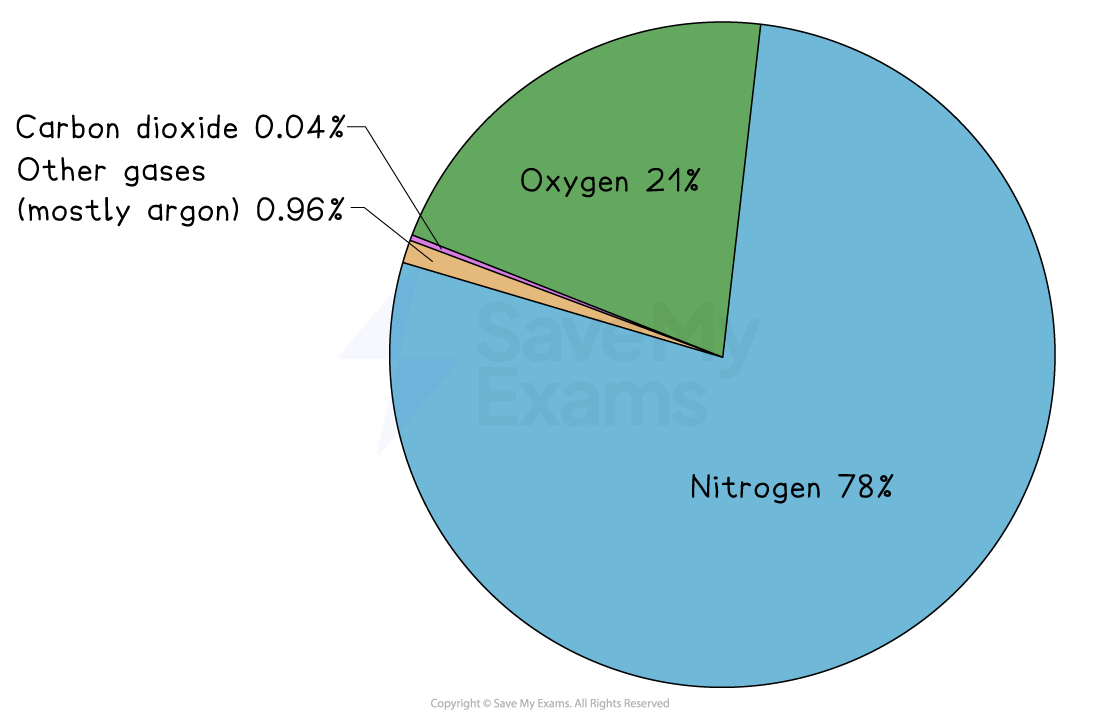
The gaseous composition of the Earth's atmosphere
- The atmosphere also contains aerosols and fine particles such as dust, salt, sand and volcanic ash
| Component | Percentage % | Importance |
|---|---|---|
| Nitrogen (N₂) | 78 | Needed for plant growth |
| Oxygen (O₂) | 21 | It is essential for respiration and is produced by photosynthesis. |
| Water vapour (H₂O) | 0.2-4.0 | Essential for precipitation |
| Carbon dioxide (CO₂) | 0.04 | It is the most abundant natural greenhouse gas and maintains Earth's temperature. It is essential for photosynthesis and is produced by respiration. |
| Ozone (O₃) | 0.00006 | Absorbs ultraviolet radiation. |
| Argon Helium (He), Krypton (Kr), Neon (Ne) | 0.96 Trace levels | These help to create an inert atmosphere to prevent oxygen and other gases from reacting to materials |
| Pollutants – sulphur dioxide (SO₂), nitrogen dioxide (NO₂), methane (CH₄) | Trace levels | It causes acid rain and the enhanced greenhouse effect. |
- The nitrogen and carbon cycle maintain the natural balance of gases in the atmosphere
- Human activities add and remove gases in the atmosphere, which upset the natural balance
Structure of the atmosphere
-
Air pressure decreases with height in the atmosphere
-
Air pressure measures how much air there is above the Earth's surface
- Low pressure means less air above
- High pressures means more air above
-
-
The atmosphere is stratified into four different layers because of temperature changes
- The key layers for living systems are the troposphere and the stratosphere
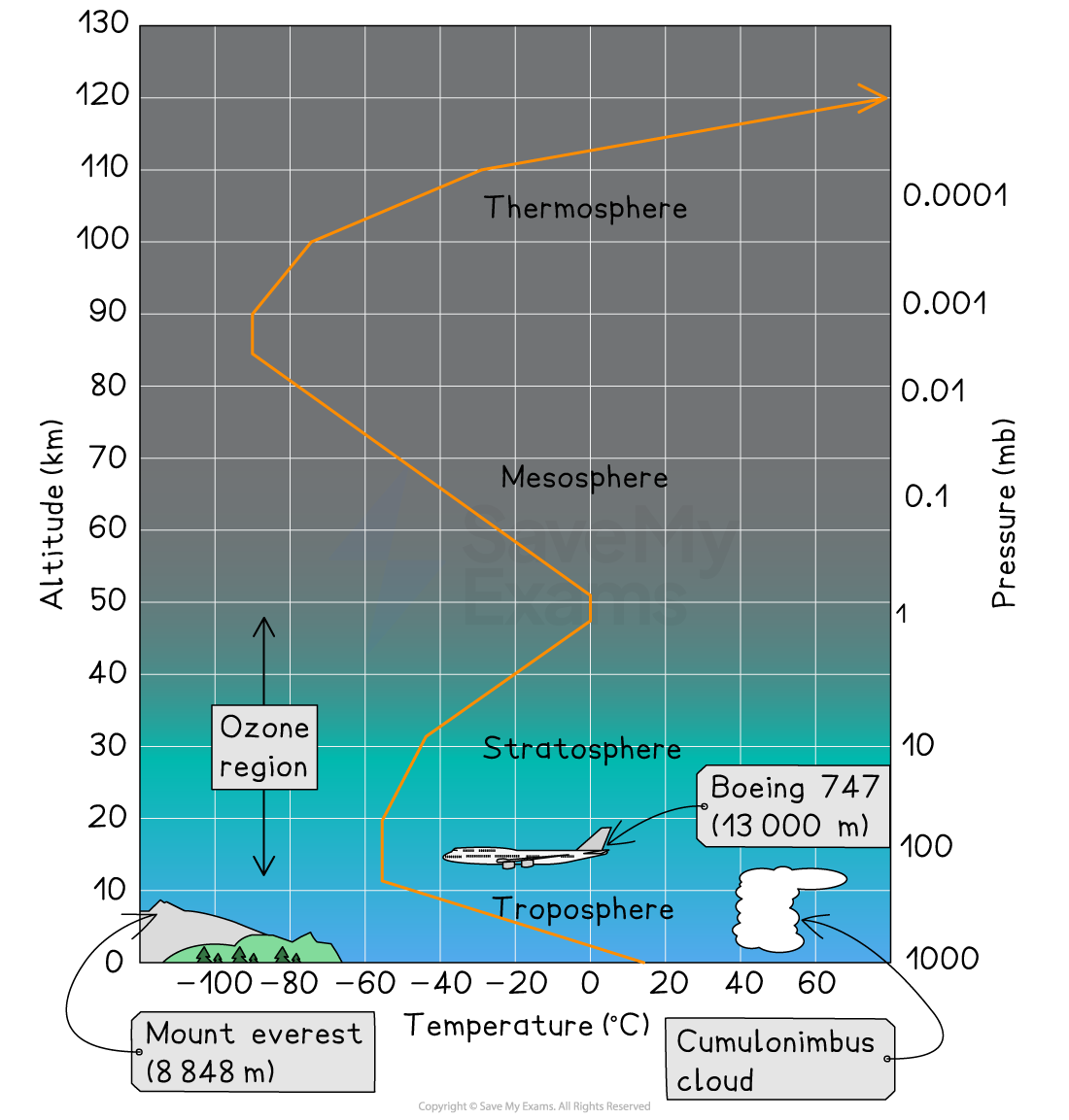
Approximate atmospheric temperatures and pressures up to an altitude of about 120 km—note that the temperature changes with each layer of atmosphere
Atmospheric layers
Troposphere
-
The lowest layer, extending up to about 10 km from the Earth's surface
-
It is where weather phenomena, such as cloud formation, precipitation, and the mixing of gases, mainly occur
-
The troposphere contains the highest concentration of water vapour, carbon dioxide, and other trace gases that are important for the functioning of living systems and the regulation of climate
-
The air in the troposphere is heated from the ground by longwave radiation so it is warmest near the Earth’s surface and cools with increasing altitude
- Temperature falls about 6 °C for every 1000 meters of altitude
-
Air pressure begins to drop but wind speeds increase with height
-
The upper limit of Earth's weather and climate is at the tropopause, where temperatures remain fairly constant
-
In the troposphere, chemical reactions involving pollutants, greenhouse gases and particles impact air quality and climate
Stratosphere
- Located above the troposphere, extending from about 10 to 50 km above the Earth's surface
- Pressure continues to fall, but temperature increases with height, called a temperature inversion caused by the presence of ozone
- Contains the ozone layer, which absorbs and blocks most of the Sun's harmful ultraviolet (UV) radiation
- The upper boundary is called the stratopause, where temperatures remain constant
Mesosphere
-
The mesosphere is the zone in which most meteors burn up as a result of colliding with gas molecules
- Pressure continues to decrease
- Temperatures rapidly fall to below -80 °C due to a lack of water vapour, dust or ozone to absorb incoming short-wave radiation
- Winds reach speeds of up to 3,000 km/hr
- The mesopause is the upper boundary
Thermosphere
-
This layer is around 80-1000 km in height
-
Temperature increases with altitude (up to 1500°C)
- This is due to solar radiation
-
The auroras occur here
-
The thermopause marks the boundary
-
The exosphere is the very outermost part of Earth’s atmosphere
- The density of atmospheric gas particles is extremely low, gradually transitioning into space
The ozone layer
- Ozone is a molecule composed of three oxygen atoms (O₃)
- Ozone is made naturally in the stratosphere, because this area has high levels of solar radiation
- Ozone plays a crucial role in protecting life on Earth by absorbing a significant portion of the Sun's harmful UV radiation
Dangers of UV radiation
-
Exposure to high levels of UV radiation can be dangerous for life in the following ways:
-
Photosynthetic organisms, like phytoplankton, are damaged by too much UV radiation because it breaks down DNA and slows photosynthesis
- This can lead to a decrease in primary production, particularly in aquatic ecosystems
-
High levels of UV radiation can lead to various health issues in humans and animals by damaging cells and tissues – these issues can include:
- Cataracts
- Skin cancer
- Sunburn
- Premature skin ageing
- Damage to immune systems
-
Was this revision note helpful?
Build on this topic