Monetary Policy Measures (Cambridge International IGCSE Economics)
Understanding monetary policy
Spec point — Understanding monetary policy
-
Monetary policy involves adjusting the money supply so as to influence total (aggregate) demand
- The money supply is the amount of money in an economy at any given moment in time
- It consists of coins, banknotes, bank deposits and central bank reserves
-
The Central Bank in each economy is responsible for setting monetary policy
- The Bank's Monetary Policy Committee usually meets 4-8 times a year to set policy
The three main instruments of monetary policy
Spec point —
4.3.2· "Monetary policy measures • changes in: – interest rate – money supply – foreign exchange rate"
The three main instruments of monetary policy
1. Changes in interest rates
- The central bank can raise interest rates to make borrowing more expensive and saving more attractive, slowing total demand and inflation
- It can lower interest rates to make borrowing cheaper, encouraging spending and investment and boosting growth
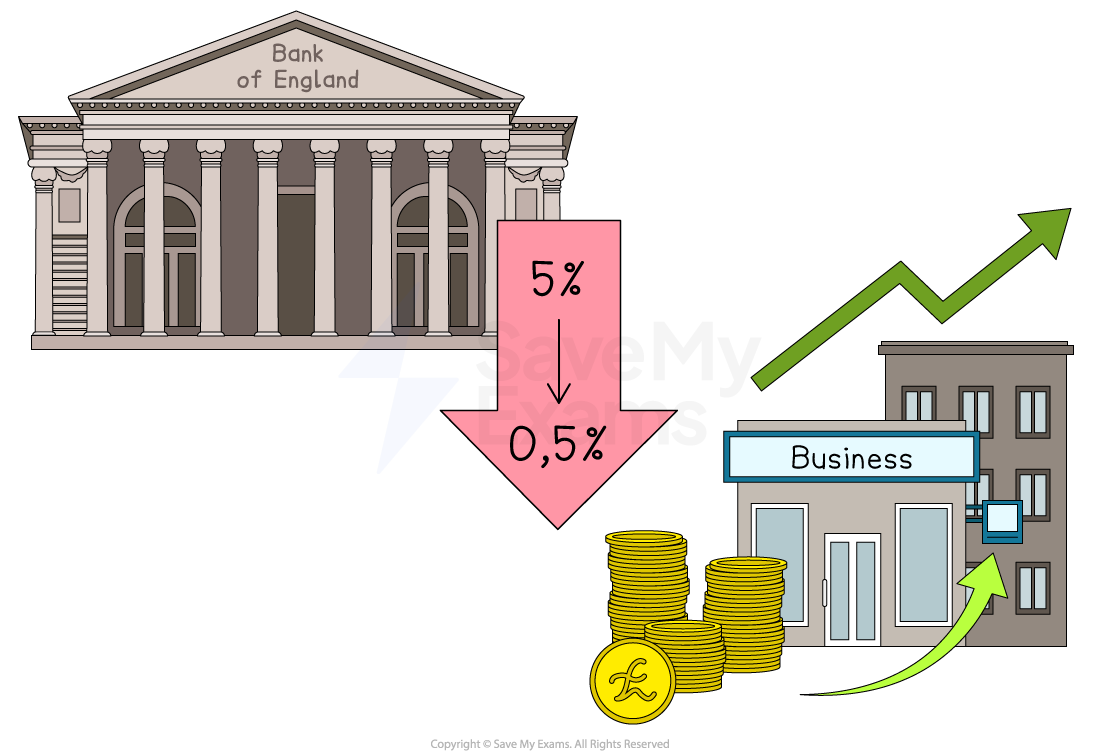
Case Study UK, 2009 Following the global financial crisis, the Bank of England cut its base interest rate from 5% in 2008 to 0.5% by 2009.
This made borrowing cheaper for households and businesses, encouraging spending and helping the economy recover from recession
2. Changes in the money supply
- Increasing the money supply (e.g., through quantitative easing) can encourage more lending and spending
- Reducing the money supply can slow down total demand and help control inflation
Case Study Eurozone, 2015 The European Central Bank introduced a €60 billion-per-month quantitative easing programme to increase the money supply. This aimed to stimulate borrowing and investment, raise demand, and push inflation back towards the 2% target
3. Changes in the foreign exchange rate
- A lower exchange rate makes exports cheaper for foreign buyers and imports more expensive, boosting total demand for domestic goods and improving the balance of payments
- A higher exchange rate makes imports cheaper, which can reduce inflation but may hurt export competitiveness
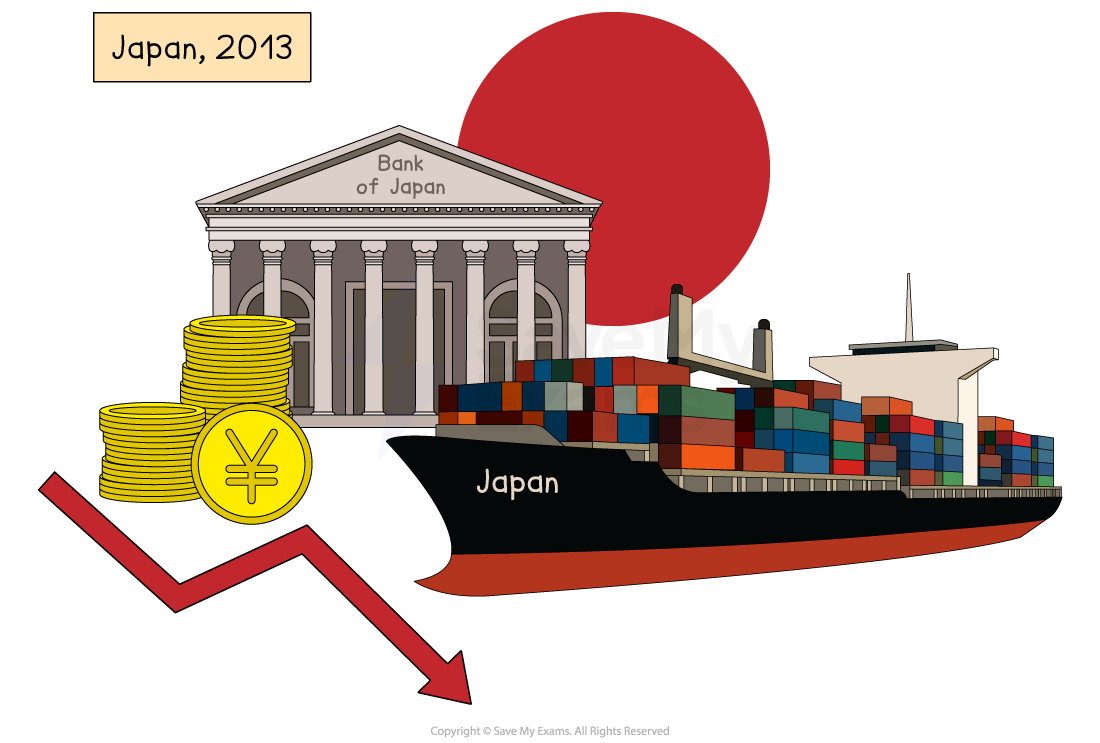
Case Study Japan, 2013 The Bank of Japan used monetary policy to weaken the value of the yen as part of “Abenomics”.
The lower yen made Japanese exports more competitive in global markets, helping to boost growth and reduce deflationary pressures
The effects of monetary policy on government macroeconomic aims
Spec point — how monetary policy measures may enable a government to achieve its macroeconomic aims
- When a policy decision is made, it creates a ripple effect through the economy, impacting the macroeconomic objectives of the government
- To understand the effects of monetary policy on an economy, it is useful to know how total demand (gross domestic product) is calculated
- Total (aggregate) demand = household consumption (C) + firms' investment (I) + government spending (G) + exports (X) - imports (M)
-
From this, it is logical that changes to monetary policy can influence any of these components – and often several of them at once
-
Economic growth
- Lower interest rates and increased money supply boost spending and investment
-
Low inflation
- Higher interest rates and reduced money supply can slow price rises
-
Low unemployment
- Expansionary monetary policy creates demand, leading to job creation
-
Healthy balance of payments
- Adjusting exchange rates can improve trade competitiveness
-
Sustainability
- Low-interest loans for green projects or incentives for clean technology investment can support environmental goals
-
Exam Hint In case study questions, state the policy measure, describe the action taken, and link it clearly to the macroeconomic aim it supports
Examples of monetary policy
Spec point — Examples of monetary policy
Examples of contractionary monetary policy
| Example 1 | The Central Bank increases interest rates |
|---|---|
| Effect on the economy | - Existing loan repayments for households become more expensive → discretionary income reduces → consumption decreases → total demand falls - Firms are less likely to borrow → less investment in capital takes place → total demand falls - Hot money flows increase → the exchange rate appreciates → exports more expensive and imports cheaper → net exports reduce → total demand decreases |
| Impact on macroeconomic aims | - Economic growth slows down - Inflation eases - Unemployment may increase as output is falling and fewer workers are required - Current Account is likely to worsen as both exports and imports reduce (exports more expensive and imports cheaper - but households have less income for imports) |
Examples of expansionary monetary policy
| Example 1 | The USA Federal Reserve Bank commits to $60bn a month of quantitative easing |
|---|---|
| Effect on the economy | - Commercial banks receive cash for their bonds → liquidity in the market increases → commercial banks lower lending rates → consumers and firms borrow more → consumption and investment increase → total demand increases |
| Impact on macroeconomic aims | - Economic growth increases - Inflation rises - Unemployment may fall as output is increasing and more workers are required - Current Account worsens (with more income, imports may rise) |
Was this revision note helpful?
Build on this topic