Supply-Side Policy Measures (Cambridge International IGCSE Economics)
Understanding supply-side policies
Spec point — Understanding supply-side policies
-
Supply-side policies aim to increase the total supply (productive potential) of the economy
- This is achieved by increasing the quality or quantity of the factors of production
- It can be represented by an outward shift of the productive possibility curve
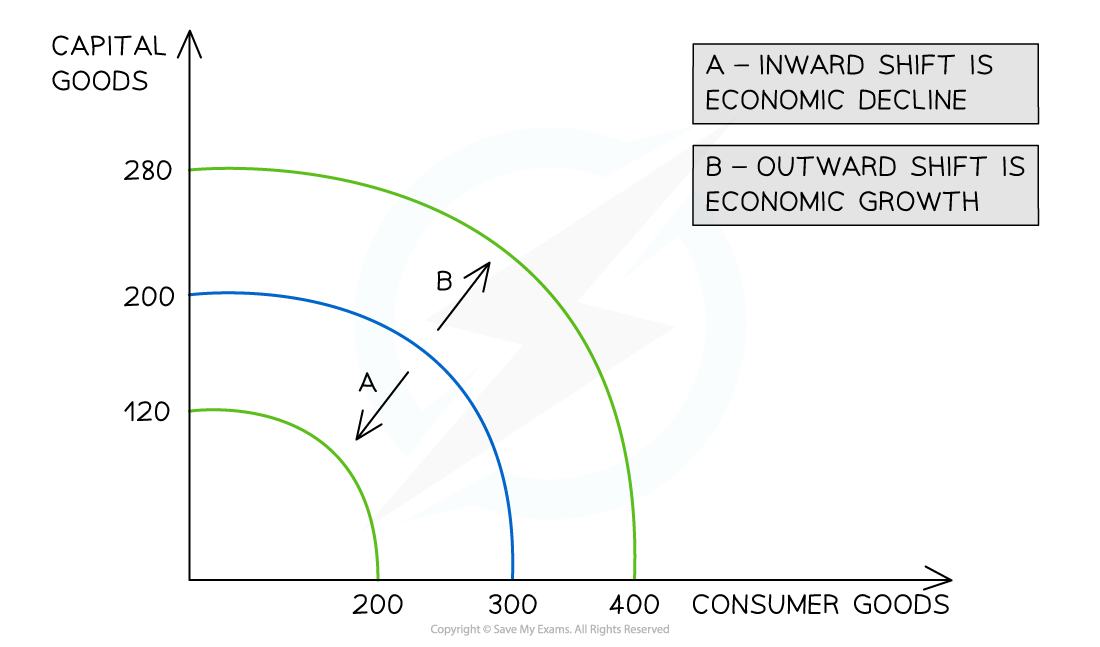
*Outward shifts of a PPC show an increase in the total supply of an economy *
-
Strategies used to increase total supply include
- Education and training
- Labour market reforms
- Lower direct taxes
- Deregulation
- Improving incentives to work and invest
- Privatisation
Supply-side policy measures
Spec point — "4.4.1 Definition of supply-side policy 4.4.2 Supply-side policy measures • education and training • infrastructure spending • labour market reforms • lower direct taxes • deregulation • improving incentives to work and invest • privatisation"
Supply-side policy measures
1. Education and training
-
This involves improving the quality of labour by increasing skills and knowledge
- Makes workers more adaptable to technological change and new industries
- Can reduce structural unemployment by helping workers move between sectors
- Includes vocational training, apprenticeships, and higher education support
-
Public investment in teacher training and educational facilities improves long-term outcomes and encourages innovation and entrepreneurship through better problem-solving skills
Case Study
Singapore’s SkillsFuture Programme
Context By the mid-2010s, Singapore faced a challenge: its economy was highly developed but risked losing competitiveness if workers’ skills did not keep up with technological change. Productivity growth was slowing, and there was a need to prepare the workforce for advanced manufacturing, digital industries, and innovation
Action taken
- In 2015, the Singapore government launched SkillsFuture, a nationwide programme providing every adult citizen with credits to spend on approved training courses
- Courses ranged from IT coding and digital marketing to advanced engineering and finance
- Employers were also encouraged to offer training *through subsidies and tax incentives
Outcome
- The programme improved workforce adaptability, reduced skills shortages in high-demand industries, and helped workers transition into better-paying roles
- By investing in human capital, Singapore increased its** long-run productive capacity and maintained high growth without fuelling inflation

2. Infrastructure spending
-
This refers to investment in transport, communications, energy and utilities
- This improves efficiency by reducing travel times and logistical costs, promoting economic growth
- This includes digital infrastructure such as broadband expansion to support the modern economy
-
This spending provides short-term job creation in construction and related industries, while also supporting international trade by improving port facilities and transport links
Case Study India’s National Infrastructure Pipeline
Context In the early 2020s, India faced persistent infrastructure gaps—poor road quality, insufficient power availability, and underdeveloped transport networks were constraining both domestic production and foreign investment.
Action taken
- In 2021, the Indian government launched the National Infrastructure Pipeline (NIP)—a strategic plan to invest around ₹111 lakh crore (~US $1.5 trillion) over five years.
- It targeted sectors like transport, energy, urban development and healthcare
- The plan also aimed to attract private investment through Public-Private Partnerships (PPPs) and streamlined approval processes
Outcome
- Transport travel times and logistics costs decreased, boosting efficiency across state borders
- New energy projects improved power reliability, reducing production delays for businesses
- The infrastructure boost attracted international investors, increasing foreign capital inflow
- Short-term job creation surged, particularly in construction, engineering and project management
- Overall, India’s productive capacity expanded, supporting long-term economic growth without triggering inflation
3. Labour market reforms
-
This refers to changes designed to make the labour market more flexible and efficient
- It may involve reducing employment protection legislation to make hiring and firing easier
- Encourages part-time and temporary contracts to meet employer needs
- Supports mobility of labour by recognising qualifications across regions or countries
- Can include policies to increase female participation in the workforce
-
These policies often reduce unemployment benefits to encourage job-seeking
4. Lower direct taxes
-
Reducing income tax increases workers’ disposable income, encouraging them to work more
-
Lower corporation tax increases retained profits for firms, boosting investment
- This can attract foreign direct investment (FDI) if taxes are internationally competitive
- Encourages entrepreneurship as more profit can be kept by business owners
5. Deregulation
-
This refers to reducing or removing rules and laws that restrict business activity
- It aims to lower costs for firms and reduce barriers to entry
- Can encourage innovation and competition in previously protected markets
- Examples include simplifying licensing requirements and reducing paperwork
-
Makes markets more dynamic and responsive to consumer needs
6. Improving incentives to work and invest
-
This involves policies that make work more rewarding than unemployment
- It may include reducing benefit payments as earnings rise
-
Investment incentives can include tax credits for research and development (R&D)
- They encourages risk-taking and business expansion
7. Privatisation
-
This refers to the the sale of state-owned enterprises to the private sector
- It encourages efficiency through competition and profit motivation
- It is often accompanied by deregulation to allow new firms to enter the market
-
Privatisation can also raise government revenue from the sale of assets
Case Study Brazil’s Airport Privatisations
Context State-owned airport management in Brazil struggled with inefficiency and underinvestment. Many regional airports lacked modern facilities and were poorly connected, limiting tourism and business travel
Action taken
- Between 2021 and 2022, Brazil moved to privatise a group of airports by granting long-term concessions to private operators
- The government maintained regulatory oversight while allowing specialists to manage, expand and modernise airport infrastructure and services
Outcome
- Airport facilities were rapidly upgraded: terminals modernised, runways extended and passenger services improved
- Air traffic increased, especially at regional airports, enhancing connectivity for tourism and trade
- Travel costs dropped for businesses and consumers due to more competitive operations
- The arrangement raised government revenue, which was reinvested in public services

Exam Hint There are some policy measures which may be a fiscal policy or a supply-side measure; e.g., building new schools requires immediate government spending (fiscal policy) but results in a greater supply of educational institutions in the economy (supply-side).
In deciding which it is in any particular question, decide whether the government is using it with the intention of increasing total demand or total supply.
Was this revision note helpful?
Build on this topic