Causes & Consequences of Inflation (Cambridge International IGCSE Economics)
The causes of inflation
Spec point —
4.7.3· "Causes of inflation • demand-pull • cost-push Consequences of inflation • how inflation affects savers, lenders and borrowers "
The causes of inflation
- An increase in the general price level in an economy can be caused by demand-pull inflation, cost-push inflation, or imported inflation
1. Demand-pull inflation
-
Demand-pull inflation is caused by excess demand in the economy
-
Total (aggregate) demand is the sum of all expenditure in the economy
- rGDP = Consumption (C) + Investment (I) + Government spending (G) + Net Exports (X-M)
-
If any of the four components of rGDP increase, there will be an increase in the total demand (AD) in the economy, leading to an increase in the general price level
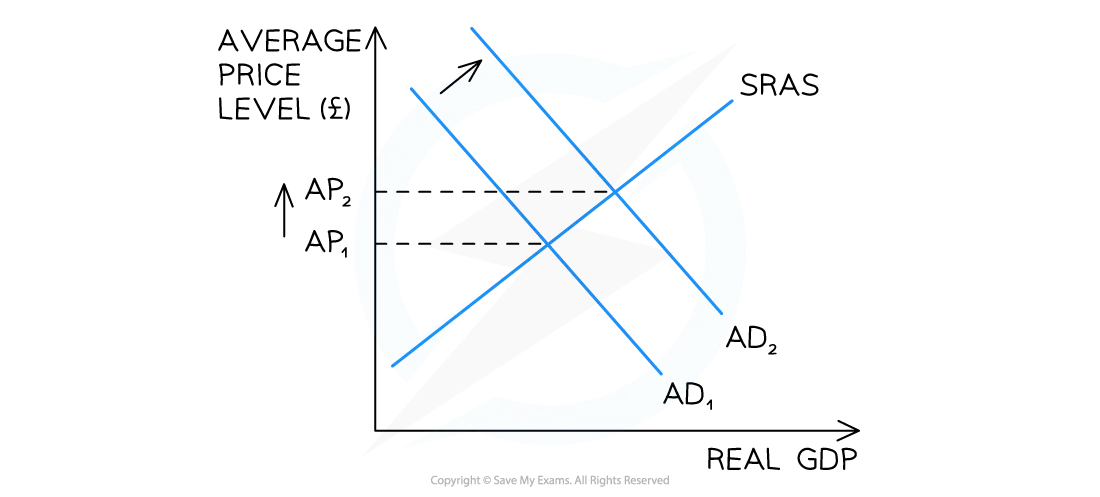
*An increase in total (aggregate) demand (AD) raises the average price level in an economy *
Diagram analysis
- If any of the four components of AD increase, there will be a shift to the right of the AD curve from AD1 → AD2
- This causes the average price level to increase from AP1 → AP2
- Demand-pull inflation has occurred
An example of demand-pull inflation
-
If the Central Bank lowers the base rate, there is likely to be increased borrowing by firms and consumers
- This will result in an increase in consumption and investment, which will increase the rGDP
- It is likely to lead to a form of demand-pull inflation
2. Cost-push inflation
- Cost-push inflation is caused by increases in the costs of production in an economy
- If any of the costs of production increase (labour, raw materials etc.), or if there is a fall in productivity, the total supply will decrease
- With less supply, prices rise, leading to an increase in the general price level
- Cost-push inflation has occurred
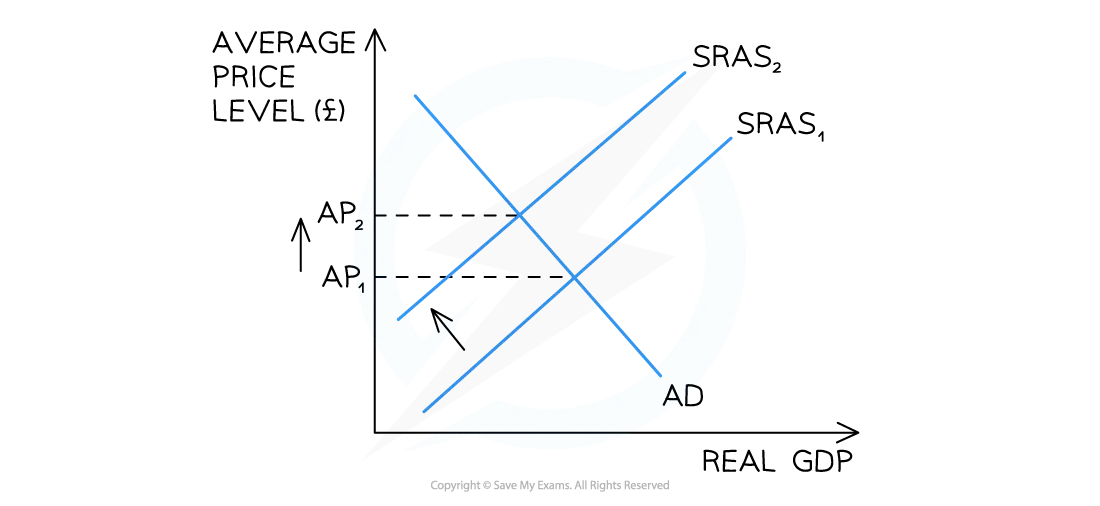
*An increase in the costs of production raises the average price level in an economy, leading to cost push inflation *
Diagram analysis
- If any of the costs of production increase (labour, raw materials etc.), or if there is a fall in productivity, there will be a shift to the left of the SRAS curve from SRAS1→SRAS2
- This increases the average price level from AP1 → AP2
- Cost-push inflation has occurred
An example of cost-push inflation
-
Trade unions negotiate higher wages for workers
- The wage increases represent an increased cost of production for firms
-
With the inputs, firms now produce less and supply reduces, leading to higher general price levels
-
Cost-push inflation has occurred
3. Imported inflation
-
Imported inflation happens when the prices of goods and services that a country imports go up, causing overall prices in the domestic economy to rise
-
If a country relies on imports for raw materials, fuel or food, any increase in global prices raises production costs for domestic firms
- For example, if the price of imported oil rises, transport and production costs increase in many industries
- This leads to higher prices for a wide range of goods.
-
Higher costs are usually passed on to consumers as higher prices, leading to cost-push inflation
-
A fall in the exchange rate (weaker currency) can also lead to imported inflation
- A weaker currency makes foreign goods more expensive, even if the foreign price hasn’t changed
Exam Hint Imported inflation is external — caused by global price changes or exchange rate movements, not by domestic demand or changes to domestic costs of production
The consequences of inflation
Spec point — The consequences of inflation
- Inflation means that the general price level is rising over time. It reduces the purchasing power of money and can affect different groups in different ways
The effects on savers, lenders and borrowers
| Group | Effect of inflation | Why? |
|---|---|---|
| Savers | - Lose out | - The value of savings falls as prices rise – money saved buys less in the future |
| Lenders | - Lose out | - The money repaid in future is worth less in real terms than when it was lent |
| Borrowers | - Gain | - They repay loans with money that has less value than when they borrowed it |
The effects on firms and consumers
| Firms | Consumers |
|---|---|
| - Uncertainty - Rapid price changes create uncertainty and delay investment - Menu change costs - Price changes force firms to change their menu prices too and this can be expensive - Lenders - Financial firms that lend money are worse off, as the money lent out is now worth less than before | - Purchasing power - A decrease in purchasing power worsens their quality of life - Savings - There is a decrease in the real value of savings (as money will be worth less in real terms) - Real income - There is a fall in real income for those on fixed incomes or pensions - Borrowers - Anyone who borrows money benefits as the repayments are worth less than when the money was originally borrowed |
The effects on workers and the government
| Government | Workers |
|---|---|
| - International competitiveness - Inflation erodes international competitiveness of export industries, as their products now look relatively more expensive to foreigners - Trade-offs - There are trade-offs involved in tackling inflation - E.g . reducing inflation may increase unemployment and/or reduce economic growth - Government debt - inflation erodes the value of government debt, as the repayments are worth less than when the money was originally borrowed | - Higher wages - Workers demand higher wages to compensate for reduced purchasing power - Morale - If wage increases ≠ inflation, motivation and productivity may fall as workers receive a lesser benefits for the same work |
Exam Hint Remember, governments want some inflation – usually 2-3% – as this is a sign of economic growth. However, inflation in excess of that is harmful in many of the ways described above.
When evaluating inflation, a considerable positive for many governments is the fact that it erodes the value of government debt. This may be difficult to grasp, but if a government has a lot of debt, it may actually be happy to let inflation run at a higher level for a period of time. The trade-off is that everyone in the economy who is not a 'borrower' is worse off, and if inflation is high, it can lead to social unrest and economic instability.
Was this revision note helpful?
Build on this topic