Data Packets (Cambridge International IGCSE Computer Science)
Spec point — "1 (a) Understand that data is broken down into packets to be transmitted (b) Describe the structure of a packet"
Data Packets
What are packets?
-
Packets are small 'chunks' of data that make up a larger piece of data that has been broken down by the TCP protocol so that it can be transmitted over the internet
-
TCP stands for Transmission Control Protocol and is used for organising data transmission over networks
-
Small 'chunks' of data are easier and quicker to route over the internet than big 'chunks' of data
- Routing involves finding the most optimal path over a network
-
Data can include anything from text, images, audio, video, animations, etc, or any combination of these
What do packets contain?
- A packet consists of:
| Header | Payload | Trailer |
|---|---|---|
| Source IP address | Actual data being transported | Additional security information (less common) |
| Destination IP address | End of packet notification | |
| Packet number (1 of 5 etc.) |
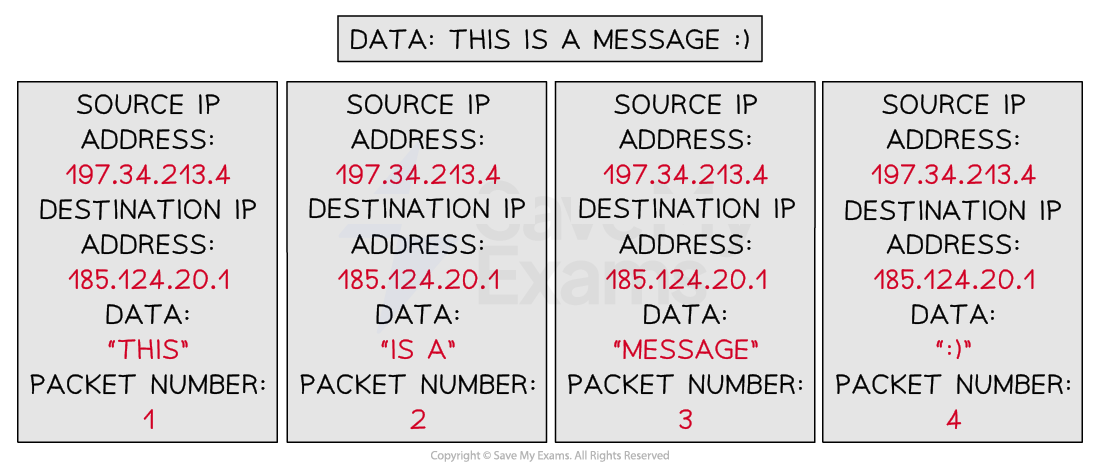
- To transmit the message “This is a message :)”over the internet, TCP might break the message down into 4 packets
-
Each packet contains a:
- source IP address
- destination IP address
- payload (the data)
- a packet number
-
Error checks make sure that when a packet is received there is minimal or no corruption of the data
-
Corruption is where packet data is changed or lost in some way, or data is gained that originally was not in the packet
-
Read error detection methods for more detail on how data packets can be checked to ensure corruption is avoided/minimised
Was this revision note helpful?
Build on this topic