Compression (Cambridge International IGCSE Computer Science)
Exam board Cambridge International · IGCSEUpdated 2025-05-13
The Need For Compression
Spec point —
1.3.3· "3 Understand the purpose of and need for data compression"
The Need For Compression
What is compression?
-
Compression is reducing the size of a file so that it takes up less space on secondary storage
-
The impact of compression is:
- Less storage space required
- Less bandwidth required
- Shorter transmission time
-
Compression can be achieved using two methods, lossy and lossless
Lossy Compression
Spec point —
1.3.4· "4 Understand how files are compressed using lossy and lossless compression methods"
Lossy Compression
What is lossy compression?
- Lossy compression is when **data is lost **in order to reduce the size on secondary storage
- Lossy compression is irreversible
- Lossy can** greatly reduce the size** of a file but at the expense of losing quality
- Lossy is only suitable for data where reducing quality is acceptable, for example images, video and sound
- In photographs, lossy compression will try to group similar colours together, reducing the amount of colours in the image without compromising the overall quality of the image
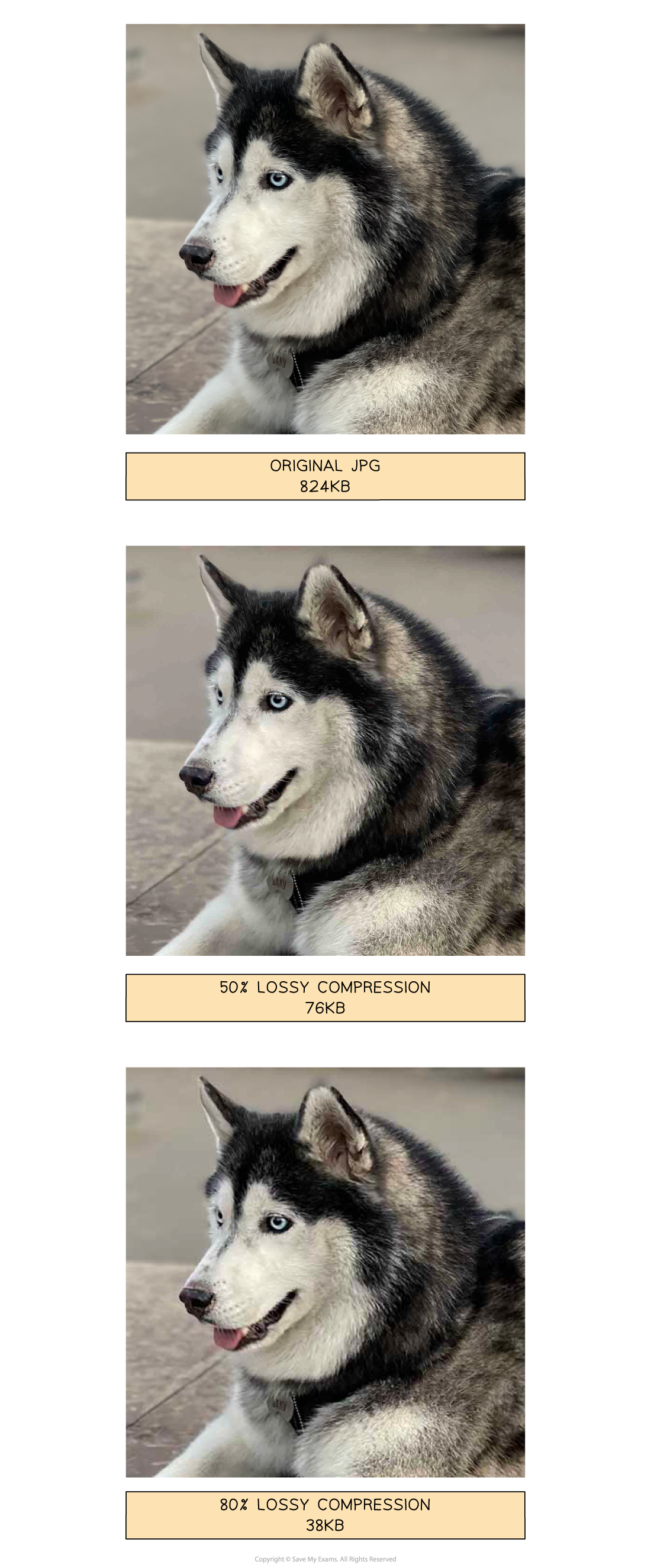
- In the images above, lossy compression is applied to a photograph and dramatically reduces the file size
- Data has been removed and the overall quality has been reduced, however it is acceptable as it is difficult to visually see a difference
- Lossy compressed photographs take up less storage space which means you can store more and they are quicker to share across a network
Lossless Compression
Spec point —
1.3.4· "4 Understand how files are compressed using lossy and lossless compression methods"
Lossless Compression
What is lossless compression?
- Lossless compression is when data is encoded in order to reduce the size on secondary storage
- Lossless compression is reversible, the file can be returned to its original state
- Lossless can reduce the size of a file but not as dramatically as lossy
- Lossless can be used on all data but is more suitable for data where a loss in quality is unacceptable, for example documents
- In a document, lossless compression algorithms such as run length encoding (RLE) can be used to analyse the contents looking for patterns and repetition.
What is run length encoding?
- Run length encoding (RLE) is a form of lossless data compression that condenses identical elements into a single value with a count
- For a text file, "AAAABBBCCDAA" is compressed to "4A3B2C1D2A"
- The string has four 'A's, followed by three 'B's, two 'C's, one 'D', and two 'A's
- RLE is used in bitmap images to compress sequences of the same colour
- For example, a line in an image with 5 red pixels followed by 3 blue pixels could be represented as "5R3B"
Lossless file formats
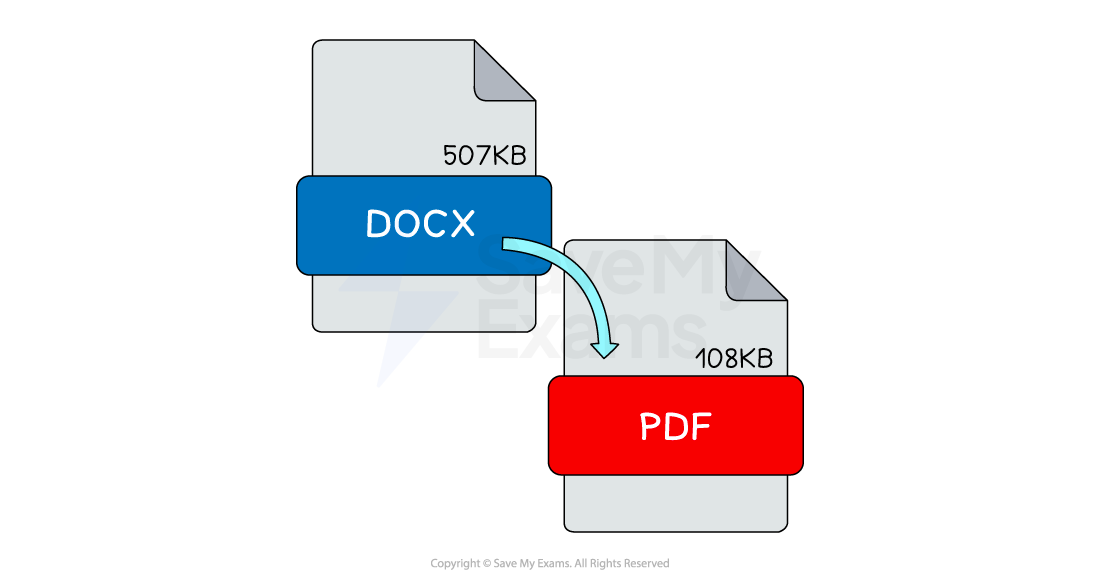
- In the image above, lossless compression is automatically applied to document formats such as DOCX and PDF with a different rate of success
- When you open a lossless compressed document the decompression process reverses the algorithms and returns the data back to its original state
- Lossless compressed documents take up less storage space which means you can store more and they are quicker to share across a network
Worked Example An email is sent containing a sound file.
Lossy compression is used to compress the sound file.
Explain two reasons why using lossy compression is beneficial. [4]
How to answer this question
- What are the differences between lossy and lossless?
- Can you state two differences? [2 marks]
- Can you say why each point is a benefit? [2 marks]
Answer
- Lossy will decrease the file size [1] -...so it can sent via email quicker [1] - Lossy means data is lost [1]
- ... the difference is unlikely to be noticed by humans [1]
Was this revision note helpful?