Linear Search & Bubble Sort (Cambridge International IGCSE Computer Science)
Linear Search
Spec point —
6.3.4a· 4 Understand standard methods of solution
What is a searching algorithm?
- Searching algorithms are precise step-by-step instructions that a computer can follow to efficiently locate specific data in massive datasets
What is a linear search?
- A linear search starts with the first value in a dataset and checks every value one at a time until all values have been checked
- A linear search can be performed even if the values are not in order
How do you perform a linear search?
| Step | Instruction |
|---|---|
| 1 | Check the first value |
| 2 | IF it is the value you are looking for - STOP! |
| 3 | ELSE move to the next value and check |
| 4 | REPEAT UNTIL you have checked all values and not found the value you are looking for |
Exam Hint You will not be asked to perform a linear search on a dataset in the exam, you will be expected to understand how to do it and know the advantages and disadvantages of performing it
| A linear search in Pseudocode |
|---|
| A linear search in Python code |
|---|
Bubble Sort
Spec point —
6.3.4a· 5 Understand standard methods of solution
What is a sorting algorithm?
- Sorting algorithms are precise step-by-step instructions that a computer can follow to efficiently sort data in massive datasets
What is a bubble sort?
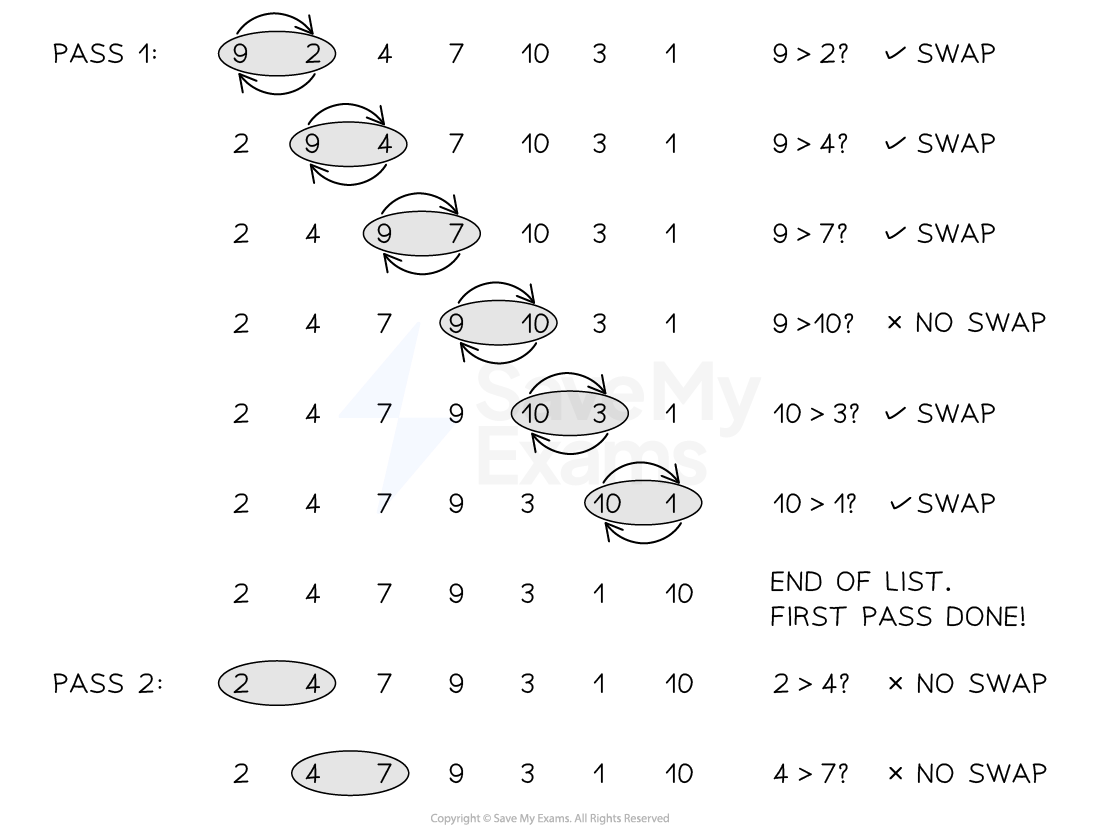
- A bubble sort is a simple sorting algorithm that starts at the beginning of a dataset and checks values in 'pairs' and swaps them if they are not in the correct order
- One full run of comparisons from beginning to end is called a 'pass', a bubble sort may require multiple 'passes' to sort the dataset
- The algorithm is finished when there are no more swaps to make
How do you perform a bubble sort?
| Step | Instruction |
|---|---|
| 1 | Compare the first two values in the dataset |
| 2 | IF they are in the wrong order... - Swap them |
| 3 | Compare the next two values |
| 4 | REPEAT step 2 & 3 until you reach the end of the dataset (pass 1) |
| 5 | IF you have made any swaps... - REPEAT from the start (pass 2,3,4...) |
| 6 | ELSE you have not made any swaps... - STOP! the list is in the correct order |
Example
- Perform a bubble sort on the following dataset
| 5 | 2 | 4 | 1 | 6 | 3 |
|---|
| Step | Instruction |
|---|---|
| 1 | Compare the first two values in the dataset | 5 | 2 | 4 | 1 | 6 | 3 | |---|---|---|---|---|---| |
| 2 | IF they are in the wrong order... - Swap them | 2 | 5 | 4 | 1 | 6 | 3 | |---|---|---|---|---|---| |
| 3 | Compare the next two values | 2 | 5 | 4 | 1 | 6 | 3 | |---|---|---|---|---|---| |
| 4 | REPEAT step 2 & 3 until you reach the end of the dataset - 5 & 4 SWAP! | 2 | 4 | 5 | 1 | 6 | 3 | |---|---|---|---|---|---| - 5 & 1 SWAP! | 2 | 4 | 1 | 5 | 6 | 3 | |---|---|---|---|---|---| - 5 & 6 NO SWAP! | 2 | 4 | 1 | 5 | 6 | 3 | |---|---|---|---|---|---| - 6 & 3 SWAP! | 2 | 4 | 1 | 5 | 3 | 6 | |---|---|---|---|---|---| - End of pass 1 |
| 5 | IF you have made any swaps... - REPEAT from the start - End of pass 2 (swaps made) | 2 | 1 | 4 | 3 | 5 | 6 | |---|---|---|---|---|---| - End of pass 3 (swaps made) | 1 | 2 | 3 | 4 | 5 | 6 | |---|---|---|---|---|---| - End of pass 4 (no swaps) | 1 | 2 | 3 | 4 | 5 | 6 | |---|---|---|---|---|---| |
| 6 | ELSE you have not made any swaps... - STOP! the list is in the correct order |
Exam Hint In the exam you do not have to show every swap that takes place in a bubble sort. You can show the outcome of a bubble sort at the end of each pass. If you have the outcome of each pass correct then a bubble sort has been implemented correctly and all marks will be given!
| A bubble sort in Pseudocode |
|---|
| A bubble sort in Python code |
|---|
Worked Example A program uses a file to store a list of words.
A sample of this data is shown
Milk Eggs Bananas Cheese Potatoes Grapes Show the stages of a bubble sort when applied to data shown [2]
How to answer this question
- We need to sort the values in to alphabetical order from A-Z
- You CAN use the first letter of each word to simplify the process
Answer
- E, B, C, M, G, P (pass 1)
- B, C, E, G, M, P (pass 2)
Was this revision note helpful?
Build on this topic