Characteristics of the CPU (Cambridge International IGCSE Computer Science)
Spec point —
3.1.3· "3 Understand what is meant by a core, cache and clock in a CPU and explain how they can affect the performance of a CPU"
Characteristics of the CPU
What are the common characteristics of the CPU?
-
There are 3 common characteristics
- Clock Speed
- Cache Size
- Number of Cores
-
Each of these characteristics has a significant impact on the performance of the CPU
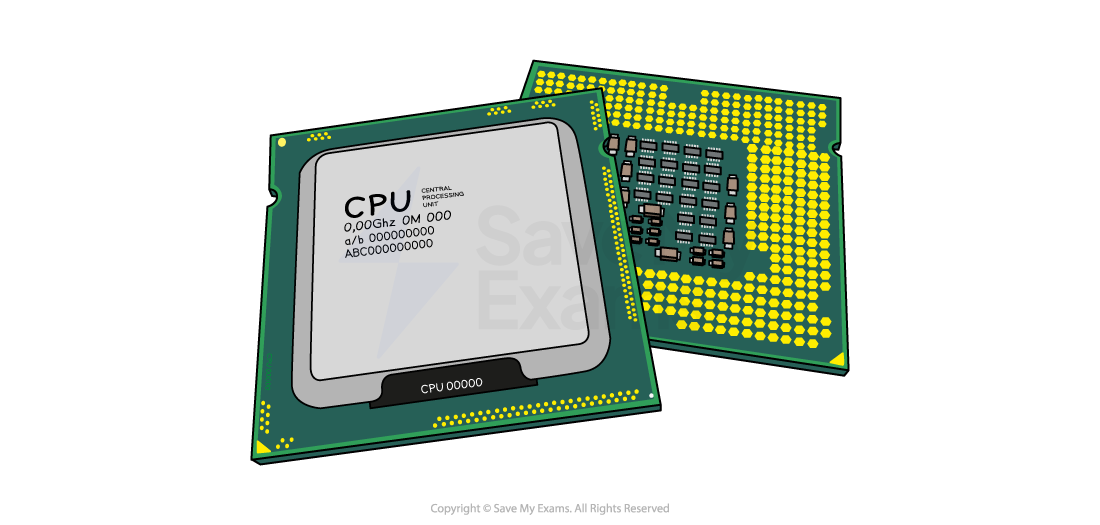
How do the characteristics of the CPU affect performance?
Clock speed
- The clock speed is measured in Hertz (Hz)
- The clock speed measures the number of fetch-decode-execute cycles that can take place in 1 second
- The faster the clock speed, the more instructions can be fetched and executed per second
- Modern computers have a clock speed in Gigahertz (GHz), meaning billion
- A clock speed of 3.5GHz can perform up to 3.5 billion instructions per second
Cache size
- Cache is very small, very fast memory on or close to the CPU
- Cache is used as temporary storage to provide quick access to a copy of frequently used instructions and data
- The larger the cache size, the more frequently used instructions or data can be stored
- This results in the CPU having to complete fewer fetch cycles from memory (RAM), speeding up the performance
- Cache also has a significantly faster read/write speed than RAM, making it much quicker to retrieve instructions from there instead of from memory (RAM)
Number of cores
-
A core works like it is its own CPU
-
Multiple core processors mean they have multiple separate processing units that can fetch, decode and execute instructions at the same time
-
For example, a dual-core processor would have 2 processing units, each with their own
- Control Unit (CU)
- Arithmetic Logic Unit (ALU)
- Accumulator (ACC)
- Registers
-
Multi-core processors can run more powerful programs with greater ease
-
Multiple cores increase the performance of the CPU by working with the clock speed
-
Example: A quad-core CPU (4 cores), running at a clock speed of 3Ghz
- 4 cores x 3GHz
- 4 x 3 billion instructions
- 12 billion instructions per second
-
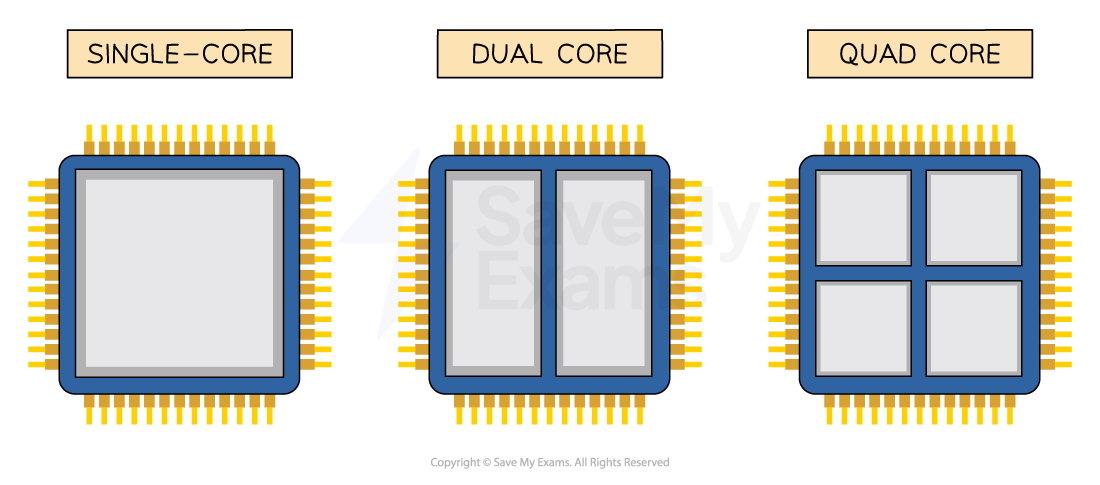
Worked Example One computer has a single core processor and the other has a dual core processor.
Explain why having a dual core processor might improve the performance of the computer
[2]
Answer
Any **2 **from:
- The computer with the dual core processor has two cores**/double the amount of cores [1]**
- Parallel processing can take place [1]**
- Each core can execute a separate instruction at the same time [1] -** Each core can process instructions independently of each other [1]
Was this revision note helpful?
Build on this topic