The Nature of Business Activity (Cambridge International IGCSE Business)
Factors of production
Spec point — Land, labour, capital and enterprise
-
Factors of production are the resources used to produce goods and services
- They include land, labour, capital and enterprise
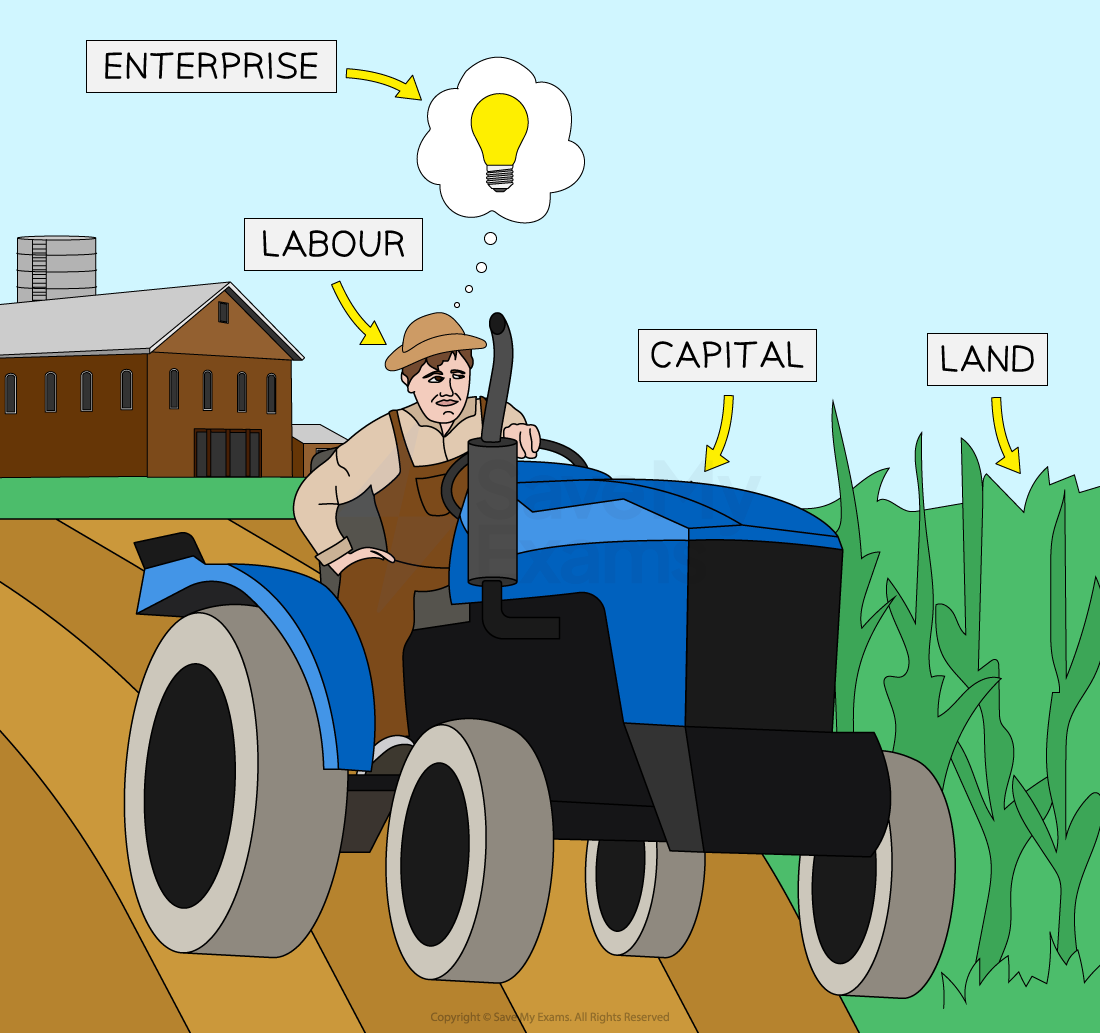
The four factors of production are land, capital, labour and enterprise
-
The production of any good or service requires the use of a combination of all four factors of production
- Goods are physical objects that can be touched (tangible), e.g., a mobile phone
- Services are actions or activities that one person performs for another (intangible), e.g., a manicure or car wash
Explanation of the four factors of production
| Land | Capital |
|---|---|
| - Non-man-made natural resources available for production - Some countries have a vast amount of a particular natural resource, so are able to specialise in its production - For example, Kuwait specialises in the product of oil which accounts for 95% of its exports | - Capital is any man-made resource that is used to produce goods and services - Examples include tools, buildings, machines and computers |
| Labour | Enterprise |
| - The human input into the production process, labour involves mental or physical effort - Not all labour is of the same quality - It can be skilled or unskilled - Some workers are more productive than others because of their education, training and experience | - Enterprise involves taking risks in setting up or running a firm - An entrepreneur decides on the combination of the factors of production necessary to produce goods and services with the aim of generating profit |
Adding value
Spec point — concept of adding value and how added value can be increased
-
Adding value is the process of taking raw materials and using them in such a way that the end product created is worth more than the cost to make it
-
It is therefore the difference between the price charged to the customer and the cost of inputs required to create the product or service
- For example, customers are prepared to pay more for potatoes when they are packaged as oven chips than they would be willing to pay for a bag of potatoes
-
The greater the added value, the more successful the business is likely to be and the higher their profits
-
Product and marketing teams explore ways to increase added value
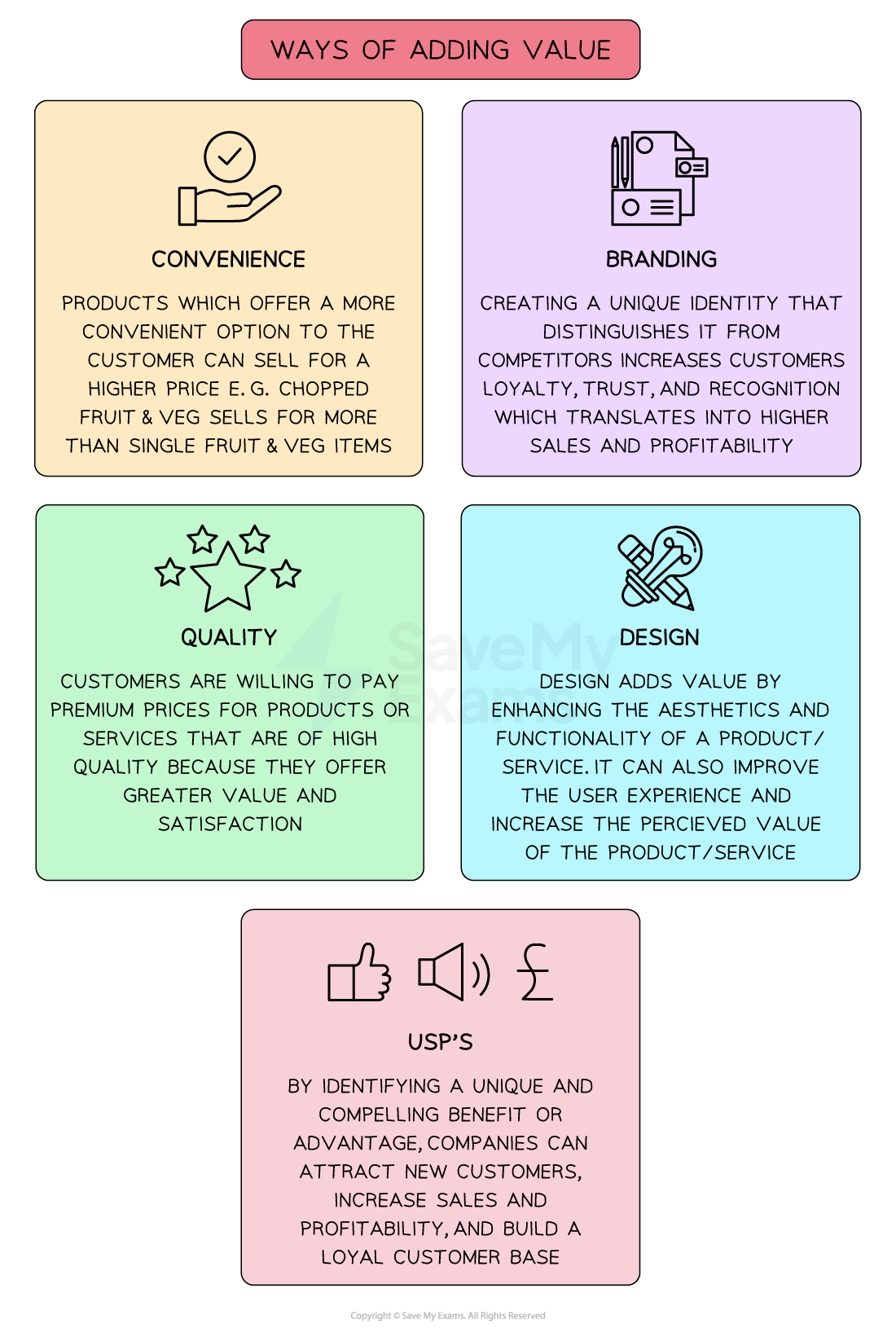
Some of the methods of adding value allow for product differentiation, which allows the business to charge a higher selling price
Examples of added value
| Method | Example |
|---|---|
| Branding | - Apple has built a brand that many customers believe is superior to other brands - They have achieved this through the use of quality materials, innovative design and good marketing - This branding allows the firm to charge a higher price for its products, thus increasing the added value |
| Convenience | - Persil initially provided a bottle of dishwashing liquid for dishwashing machine use - This resulted in spillage as customers added the liquid to their machines, so Persil then created tablets - The tablets offered a much more convenient option and Persil was able to charge a higher selling price for them |
| Quality | - Jo Malone perfume products are well known for their beautiful packaging, which creates an exciting opening experience for the customer - This allows the firm to charge a higher price for its products, thus increasing the added value |
| Unique selling points (USPs) | - MoonPig birthday cards can be completely customised (size, colour, design etc.) and the level of customisation has helped them gain a competitive advantage - This customisation allows the firm to charge a higher price for its cards, thus increasing the added value |
| Design | - Samsung Galaxy Watch 5 has robust health tracking tools built into it, along with an amazing screen, which has helped it gain a competitive advantage - These features allow the firm to charge a higher price for its products, thus increasing the added value |
Exam Hint Don’t confuse adding value with profit – adding value is the difference between cost of inputs and selling price
Opportunity cost
Spec point — concept of opportunity cost
-
Opportunity cost is the loss of the next best alternative when making a decision
-
Businesses thrive when they are able to meet customer needs and wants
- Needs are essential, e.g. shelter or food
- Wants are desires which are not essential e.g Nike trainers
-
Due to the problem of scarcity, there is a basic economic problem
- Choices have to be made by producers, consumers, workers and governments about the most efficient use of resources
-
There is an opportunity cost in the allocation of resources
-
When a consumer chooses to purchase a new phone, they may be unable to purchase new jeans
- The jeans represent the loss of the next best alternative (the opportunity cost)
-
When a producer decides to allocate all of their resources to producing electric vehicles, they may be unable to produce petrol vehicles
- The petrol vehicles represent the loss of the next best alternative (the opportunity cost)
-
When a government decides to provide free school meals to all primary students in the country, they may be unable to fund rural libraries, which may have to close
- The libraries represent the loss of the next best alternative (opportunity cost)
-
Was this revision note helpful?
Build on this topic