Methods of Market Research (Cambridge International IGCSE Business)
Why businesses use market research
Why do businesses use market research?
-
Market research is the collection, compilation and analysis of information about a market
-
Effective market research helps a business
- Reduce risk when launching new products or entering new markets
- Identify and understand the future needs and wants of customers
- Understand consumer behaviour
- Identify how much consumers are prepared to pay
- Identify potential gaps in the market which can be exploited to increase sales
- Identify competitors and gauge their potential strengths and weaknesses
-
With effective market research businesses are well-placed to make informed decisions about the most effective way to use their valuable resources and develop a suitable marketing mix
-
On-going market research helps businesses to update their marketing strategy in line with customers' changing needs and preferences
Primary market research
Spec point — "primary research methods, e.g. questionnaires or surveys, interviews, focus groups, observation advantages and disadvantages of primary market research methods"
Primary market research
-
Primary market research is the process of gathering information directly from consumers in the target market
- This process gathers **information that **does not already exist and is specific to the needs of the business collecting it
-
Surveys,** interviews and focus groups** are common primary market research methods
- These methods make use of questionnaires to organise research questions and responses
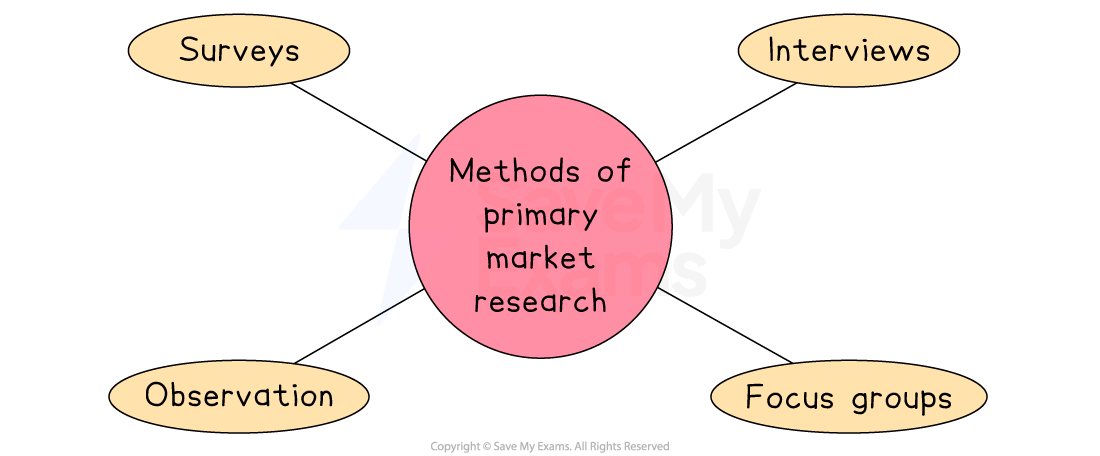
Primary market research methods include surveys, interviews, observation and focus groups
Primary market research methods
Surveys
- A series of questions are posed to a defined number of people using a questionnaire
- Surveys can be conducted face-to-face, online, by phone or by post
| Advantages | Disadvantages |
|---|---|
| - Can reach a wide audience quickly - Data is easy to compare and analyse | - Responses may be rushed or dishonest - Limited opportunity for follow-up or clarification |
Interviews
- A formal meeting between a researcher and a customer using structured or semi-structured questions
- Interviews allow detailed responses and observation of body language
| Advantages | Disadvantages |
|---|---|
| - In-depth and detailed responses - Can explore topics further through follow-up questions | - Time-consuming and expensive - Results may be harder to compare due to open-ended answers |
Observation
- A market researcher watches consumer behaviour in real time, such as shopping patterns, product placement, or packaging influence
| Advantages | Disadvantages |
|---|---|
| - Shows actual behaviour rather than reported behaviour - Useful for identifying trends or problems | - Cannot always understand reasons behind actions - Can be intrusive or affect natural behaviour |
Focus groups
- Small group discussions led by a specialist to gather detailed feedback from target customers on products, services, or marketing strategies
| Advantages | Disadvantages |
|---|---|
| - Provides deep insights and opinions - Can test ideas before wider launch | - A small sample size may not represent wider market - Dominant voices may skew the discussion |
Sampling
Spec point — the concept of sampling and why it is useful to businesses
-
Primary market research is conducted with a small representative sample of the market as a whole
- Market researchers use carefully designed sampling methods from which accurate **conclusions can be drawn **about likely customer preferences and behaviour
- In general,** the larger the sample size, the more likely it is that results of market research activities will reflect the market as a whole**
Why is sampling useful?
-
It saves time and money
- It is usually too expensive and time-consuming to collect data from every potential customer
- Sampling allows the business to get useful information quickly and at a lower cost
-
It can provides reliable insights
- If the sample is chosen carefully, it can represent the larger market
- This means the business can still learn about customer preferences, buying habits, or opinions without needing to ask everyone
-
It helps a business make better decisions
- Sampling allows a business to test ideas, such as new products or adverts, before launching on a larger scale
- This helps reduce risk
-
It is useful for identifying trends
- By asking a smaller group of people from different segments, a business can spot patterns in customer behaviour or preferences
Secondary market research
Spec point — "secondary research methods, e.g. competitor websites, government sources, market reports, trade magazines advantages and disadvantages of secondary market research methods"
Secondary market research
-
Secondary research involves the collection, compilation, and analysis of data that already exists
- It helps businesses make informed decisions without carrying out their own primary market research
-
Businesses must weigh up the reliability of secondary market research and aspects such as cost, relevance and availability of data when making a decision on which secondary data to use
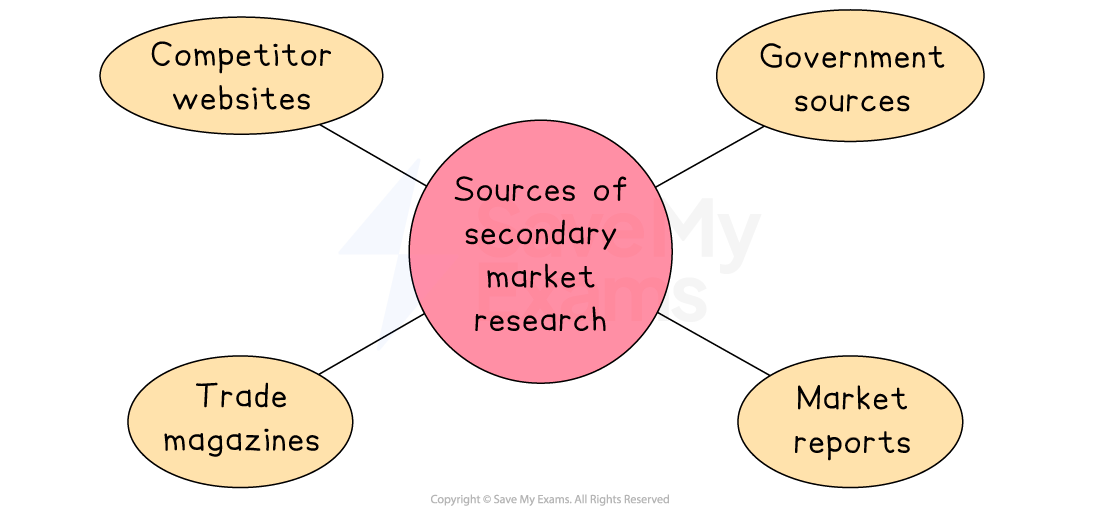
Secondary market research can be sources from competitor websites, government data, trade magazines and market reports
Sources of secondary market research
Competitor websites
- Businesses can visit the websites of their competitors to gather useful information about their products, pricing, promotions, customer service and branding
Why are they useful?
- Comparing prices and features
- Identifying current marketing strategies
- Understanding how competitors position themselves in the market
Government sources
- Governments publish a wide range of free and reliable data, including statistics on population, employment, income, business activity and economic growth
Why are they useful?
- Spotting demographic trends (e.g. ageing population)
- Analysing the economic climate (e.g. inflation, interest rates)
- Understanding changes in consumer spending or regional business conditions
Market reports
- Market research companies, such as Mintel or Euromonitor, produce in-depth reports on industries, consumer trends and market performance
- These are usually detailed and may be expensive to access
Why are they useful?
- Assessing market size and growth
- Understanding consumer behaviour and preferences
- Identifying future opportunities or threats in a market
Trade magazines
- Magazines focused on a specific industry, often published by trade associations or business groups
- They include news, expert opinions and case studies
Why are they useful?
- Staying up-to-date on trends, new products, and innovations
- Monitoring competitor activity within the industry
- Gaining insight into best practices and future developments
Evaluating secondary market research
| Advantages | Disadvantages |
|---|---|
| - Cost-effective - Secondary research is often cheaper than conducting primary research since the data already exists - Time-saving - Information can be accessed quickly without needing to collect new data - Wide range of data - It covers many topics and often has large sample sizes, offering valuable insights | - It may be outdated - Information might not reflect current market trends or customer preferences - Lack of relevance - Data might not be specific enough for the business’s needs, so primary market research may also be needed - Unknown accuracy - The reliability of the data can be uncertain if the original source is unclear or biased |
Exam Hint Be careful not to confuse primary and secondary research – primary gathers new data (e.g. surveys), while secondary uses existing data (e.g. reports). Mixing these up is a common exam mistake
Factors influencing the accuracy of market research data
- The reliability and accuracy of market research depends upon a large number of factors, including:
1. Question phrasing
-
How questions are phrased in questionnaires or other tools used to conduct surveys
- Questions should be written in such a way that they do not encourage a predetermined response
2. Sample selection
-
How carefully the sample is selected
- Including its size,types of respondent chosen and how closely these reflect the intended target market
3. Skills of interviewer
-
Who conducts the research including their experience, research skills and source (primary or secondary?)
-
Potential for bias when conducting research or analysing results
- The research and its analysis should be as objective as possible
4. Time and place of research
-
When and where the research is conducted
- Customer tastes, fashions, economic conditions and technology change, giving data a relatively short period of usefulness
- Customers in different geographic areas can have very different opinions
Was this revision note helpful?
Build on this topic