Excerpt: Students are asked to solve ∫ab1−x2dx by substitution, before looking at how they can link their answer to a geometric representation of the problem.
From here we could substitute in our values of θ but we will get expressions like sin(arccosb) which can be difficult to work with. Instead it will be helpful to rewrite our expression in terms of x.
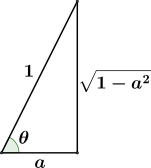
The functions sinθ, cosθ and θ appear. We know cosθ=x, as this is our original substitution, and therefore θ=arccosx. For sinθ we can think of sin2θ+cos2θ=1, or a right angle triangle with a hypotenuse of 1 and base of x, both of which give us the same result: sinθ=1−x2.
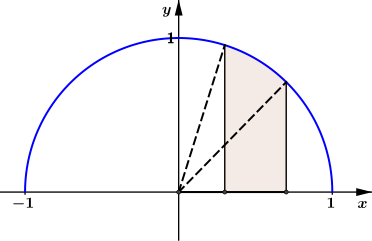
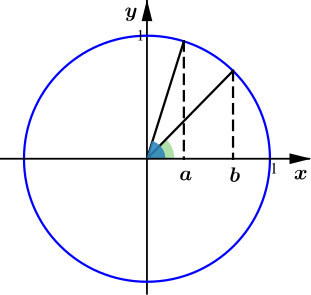
How does your answer to ∫ab1−x2dx relate to the following diagram?
Suggestion
Look carefully at the diagram above.
Do you know any information that you can add to the diagram?
Are there lengths and areas that you can work out?
Further suggestions can be found by working through the questions below:
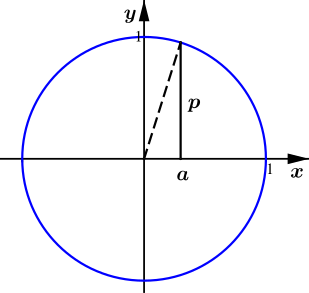
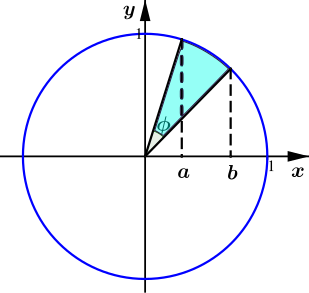
Find p in terms of a . Solution As this is a unit circle the hypotenuse of the triangle is 1 . Therefore p=1−a2 .
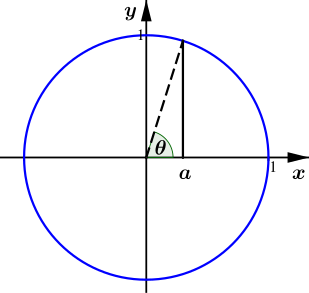
Find θ in terms of a . Solution As we know all three sides of the triangle there are multiple ways we could write the angle, but the simplest way would be to use cosθ=1a which means θ=arccosa.
Find ϕ and the shaded area in terms of a and b . It will be helpful to find the area of the sector using radians rather than degrees. Solution We already know one angle marked in the digram below, arccosa. The other can be found in the same way and is arccosb. Therefore ϕ=arccosa−arccosb . The area of a sector =21r2θ, and r=1 , so the area is 21(arccosa−arccosb).
Solution
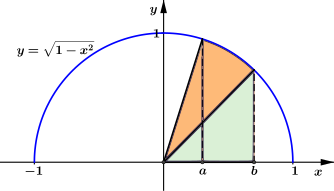
Firstly we might notice that the diagram has an area shaded between lines which could be x=a and x=b, so this could be represented by an integral between a and b. The curve appears to be a semicircle with radius 1. A unit circle has equation x2+y2=1, but if this is rearranged to find y then we get y=±1−x2. The positive root, gives us a semicircle above the x-axis as all the y-values must be positive. Therefore the shaded area is represented by the integral ∫ab1−x2dx, which we have already worked out using the substitution x=cosθ to get ∫ab1−x2dx=21b1−b2−21arccosb−21a1−a2+21arccosa.
Finding the area with geometry
As it is part of a semicircle, we can break the area down into more familiar shapes. We can find the area of the triangle and the sector shaded below.
The green triangle has area 21b1−b2 and the orange sector has area 21(arccosa−arccosb), (to see why, look at the suggestion section). We can also find the area of the triangle with base a which is 21a1−a2.
The total area is found by adding the orange sector and the green triangle with base b, then subtracting the triangle with base a. This gives us 21b1−b2+21(arccosa−arccosb)−21a1−a2.
The geometric pieces can be thought about in a number of ways. You might have started from the answer of the integral which can be written in the form ∫ab1−x2dx=F(b)−F(a), where F(b)=21b1−b2−21arccosb and F(a)=21a1−a2−21arccosa.
Can you see which areas are represented by F(b) and F(a)?