Integral chasing
Excerpt: Students work out four definite integrals, giving results in terms of unknowns whose values can then be determined. The task offers lots of practice of algebra skills and integration together.
Problem
Below is a selection of integrals, some of which you cannot do without performing others first and some that require the use of other mathematical skills.
Can you find the missing positive numbers to ?
Test your solution
Once you have found the missing positive numbers to , can you use them in the statement below to test your values?
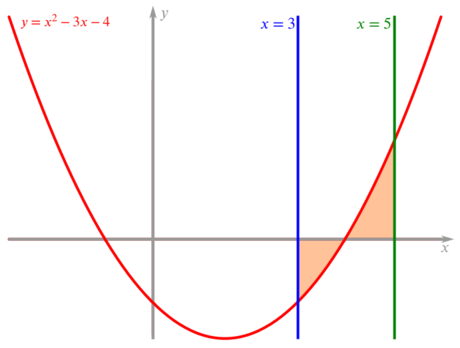
The area formed by the -axis, the lines and , and the curve is .
Remember, when we are looking at area, what must we check about the curve between the lines and when it is plotted?
Solution
We have four integrals to look at, but only two of them contain just one of the letters—(1) and (3).
We could start with the first integral,
We can see that the value the integral takes is positive, so we have an area formed between and the -axis.
This can only happen when , since is also positive. We now have a good feeling for the sort of value for we are looking for.
If we perform the integration we get the following,
Simplifying the above we find that,
The prime factor decomposition of is . Trying the possible combinations leads us to . Given that is positive, we must have .
Is this sensible?
Well, we thought above that and we have found a value that fits with this.
Which integral could we tackle next?
Integral 2
For this integral it is a good idea to rewrite the integrand and we can also fill in the value for .
Why is it helpful that and are the numbers we require to substitute in?
Performing the integration and solving a linear equation in , we find that .
Integral 3
This integral does not depend on any of the unknowns. It is again useful to rewrite the integrand.
Performing the integration and solving a linear equation in , we find that .
Integral 4
This equation contains all four of the unknowns so is best kept til last. As before, we start by rewriting the integrand and substituting in the values for , and .
We can also substitute our values for , and into the right hand side of the original equation to give .
Performing the integration and solving a quadratic equation in , we find that .
Test your solution - explained
The area formed between the -axis and the lines and , and the curve is .
To check that we have found the correct values for , , and we can evaluate the integral between the given values,
and check it is equal to .
But we are not told about the integral, we are told that the area formed between the curve and the -axis is . This means we need to be careful if our curve crosses the -axis.
Sketching the curve reveals that the curve crosses the -axis at . So we must separately calculate the areas between the values and , and and .
Sketch of curve
The curve
We can thus split our integral up into two
which will give the negative value and
which will give the positive value .
Therefore, the total area formed between the curve, the lines and , and the -axis is .