GeoGebra constructions... quadratic edition
Excerpt: Students are challenged to use GeoGebra to construct quadratics that meet certain constraints. This activity encourages them to generalise and make links between different forms of a quadratic and its graph.
Problem
Two points on the axis
Using GeoGebra, plot two points and on the -axis of a graph. Can you instruct GeoGebra to draw a quadratic which passes through both of them?
It should be constructed in such a way that when you move either or along the -axis, the quadratic changes so that it continues to pass through both of them.
If you want some guidance on how to get the coordinates of the points and , or how to enter an equation in GeoGebra, see the Using GeoGebra section.
This applet shows what the result could look like:
[interactive embed (geogebra-iframe): //www.geogebratube.org/material/iframe/id/aJpv7pKA/width/597/height/422/border/888888/rc/false/ai/false/sdz/false/smb/false/stb/false/stbh/false/ld/false/sri/true/asb/false/at/html5] — not part of the text import; see the source page.
Download GeoGebra file
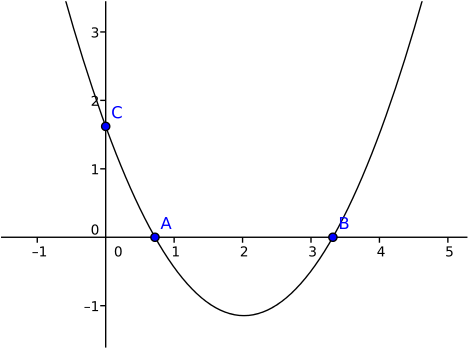
Developing this idea further, add a point to the -axis. Can you make your quadratic pass through , and , like this?
Taking it further
One point as the vertex
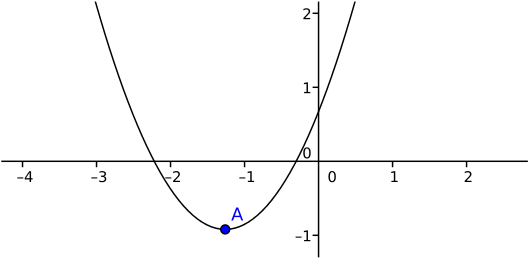
On a new graph, plot a point . Can you instruct GeoGebra to draw a quadratic which has its vertex at ?
It should be constructed in such a way that when you move , the quadratic changes in response.
This is what the result could look like:
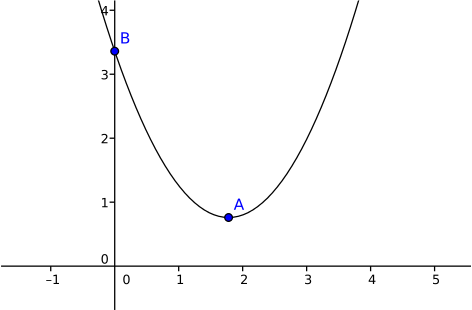
Developing this idea further, add a point to the -axis. Can you make your quadratic have its vertex at and pass through , like this?
Taking it further
Any three points
The final (very hard) challenge: plot three points , and anywhere on the graph, and draw a quadratic passing through these three points, like this:
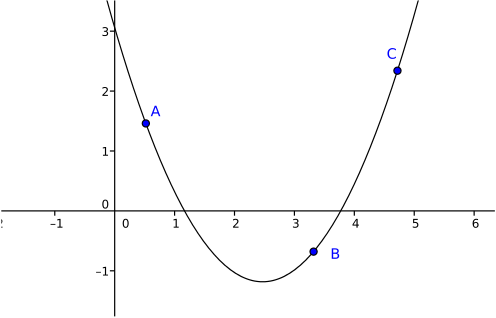
Is there more than one quadratic you could draw?
Using GeoGebra
GeoGebra can be downloaded from http://www.geogebra.org/download or used online at http://www.geogebra.org/graphing.
If a point is plotted on an axis using the “Point” tool:

then the point will be (automatically) constrained to lie on that axis.
Formulae can be entered in the input bar, so for example, if a point is created on the graph, we can create a formula for its -coordinate:
xa = x(A)
and likewise for its -coordinate:
ya = y(A)
Then let’s say we wished to draw the straight line with gradient through . We could type into the input bar:
y - ya = 3(x - xa)
(using the form for the equation of a straight line). The line should appear, and if the point is moved, the straight line will move with it.
These three lines of input could have been compressed to the single line:
y - y(A) = 3(x - x(A))
It is mostly a matter of preference which you choose to use.
For more details on using GeoGebra, see the Help section of the GeoGebra website (http://wiki.geogebra.org/en/Main_Page), which includes a tutorial and manual. Also, MEI has produced a series of GeoGebra guides, which can be found here.
Suggestion
How many different ways do you know to write the equation of a quadratic?
Which of these might be most useful for each of these problems?
Which form of quadratic most easily allows you to find the vertex of the quadratic?
Any three points
The final (very hard) challenge: plot three points , and anywhere on the graph, and draw a quadratic passing through these three points.
It will be useful when working on this one to use clear notation for the coordinates of , and . Something like , and would work well.
If the quadratic is (using , and instead of the usual , and to avoid confusion), what equations can we write down for , and ? How can we go about solving these?
A straightforward approach
Can you find a quadratic which passes through and intercepts the -axis at and ?
What other two similar quadratics can you find?
How can you combine these to solve the problem?
A slick approach
Solution
Here is a solution:
[interactive embed (geogebra-iframe): //www.geogebratube.org/material/iframe/id/aJpv7pKA/width/597/height/422/border/888888/rc/false/ai/false/sdz/false/smb/false/stb/false/stbh/false/ld/false/sri/true/asb/false/at/html5] — not part of the text import; see the source page.
Download GeoGebra file
We want the quadratic to pass through and on the -axis. If we write the coordinates of these points as and , we see that the roots of the quadratic must be and .
A quadratic which has these roots is , so this is what we need.
To draw this in GeoGebra, we need to work out and . We can do this by typing:
a = x(A)
b = x(B)
y = (x-a)(x-b)
or all in one go as:
y = (x-x(A))(x-x(B))
Here is a solution:
[interactive embed (geogebra-iframe): //www.geogebratube.org/material/iframe/id/tfjwgjS3/width/597/height/422/border/888888/rc/false/ai/false/sdz/false/smb/false/stb/false/stbh/false/ld/false/sri/true/asb/false/at/html5] — not part of the text import; see the source page.
Download GeoGebra file
In the first part of this problem, we found that one quadratic which passes through and has equation .
We could expand this to get , and we see that the coefficient of is .
There was no need for us to make this choice, though: we could choose any (non-zero) coefficient for . So we could equally well have used as our equation, as this also passes through and on the -axis.
This new quadratic crosses the -axis where ; substituting in shows that the intercept is at . As we want it to cross the -axis at , we choose so that This can easily be rearranged to get .
We can therefore specify the whole quadratic to GeoGebra as
y = y(C)/(x(A)*x(B)) * (x-x(A))(x-x(B))
We are assuming here that . If , this means that either or lies at the origin, and it is not going to be possible for the quadratic to then pass through both and along with .
The one exception is if also lies at the origin. In this case, we have , which is not defined. And geometrically, in this situation, we are only specifying where the quadratic crosses the -axis, so there are many possibilities for the quadratic.
Here is a solution:
[interactive embed (geogebra-iframe): //www.geogebratube.org/material/iframe/id/FGaTpJJM/width/597/height/422/border/888888/rc/false/ai/false/sdz/false/smb/false/stb/false/stbh/false/ld/false/sri/true/asb/false/at/html5] — not part of the text import; see the source page.
Download GeoGebra file
Since we are thinking about the vertex of the quadratic, it makes most sense to work with the completed square form of the quadratic: This has its vertex at .
So if we write the coordinates of point as , our quadratic could be
In GeoGebra terms, we can type this in as either:
a1 = x(A)
a2 = y(A)
y=(x-a1)^2+a2
or all in one go as
y=(x-x(A))^2+y(A)
Here is a solution:
[interactive embed (geogebra-iframe): //www.geogebratube.org/material/iframe/id/qAF9xE9g/width/597/height/422/border/888888/rc/false/ai/false/sdz/false/smb/false/stb/false/stbh/false/ld/false/sri/true/asb/false/at/html5] — not part of the text import; see the source page.
Download GeoGebra file
In the first part of this problem, we found that one quadratic which passes through has equation .
As we noted in the “taking it further” part of question 1 above, there was no need for us to make the coefficient of equal to . We could equally well have used for any choice of , for this also has its vertex at .
This new quadratic crosses the -axis where , so at . As we want it to cross the -axis at (where has coordinates , we will choose so that This can easily be rearranged to get .
We can specify this to GeoGebra all in one go as
y = (y(B)-y(A))/(x(A)^2) * (x-x(A))^2 + y(A)
As in question 1, we are assuming that . What would happen if ?
Here is a solution:
[interactive embed (geogebra-iframe): //www.geogebratube.org/material/iframe/id/drxVRBtx/width/597/height/422/border/888888/rc/false/ai/false/sdz/false/smb/false/stb/false/stbh/false/ld/false/sri/true/asb/false/at/html5] — not part of the text import; see the source page.
Download GeoGebra file
We write , and as in the suggestion.
which are two simultaneous equations for the two unknowns and .
We can make the coefficients of the same by multiplying by and by , and then subtracting to get and so
where we have negated the top and bottom of the final answer to make the denominator the same as for .
This is a bit of a mouthful. It can be entered into GeoGebra, perhaps most easily by working out the common denominator first:
d=(x(A)^2-x(C)^2)(x(B)-x(C))-(x(B)^2-x(C)^2)(x(A)-x(C))
p=((y(A)-y(C))(x(B)-x(C))-(y(B)-y(C))(x(A)-x(C)))/d
q=((y(B)-y(C))(x(A)^2-x(C)^2)-(y(A)-y(C))(x(B)^2-x(C)^2))/d
r=y(A)-p*x(A)^2-q*x(A)
y=p*x^2+q*x+r
While this gives a correct answer, it does not give any idea of what is really going on. It is also not “symmetric”: the roles of , and are identical in the problem, though the formula we’ve ended up with does not look symmetrical at all.
The second approach gives much more insight into what is going on here.
We take our quadratic to be
(using
,
and
instead of the usual
,
and
to avoid confusion). Since the quadratic must pass through the points
,
and
, we can write down three simultaneous equations for
,
and
:
If we subtract equation
from equations
and
, we get
Rather than trying to substitute this into
or
to find
, we can start again: multiplying
by
and
by
and subtracting gives
so that
Finally, we substitute this into
to get
, so in full,
A straightforward approach
The suggestion asked:
Can you find a quadratic which passes through and intercepts the -axis at and ?
What other two similar quadratics can you find?
How can you combine these to solve the problem?
We can use the idea from the extension to question 1 above to find such a quadratic. As it passes through and , it must have the form . Since it also passes through , it must satisfy so that , giving
Likewise, a quadratic which passes through and intercepts the -axis at and is and one which passes through and intercepts the -axis at and is
If we add these three quadratics together, we get a quadratic which passes through , and . For example, when , the first quadratic evaluates to , while the second and third evealuate to : the sum is therefore , so the quadratic passes through . Likewise, it passes through and .
So an alternative way of expressing the equation of the quadratic through , and is
We can enter this in GeoGebra (all on one line) as
y=(x-x(B))(x-x(C))/((x(A)-x(B))(x(A)-x(C)))*y(A)+
(x-x(C))(x-x(A))/((x(B)-x(C))(x(B)-x(A)))*y(B)+
(x-x(A))(x-x(B))/((x(C)-x(A))(x(C)-x(B)))*y(C)
This formula shows the symmetry of the answer.
The technique we have used here is known as the Lagrange Interpolating Polynomial. The formula was first published by Waring in 1779, rediscovered by Euler in 1783, and published again by Lagrange in 1795.
Can you see how the same idea could be used to fit a cubic through 4 points, or a quartic (degree 4 polynomial) through 5 points, and so on?
A slick approach
We see from the straightforward approach that the three points give us three simultaneous linear equations in three unknowns (, and ). These equations will have a unique solution (which we found), so there is only one possible quadratic.
The only exception to this will be if two or more of , and share the same -coordinate, in which case there may be no possible quadratics (if they have different -coordinates) or infinitely many possible quadratics (if they are the same point).
Solution