1.4.1 The Water Cycle (Cambridge International AS Environmental Management)
Water Cycle Processes
Spec point —
1.4.1
Water on Earth
-
Fresh water only makes up a very small fraction (approximately 2.5% by volume) of the Earth’s water storages
- The rest is saltwater
-
Of this fresh water, approximately 68.7% is stored in glaciers and ice sheets and 30% is stored as groundwater
-
The remaining 1.3% of freshwater is in rivers, lakes and the atmosphere
-
All water (both saltwater and freshwater) is part of the water cycle
Comparison of the world's freshwater stores
Water Cycle
-
Globally, the water cycle is a closed system
- This means that there is a constant amount of water on the planet
-
Within the water cycle, there are stores and transfers
-
The water cycle is a series of processes in which water is constantly recycled through the system
- The cycle also shapes landscapes, transports minerals and is essential to all life on Earth
-
The main processes (transfers) occurring within the water cycle are:
- Evaporation - the sun evaporates surface water into vapour
- Condensation - water vapour condenses and precipitates
- Flows - water runs off the surface into streams and reservoirs or beneath the surface as groundwater flow
-
These processes transfer the water on Earth from one store to another (e.g. river to ocean or ocean to atmosphere)
-
The water cycle involves energy exchange, leading to local temperature fluctuations
- As water evaporates, it absorbs energy from its surroundings
- This effectively cools the environment
- The reverse happens when water condenses (heat is released)
- This heat exchange influences the local climate
The transfers and stores of the water cycle
Storages & Processes
-
Storages in the water cycle include:
- Rivers, lakes and oceans
- Groundwater (aquifers)
- Soils
- The atmosphere
- Glaciers and ice caps
- Organisms (e.g. trees)
-
The main processes in the water cycle include:
- Condensation
- Precipitation
- Interception
- Infiltration
- Surface run-off
- Through-flow
- Groundwater flow
- Transpiration
- Evaporation
Water Cycle Processes
| Process | Description |
|---|---|
| Condensation | The process through which water vapour in the atmosphere transforms into liquid water, forming clouds or dew, as a result of cooling |
| Precipitation | The process of water falling from the atmosphere to the Earth's surface in the form of rain, snow, sleet, or hail |
| Interception | The process through which precipitation is prevented from reaching the ground, usually by being caught on leaves or branches |
| Infiltration | The process of water seeping into the soil from the surface, entering the soil layers and becoming groundwater |
| Surface run-off | The movement of water over the Earth's surface, typically occurring when the ground is saturated or impermeable, leading to excess water |
| Through-flow | The movement of water through the soil between the groundwater store (water table) and the surface |
| Groundwater flow | The movement of water through underground rock layers |
| Transpiration | The process by which plants absorb water from the soil through their roots and release it as water vapour through tiny openings called stomata in their leaves |
| Evaporation | The process by which liquid water changes into a gaseous state (water vapour) and enters the atmosphere from water bodies such as oceans, lakes, and rivers |
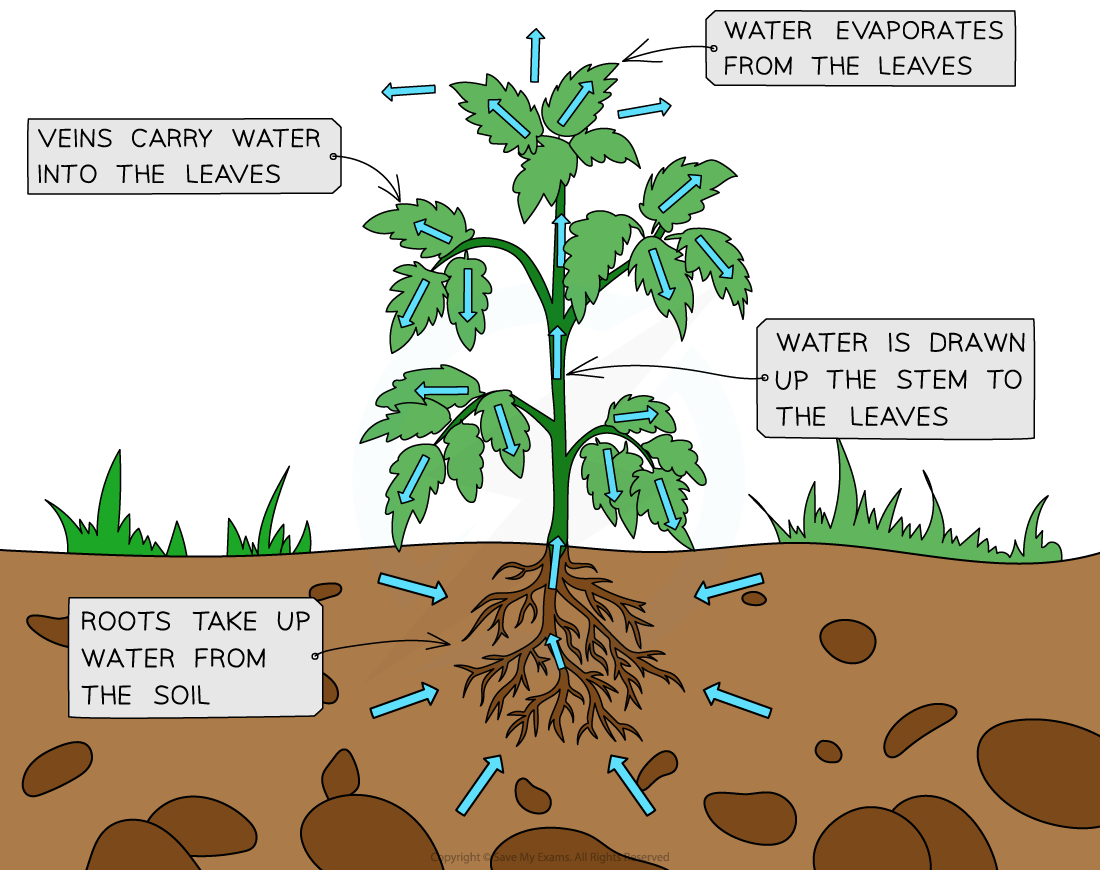
The loss of water vapour from the leaves of the plant (transpiration) causes water to move upwards through the plant, allowing more water to be drawn in through the roots
Was this revision note helpful?
Build on this topic