The M+1 & M+2 Peaks (Cambridge International AS Chemistry)
Determine Number of Carbon Atoms Using M+1 Peak
-
The [M+1] peak is caused by the presence of the carbon-13 (13C) isotope in the molecule
-
Carbon-13 makes up approximately 1.1% of all carbon atoms
-
Therefore, the [M+1] peak is much smaller than the M peak as the isotope is less common
- The ratio of 13C to 12C is approximately 1:99
-
Thus, the greater the number of carbon atoms present in a molecule the greater the height of the [M+1] peak
-
The number of carbon atoms, n, in a compound can be deduced using the [M+1] peak and the following formula:
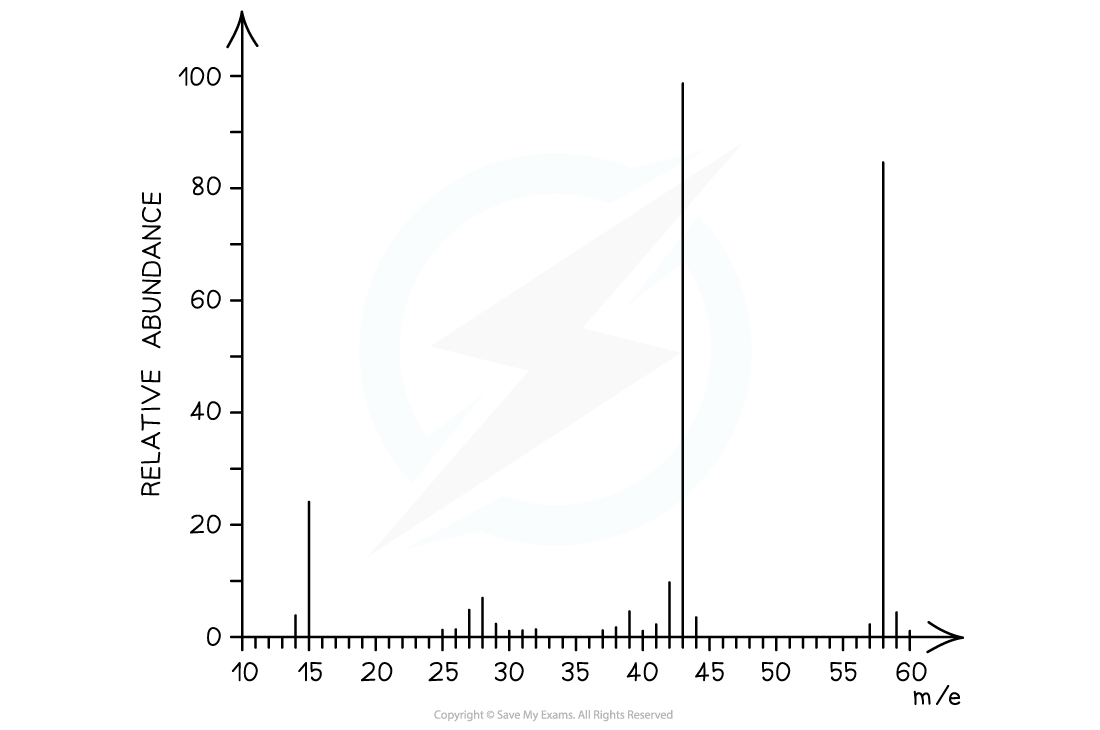
Worked Example Determine the number of carbon atoms of compound X with the following mass spectrum:
Answer:
The M+ ion peak is at m/e 58 with a relative abundance of around 85
The [M+1] peak is at m/e 59 with a relative abundance of 3
Therefore, the number of carbon atoms (n) is:
There are therefore 3 carbon atoms present in compound X
Detecting Bromine & Chlorine Atoms Using M+2 Peak
- The presence of bromine or chlorine atoms in a compound gives rise to a [M+2] and possibly [M+4] peak
Chlorine
-
Chlorine exists as two isotopes, 35Cl and 37Cl
-
A compound containing one chlorine atom will therefore have two molecular ion peaks due to the two different isotopes it can contain
- 35Cl = M+ peak
- 37Cl = [M+2] peak
- The ratio of the peak heights is 3:1 (as the relative abundance of 35Cl is 3x greater than that of 37Cl)
-
A compound containing two chlorine atoms will have three molecular ion peaks due to the different combinations of chlorine isotopes they can contain
- 35Cl + 35Cl = M+ peak
- 35Cl + 37Cl = [M+2] peak
- 37Cl + 37Cl = [M+4] peak
- The ratio of the peak heights is 9:6:1
Mass spectra of chlorine containing compounds
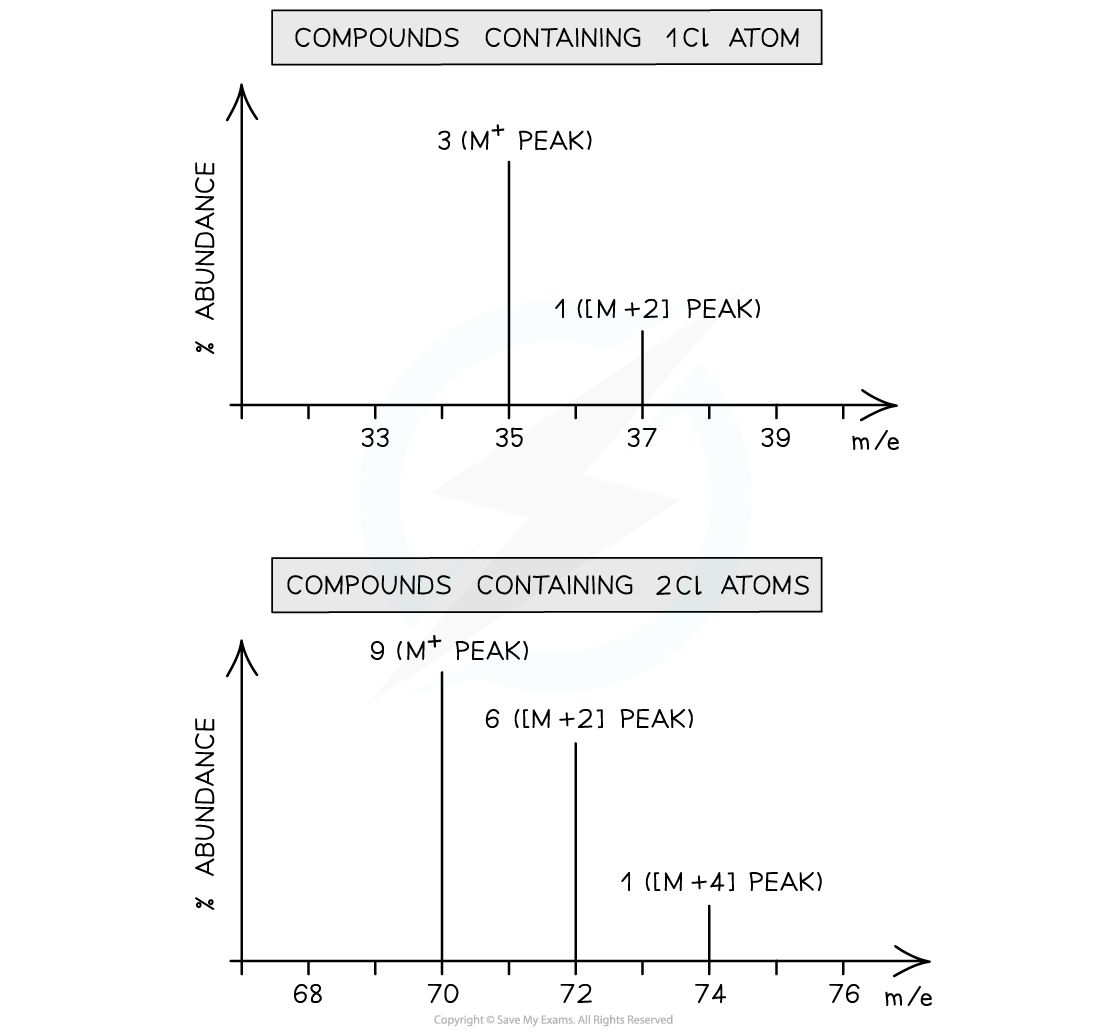
Mass spectrum of compounds containing one chlorine atom (1) and two chlorine atoms (2)
Bromine
-
Bromine too exists as two isotopes, 79Br and 81Br
-
A compound containing one bromine atom will have two molecular ion peaks
- 79Br = M+ peak
- 81Br = [M+2] peak
- The ratio of the peak heights is 1:1 (they are of similar heights as their relative abundance is the same!)
-
A compound containing two bromine atoms will have three molecular ion peaks
- 79Br + 79Br= M+ peak
- 79Br+ 81Br = [M+2] peak
- 81Br + 81Br= [M+4] peak
- The ratio of the peak heights is 1:2:1
Mass spectra of bromine containing compounds
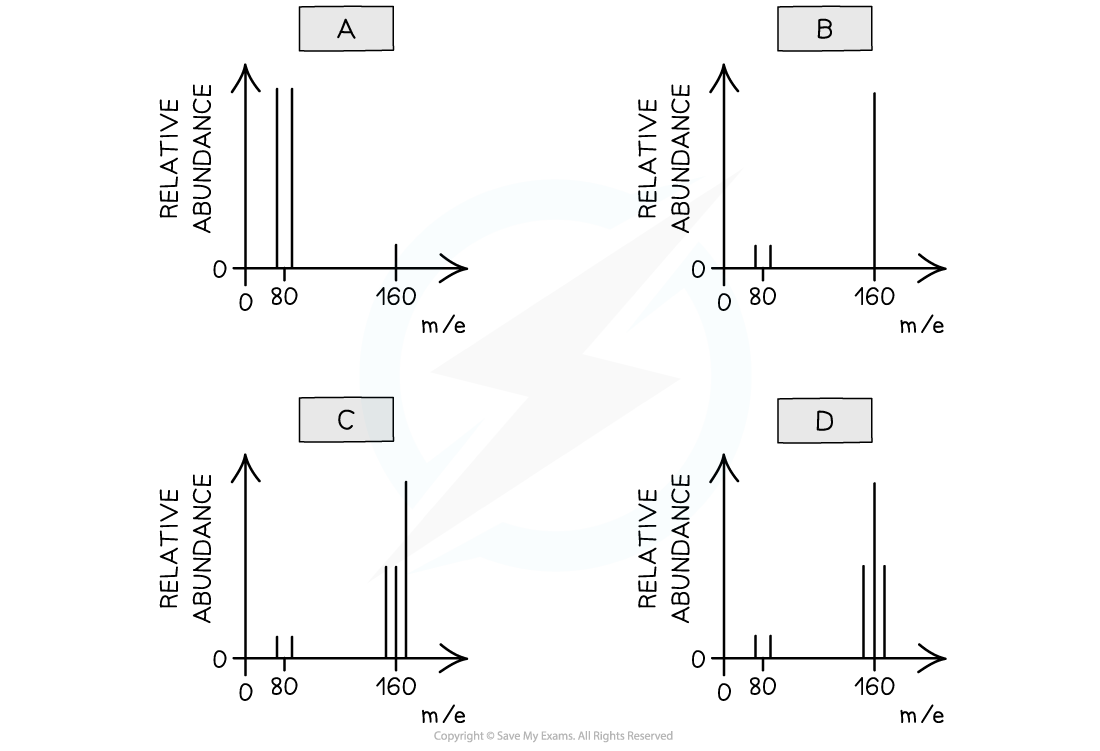
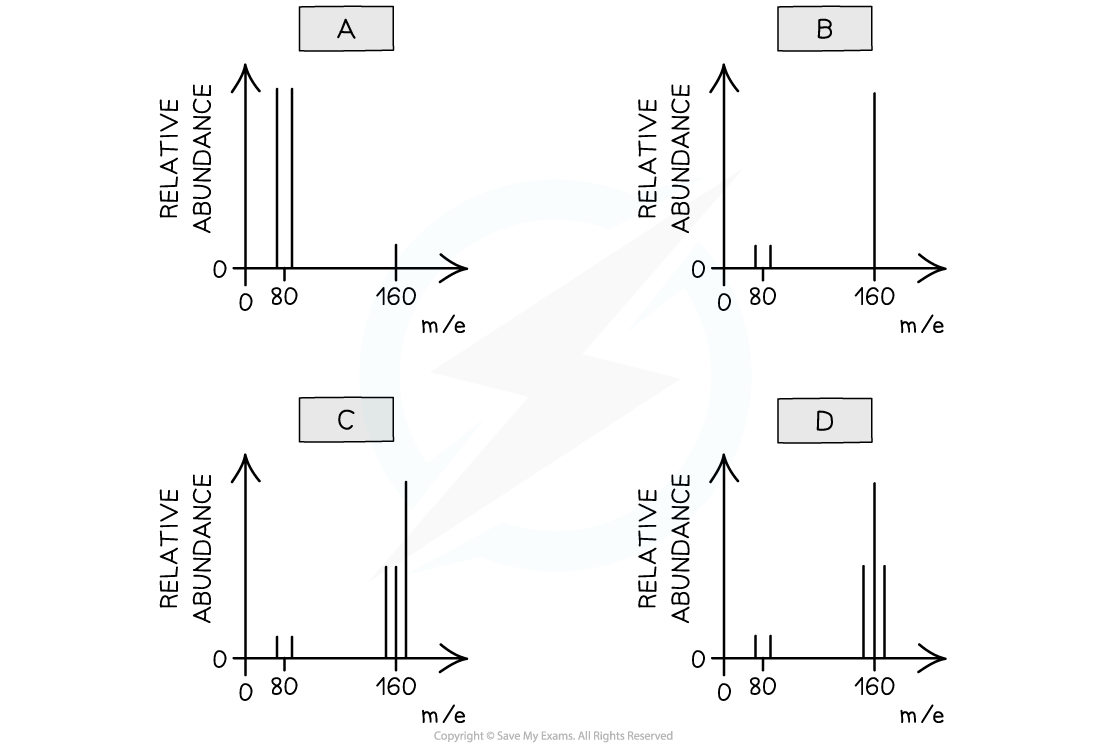
Mass spectra of four bromine-containing compounds (A–D), illustrating characteristic patterns due to the presence of two isotopes: 79 Br 79 Br and 81 Br 81 Br. Each spectrum shows distinctive peak groupings depending on the number of bromine atoms in the molecule.
Worked Example Two stable isotopes of bromine have relative masses of 79 and 81
Which is the correct pattern of peaks in the mass spectrum of molecular bromine?
Answer:
The correct answer is D
Bromine is a diatomic molecule there will be 5 peaks on the mass spectrum of bromine
Bromine consists of molecules, not individual atoms
When bromine is passed through the mass spectrometer, an electron is given off to give the molecular ion, Br2+
Some of these will fragment to make Br + Br+
- Br2+ → Br + Br+
The Br atom passes through the machine, and the Br+ ions will give lines at 79 and 81
There will also be a line for the unfragmented Br2+ ion
This will give 3 molecular ion peaks
- Br2+ ion containing the isotopes 79 + 79 = 158
- Br2+ containing the isotopes 79 + 81 = 160
- Br2+ containing the isotopes 81 + 81 = 162
Was this revision note helpful?
Build on this topic