Molecular Ion Peak & Fragmentation (Cambridge International AS Chemistry)
Mass Spectrometry: Deducing Molecular Formula
- Each peak in the mass spectrum corresponds to a certain fragment with a particular m/e **value
- The peak with the highest m/e value (ignoring the small [M+1] and [M+2] peaks) is the molecular ion (M+**) peak which gives information about the molecular mass of the compound
- The molecular ion is the entire molecule that has lost one electron when bombarded with a beam of electrons
MOLECULEMOLECULE+• + e–
-
The [M+1] peak is a smaller peak which is due to the natural abundance of the isotope carbon-13
-
The height of the [M+1] peak for a particular ion depends on how many carbon atoms are present in that molecule; the more carbon atoms, the larger the [M+1] peak is
- For example, the height of the [M+1] peak for a hexane (containing six carbon atoms) ion will be greater than the height of the [M+1] peak of an ethane (containing two carbon atoms) ion
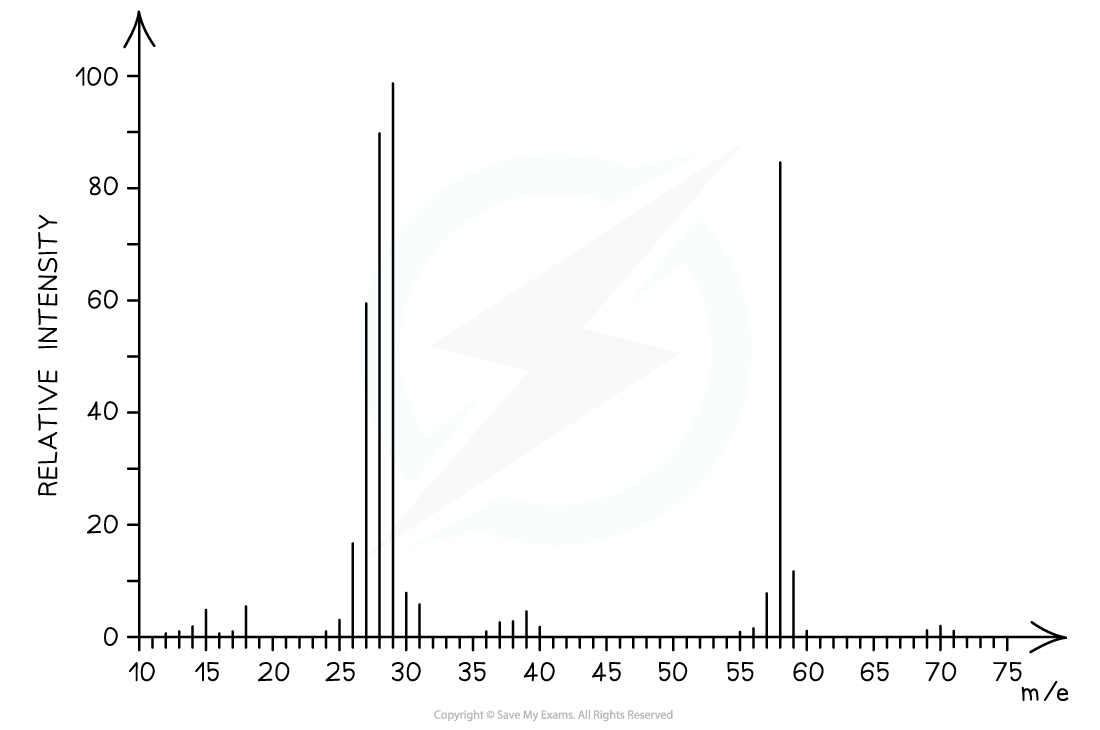
Worked Example Determine whether the following mass spectrum corresponds to propanal or butanal.
Answer:
- The mass spectrum corresponds to propanal as the molecular ion peak is at m/e = 58
- Propanal arises from the CH3CH2CHO+ ion which has a molecular mass of 58
- Butanal arises from the CH3CH2CH2CHO+ ion which has a molecular mass of 72
Identifying Molecules using Fragmentation
-
The molecular ion peak can be used to identify the molecular mass of a compound
-
However, different compounds may have the same molecular mass
-
To further determine the structure of the unknown compound, fragmentation is used
-
Fragments may appear due to the formation of characteristic fragments or the loss of small molecules
- For example, a peak at 29 is due to the characteristic fragment C2H5+
- Loss of small molecules gives rise to peaks at M – 18 (loss of H2O), M – 28 (loss of CO) and M – 44 (loss of CO2)
Alkanes
- Simple alkanes are fragmented in mass spectrometry by breaking the C-C bonds
- M/e values of some of the common alkane fragments are given in the table below
m/e values of fragments table
| Fragment | m/e |
|---|---|
| CH3+ | 15 |
| C2H5+ | 29 |
| C3H7+ | 43 |
| C4H9+ | 57 |
| C5H11+ | 71 |
| C6H13+ | 85 |
Mass spectrum showing fragmentation of alkanes
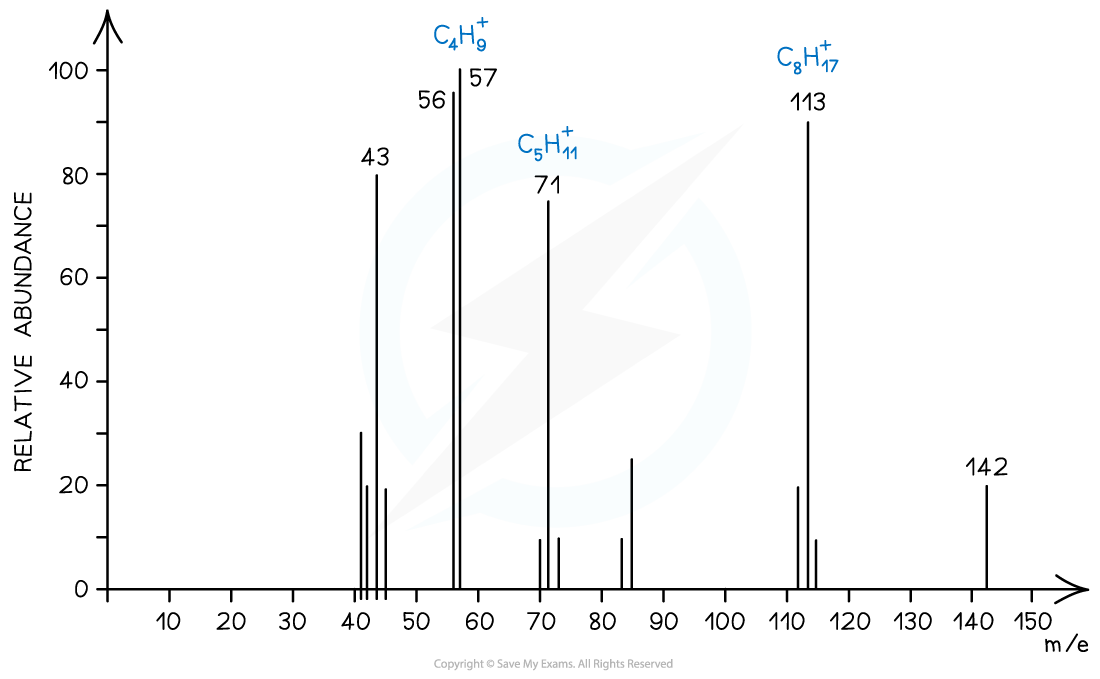
*Straight chain alkanes show characteristic peaks *
Halogenoalkanes
- Halogenoalkanes often have multiple peaks around the molecular ion peak
- This is caused by the fact that there are different isotopes of the halogens
Mass spectrum for a bromine containing species
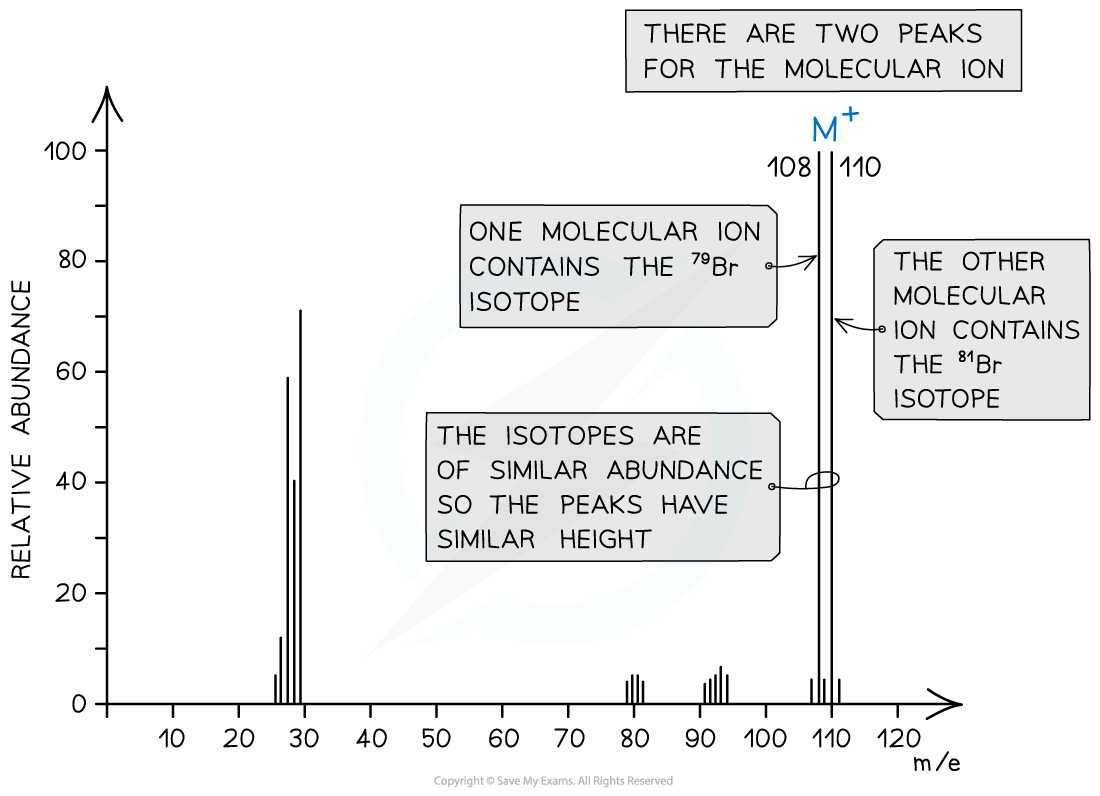
Mass spectra show different halogen isotopes in the molecular ion
Alcohols
-
Alcohols often tend to lose a water molecule giving rise to a peak at 18 below the molecular ion
-
Another common peak is found at *m/e *value 31 which corresponds to the CH2OH+ fragment
-
For example, the mass spectrum of propan-1-ol shows that the compound has fragmented in four different ways:
- Loss of H• to form a C3H7O+ fragment with m/e = 59
- Loss of a water molecule to form a C3H6+ fragment with m/e = 42
- Loss of a •C2H5 to form a CH2OH+ fragment with m/e = 31
- And the loss of •CH2OH to form a C2H5+ fragment with m/e = 29
Mass spectrum of propan-1-ol
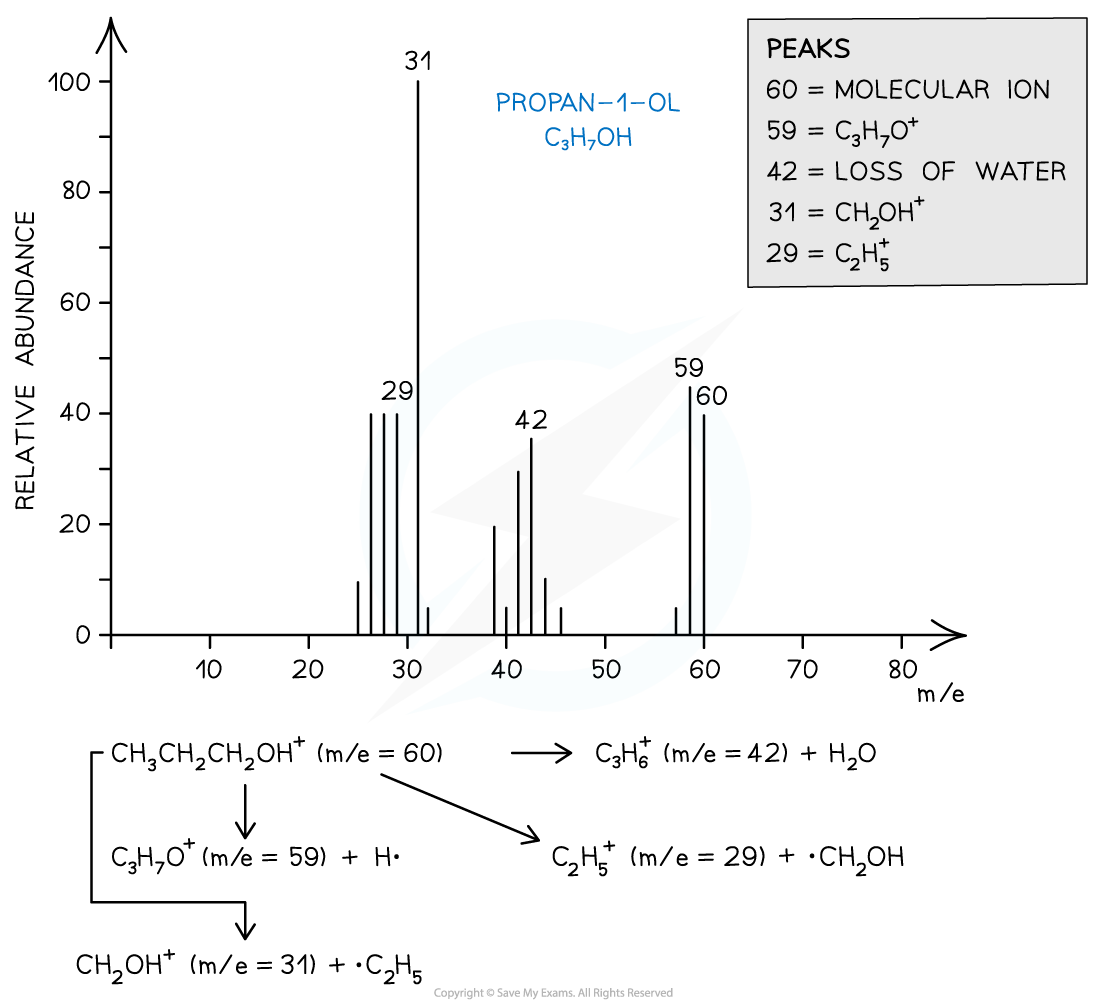
Mass spectrum showing the fragmentation patterns in propan-1-ol (alcohol)
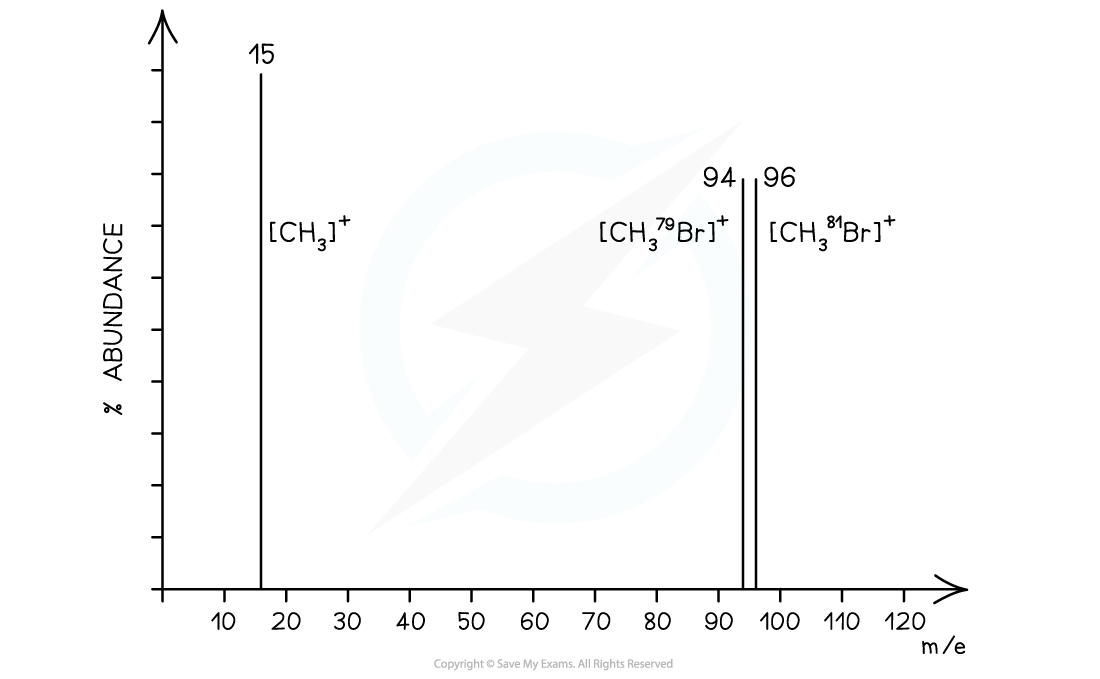
Worked Example Which of the following statements about the mass spectrum of CH3Br is correct?
- There is one peak for the molecular ion with an m/e value of 44
- There is one peak for the molecular ion with an m/e value of 95
- The last two peaks have abundances in the ratio 3:1 and occur at m/e values of 94 and 96
- The last two peaks are of equal size and occur at m/e values of 94 and 96
Answer:
The correct answer is 4 as bromomethane (CH3Br) will fragment into 3 peaks
- CH381Br → [CH381Br]+ + e− at m/e 96
- CH379Br → [CH379Br]+ + e− at m/e 94
- CH3Br → [CH3]+ + •Br at m/e 15
The last two peaks (which correspond to the molecular ion peak) therefore are equal in size and occur at m/e values of 94 and 96
Worked Example Which alcohol is not likely to have a fragment ion at m/e at 43 in its mass spectrum?
- (CH3)2CHCH2OH
- CH3CH(OH)CH2CH2CH3
- CH3CH2CH2CH2OH
- CH3CH2CH(OH)CH3
Answer:
The correct answer is 4 because a line at m/e = 43 corresponds to an ion with a mass of 43 for example:
- [CH3CH2CH2]+
- [(CH3)2CH]+
2-butanol is not likely to have a fragment at m/e = 43 as it does not have either of these fragments in its structure
Was this revision note helpful?
Build on this topic