Esters (Cambridge International AS Chemistry)
Production of Esters
-
Esters are compounds with an -COOR functional group and are characterised by their sweet and fruity smells
-
They are prepared from the condensation reaction between a carboxylic acid and alcohol with concentrated H2SO4 as catalyst
- This is also called esterification
-
The first part of the ester’s name comes from the alcohol and the second part of the name comes from the carboxylic acid
- E.g. Propanol and ethanoic acid will give the ester propyl ethanoate
Example esterification reaction
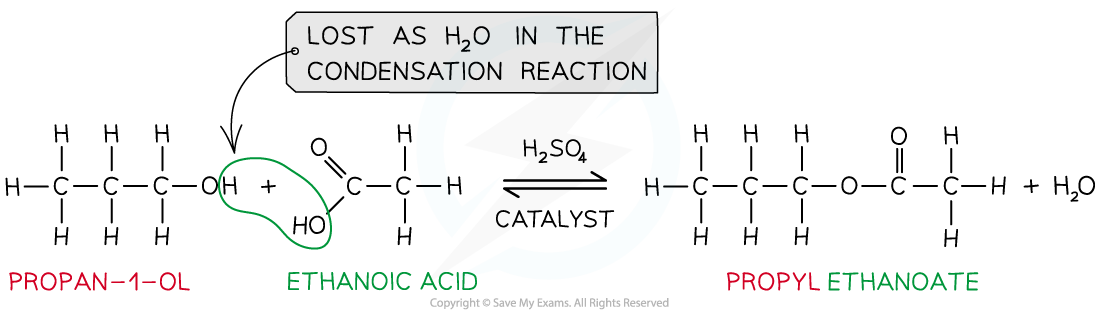
Esters are formed from the condensation reaction between carboxylic acids and alcohols
Hydrolysis of Esters
Spec point —
18.2.2
- Esters can be hydrolysed to reform the carboxylic acid and alcohol by either dilute acid or dilute alkali and heat
- When an ester is heated under reflux with dilute acid(eg. sulfuric acid) an equilibrium mixture is established as the reaction is reversible
Example acid hydrolysis of an ester
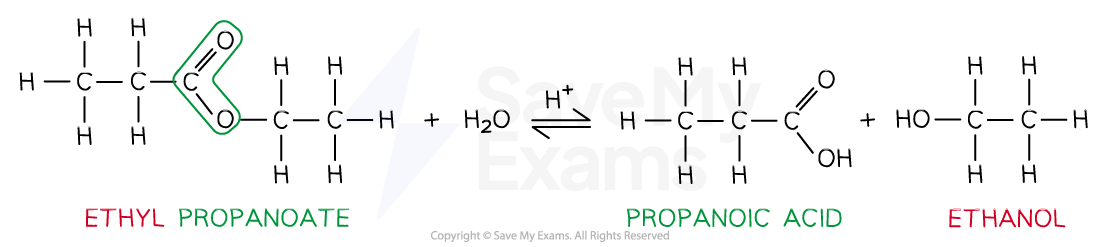
Ester hydrolysis by dilute acid is a reversible reaction forming carboxylic acid and alcohol
-
However, heating the ester under reflux with dilute alkali (eg. sodium hydroxide) is an irreversible reaction as the ester is fully hydrolysed
-
This results in the formation of a sodium carboxylate salt which needs further acidification to turn into a carboxylic acid
- The sodium carboxylate (-COO-) ion needs to get protonated by an acid (such as HCl) to form the carboxylic acid (-COOH)
Example alkaline hydrolysis of an ester
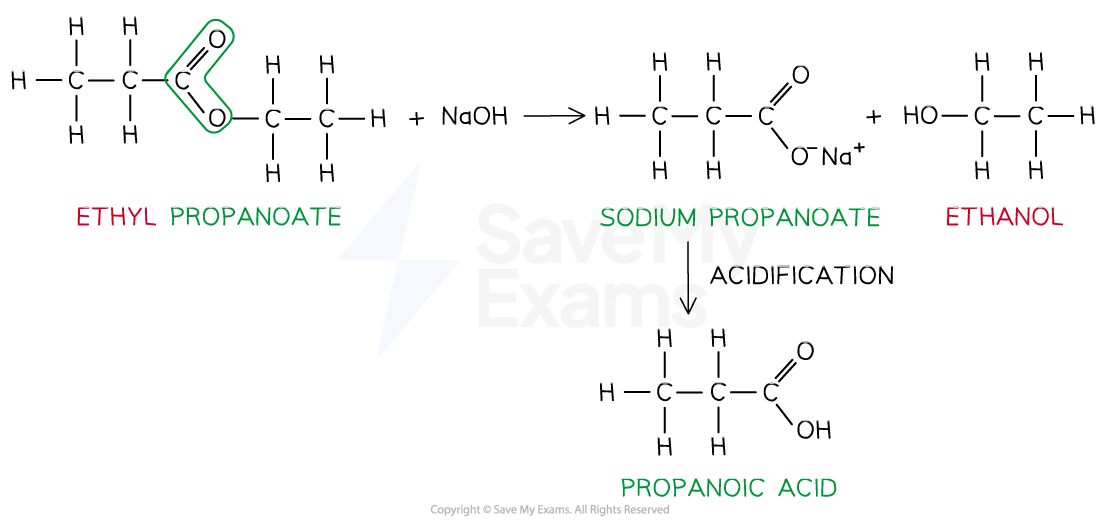
Ester hydrolysis by dilute alkali is an irreversible reaction forming a sodium carboxylate salt and alcohol
Was this revision note helpful?
Build on this topic