Carboxylic Acids (Cambridge International AS Chemistry)
Production of Carboxylic Acids
- Carboxylic acids are compounds with a -COOH functional group
- They can be prepared by a series of different reactions
Oxidation of primary alcohols & aldehydes
-
Carboxylic acids can be formed from the oxidation of primary alcohols and aldehydes by either acidified K2Cr2O7 or acidified KMnO4 and reflux
-
The oxidising agents themselves get reduced causing the solutions to change colour
- In K2Cr2O7 the orange dichromate ions (Cr2O72-) are reduced to green Cr3+ ions
- In KMnO4 the purple manganate ions (MnO4-) are reduced to colourless Mn2+ ions
Oxidation of primary alcohols and aldehydes
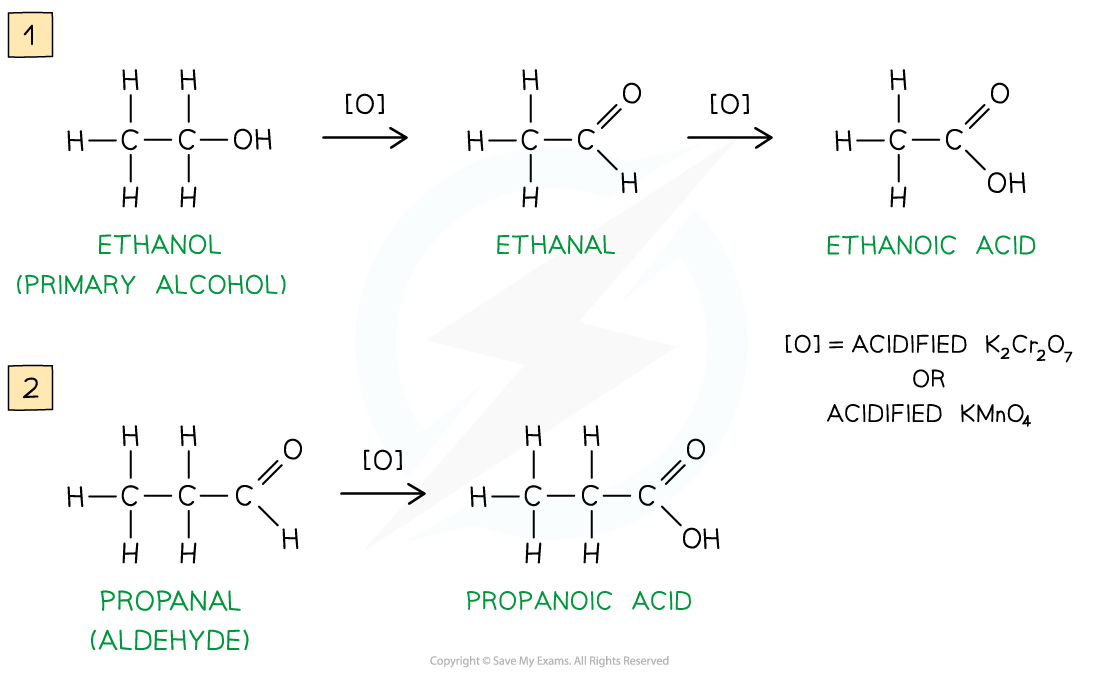
Oxidation of primary alcohols (1) and aldehydes (2) gives carboxylic acids
Hydrolysis of nitriles
-
Carboxylic acids can also be prepared from the hydrolysis of nitriles using either dilute acid or dilute alkali followed by acidification
- Hydrolysis by dilute acid results in the formation of a carboxylic acid and ammonium salt
- Hydrolysis by dilute alkali results in the formation of a sodium carboxylate salt and ammonia; Acidification is required to change the carboxylate ion into a carboxylic acid
-
The -CN group at the end of the hydrocarbon chain is converted to a -COOH group
Hydrolysis of nitriles
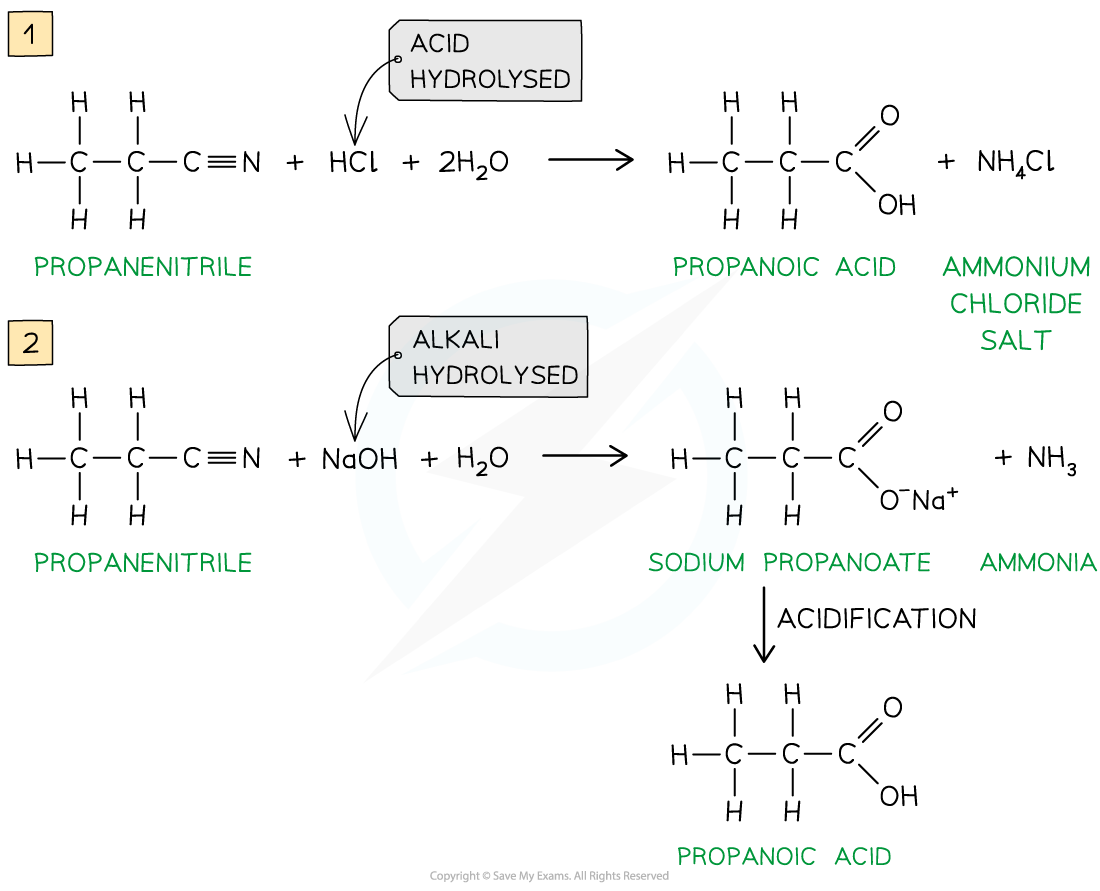
Hydrolysis of nitriles by either dilute acid (1) or dilute alkali and acidification (2) will form a carboxylic acid
Hydrolysis of esters
-
Esters are formed from the condensation reaction between an alcohol and a carboxylic acid
-
Hydrolysis of esters by dilute acid or dilute alkali and heat followed by acidification will reform the alcohol and the carboxylic acid
- Hydrolysis by dilute acid is a reversible reaction where an equilibrium is established
- Hydrolysis by dilute alkali is an irreversible reaction as all the ester is broken down to form a sodium carboxylate salt and an alcohol; acidification is required to change the carboxylate ion into a carboxylic acid
Hydrolysis of esters
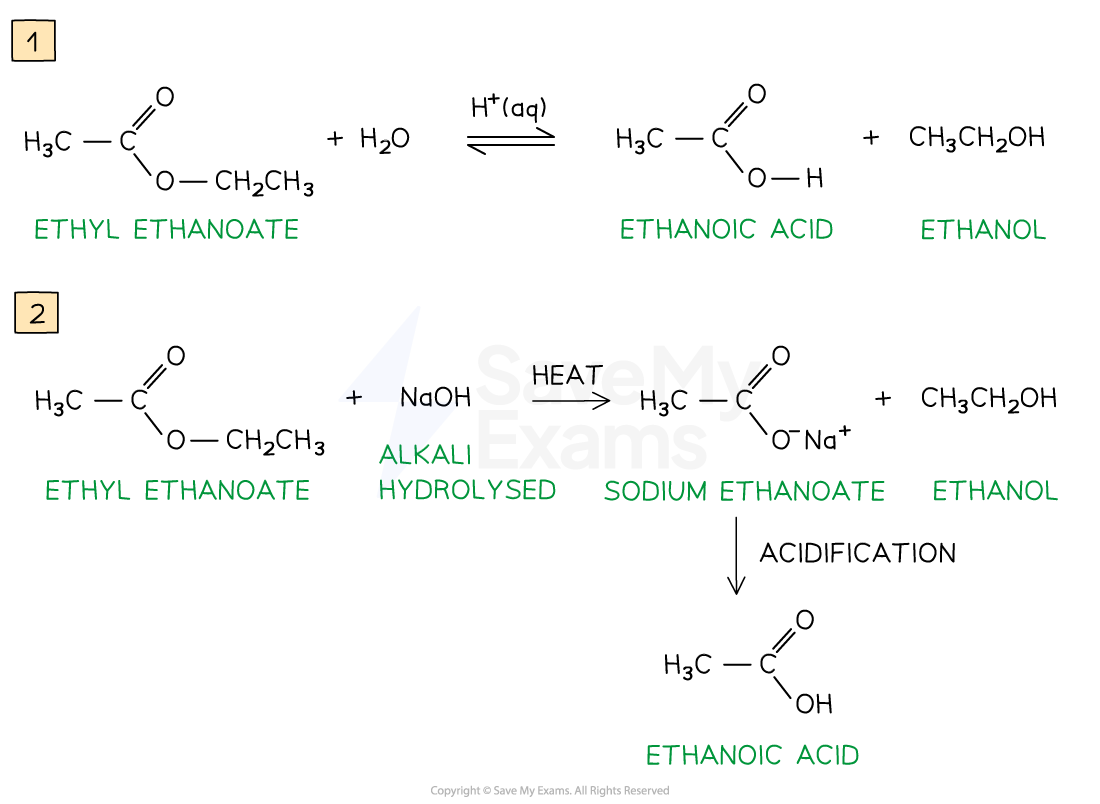
Hydrolysis of esters by either dilute acid (1) or dilute alkali and heat followed acidification (2) will form a carboxylic acid
Reactions of Carboxylic Acids
- Carboxylic acids are weak acids as they do not completely dissociate in water
- This means that the position of the equilibrium lies to the left and that the concentration of H+ is much smaller than the concentration of the carboxylic acid
- The solution has a pH value of less than 7
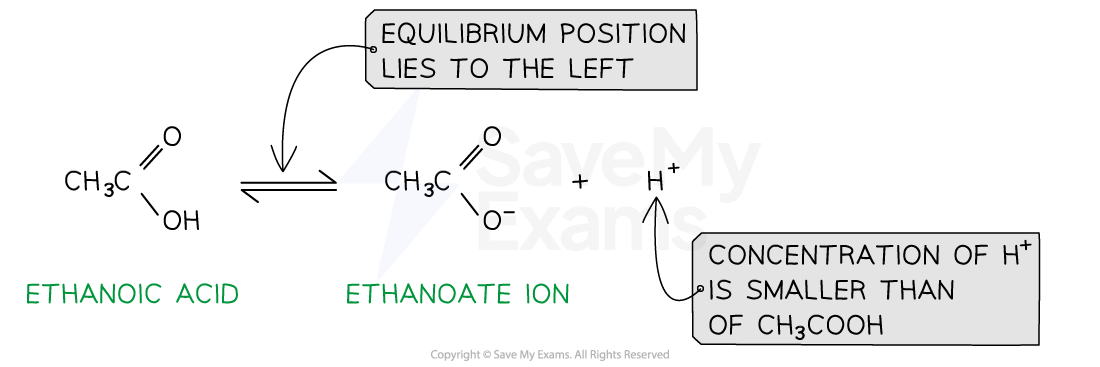
Carboxylic acids are weak acids that do not fully dissociate in water, the position of the equilibrium lies to the left
Carboxylic acid reaction types
-
Carboxylic acids are reactive compounds which can undergo many types of reactions including:
- Redox reactions with reactive metals
- Neutralisation reactions with alkali
- Acid-base reactions with carbonates
- Esterification with alcohols
- Reduction by LiAlH4
Redox reactions with reactive metals
- This reaction produces a salt and hydrogen gas
- General word equation:
Metal + carboxylic acid → salt + hydrogen
- Example reaction equation:
Sodium + ethanoic acid → sodium ethanoate + hydrogen
2Na + 2CH3COOH → 2CH3COO-Na++ H2
Neutralisation reactions with alkali
- This reaction produces a salt and water
- General word equation:
Alkali + carboxylic acid → salt + water
- Example reaction equation:
Sodium hydroxide + ethanoic acid → sodium ethanoate + water
NaOH + CH3COOH → CH3COO-Na++ H2O
Acid-base reactions with carbonates
- This reaction produces a salt, water and carbon dioxide gas
- General word equation:
Carbonate + carboxylic acid → salt + water + carbon dioxide
- Example reaction equation:
Sodium carbonate + ethanoic acid → sodium ethanoate + water + carbon dioxide
Na2CO3+ 2CH3COOH → 2CH3COO-Na++ H2O + CO2
Esterification with alcohols
- This reaction produces an ester and water
- General word equation:
Alcohol + carboxylic acid → ester + water
- Example reaction equation:
Ethanol + ethanoic acid ⇌ ethyl ethanoate + water
CH3CH2OH + CH3COOH ⇌ CH3COOCH2CH3+ H2O
Reduction by LiAlH4
- This reaction produces a primary alcohol and water
- General word equation:
Reducing agent + carboxylic acid → primary alcohol + water
- Example reaction equation, using LiAlH4:
4[H] + ethanoic acid → ethanol + water
4[H] + CH3COOH → CH3CH2OH + H2O
Was this revision note helpful?
Build on this topic