Training and Development (Cambridge International AS Business)
Different types of training
-
Businesses need to make sure that new and existing staff are trained and developed appropriately
- Training is the teaching of new skills
- Development is the improvement of existing skills
1. Induction training
- Induction training is a type of training that new employees receive when they start working for a business
Components of induction training
Common elements of induction training
-
Induction trtaining introduces employees to the business, its culture, policies, procedures, and their job roles and responsibilities
- E.g.New employees at Marks & Spencer receive induction training that covers customer service, product knowledge, store policies and safety procedures
Evaluating induction training
| Advantages | Disadvantages |
|---|---|
| - Helps new employees to understand their job roles and responsibilities - Introduces employees to the company culture, policies and procedures - Improves employee confidence and motivation - Reduces the time taken for new employees to become productive | - Can be time-consuming and expensive to organise - May not cover all aspects of the job role - May not be effective in all cases, leading to employee dissatisfaction and higher turnover rates |
2. On the job training
-
A type of training that takes place while employees are working in their job roles
-
Employees learn new skills and knowledge from colleagues while performing their job duties
- E.g. A sous chef at The Ivy Restaurant in York may receive on-the-job training from the Chef to learn how to prepare new dishes, use new equipment, or improve their cooking techniques
Evaluating on the job training
| Advantages | Disadvantages |
|---|---|
| - Training is tailored to the employee's specific job role and responsibilities - Training is often more practical and relevant to the employee's job duties - Can be cost-effective, as it takes place during working hours | - Employees may make mistakes while learning, which can impact productivity and quality - Can be disruptive to the workplace, as it requires the trainer to devote time to training the employee - May not be effective in all cases, leading to employee dissatisfaction and higher staff turnover rates |
3. Off the job training
-
A type of training that takes place outside of the workplace
-
It can be in the form of workshops, seminars, conferences, or online courses
- E.g. Teachers can attend exam board training days at which they learn how to better teach the syllabus and help their students to prepare for their exams
Evaluating off the job training
| Advantages | Disadvantages |
|---|---|
| - Employees learn new skills and knowledge outside of the workplace, which can bring fresh ideas and perspectives to the workplace - Training can be tailored to the employee's specific needs and interests - Training can be used as a reward or incentive for high-performing employees - It can be cost-effective if training is provided online or through webinars | - It can be expensive to organise, especially if travel and accommodation are required - Employees may miss work while attending training, which can impact productivity - The training may not be directly applicable to the employee's job role or the needs of the firm |
The impact of training and development
- Effective training can improve employees' performance, as well as their confidence and motivation in the workplace
Factors affecting the impact of training
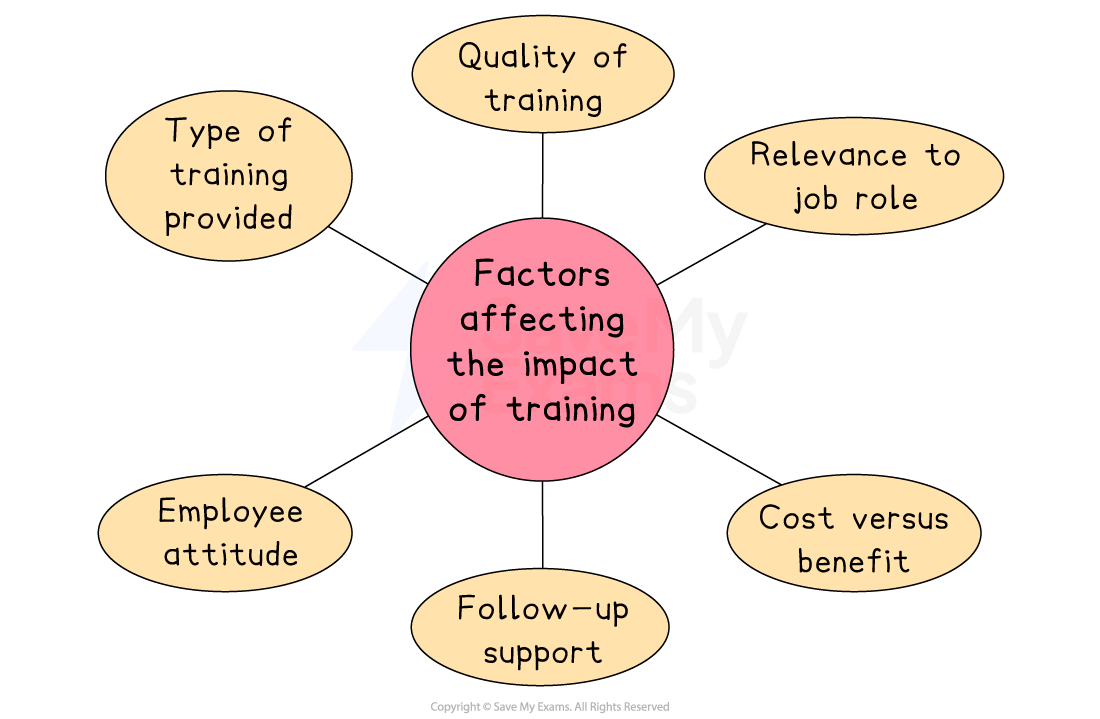
The impact of training is affected by factors including its quality, the attitudes of employees and its relevance to the job role
1. Type of training provided
-
On-the-job training is practical and inexpensive, and allows learning in a real work environment
- However, it may be rushed or poorly structured if the trainer is not experienced, which can reduce how useful the training is
-
Off-the-job training is often delivered by professional trainers and may include detailed or specialist content
- However, it can be costly and time-consuming, and employees are not working during this time, reducing productivity
2. Quality of training
- Training that is well-planned, clearly delivered and engaging helps employees understand and remember the information, and is more likely to improve performance and confidence
- If the training is badly organised, unclear or not suited to the employee's needs, it may waste time and money without improving skills or results
3. Relevance to job role
-
Training must be directly linked to the employee’s daily tasks and responsibilities
- If the training is too general or unrelated, the employee may struggle to apply what they’ve learned to their actual job
4. Employee attitude
-
Training works best when employees are willing to learn and see it as an opportunity for personal growth
- Positive and motivated employees are more likely to engage with training and apply what they learn.
- If employees are not interested or see training as a waste of time, its impact will be much smaller
5. Follow-up support
-
After the initial training, it is important to give employees continued support, such as coaching, mentoring, or feedback
- This helps them practise new skills and feel confident using them over time
-
However, without follow-up, employees may forget what they learnt or not know how to apply it properly in real work situations
6. Cost versus benefit
-
Training often requires money, time, and resources
- Businesses must decide if the potential benefits, such as higher productivity, better customer service, or lower staff turnover, are worth the cost
-
Well-targeted training that leads to noticeable improvements is usually worth the investment
Advantages and disadvantages of training to a business
| Advantages | Disadvantages |
|---|---|
| - Can improve employee performance, leading to higher productivity and efficiency | - Training can be expensive, especially off-the-job or specialist courses |
| - Increases motivation and job satisfaction, reducing staff turnover | - Takes time away from daily work, which can affect short-term output |
| - Helps employees adapt to new technology or changes in the business | - Some employees may leave after receiving training, taking skills elsewhere |
| - Builds a stronger, more flexible workforce ready to take on new roles | - Not all training is effective – poor-quality programmes may have little impact |
| - Enhances business reputation as a good employer, attracting new talent | - Planning and organising training takes time and resources |
Employee development to encourage intrapreneurship
-
Intrapreneurship is when employees act like entrepreneurs within a business
- They take initiative, develop new ideas, and look for better ways to do things while still being employed by the company
- They help a business grow by driving innovation, improving processes or creating new products
Approaches businesses may take to encourage intrapreneurship
| Approach | Explanation |
|---|---|
| Training in creativity and problem-solving | - Helps employees think in new ways, question current methods, and solve challenges independently |
| Encouraging idea sharing | - Creates space for employees to pitch ideas and be heard, with rewards for good suggestions |
| Job rotation and project work | - Increases employee knowledge across departments, giving them a broader view and more confidence to suggest improvements |
| Leadership and personal development programmes | - Builds confidence and skills needed for independent thinking and decision-making. |
| Creating a culture of trust and experimentation | - Encourages employees to try new things without fear of failure, which helps ideas grow |
Employee development to encourage multi-skilling and flexibility
-
Multi-skilling means employees are trained to carry out a variety of tasks, not just one specific job
-
Flexibility means employees can adapt to different roles, work patterns, or changing business needs
- This might include flexible working hours, remote working or being able to switch between tasks and teams
Benefits of multi-skilling and flexibility
-
Reduces reliance on specific individuals
-
When more employees are trained to do the same task, the business can continue running smoothly even if someone is absent
-
This avoids delays and reduces pressure on individual workers
- E.g. If a chef is off sick, a multi-skilled kitchen assistant who has been trained in cooking can step in and keep a restaurant's service running
-
-
Helps the business respond quickly to changes in demand or workload
-
Flexible and multi-skilled employees can be moved to busier departments or roles when needed
-
This allows the business to handle busy periods or sudden changes without hiring more staff
- E.g. In a retail store, staff trained in both stocking shelves and working on the tills can be moved to the checkout area during peak shopping hours
-
-
Increases employee satisfaction
-
Doing different tasks keeps work engaging and helps employees feel more skilled and confident
-
Varied work can reduce boredom and increase motivation
- E.g. In a call centre, giving staff the chance to work on different types of calls or help with training new starters can make the job more enjoyable
-
-
Improves productivity and efficiency
-
Multi-skilled workers are more useful across the business and can perform several roles
-
This reduces *downtime *and helps the business run smoothly
- E.g. Manufacturing employees who can operate different machines ensure production continues even if one area has fewer staff available
-
Approaches businesses may take to encourage multi-skilling and flexibility
| Approach | Explanation |
|---|---|
| Job rotation | - Employees are moved between different roles to gain a range of skills and experience |
| Cross training | - Employees are trained in tasks outside their usual role, so they can step in when needed |
| Team-based working | - Employees work in flexible teams that can shift roles depending on the task or project |
| Flexible working arrangements | - Employees are supported to work flexible hours or locations or shift between teams |
| Personal development planning | - Employees set goals with managers to build skills beyond their current role |
Was this revision note helpful?
Build on this topic