11 markeasy
A microscope has a resolution of 200 nm.
Which of the following organelles would not be resolved by this microscope?
Choose your answer
Mitochondria
Lysosomes
Ribosomes
Chloroplasts
15 questions · 66 marks · ≈ 66 min · spans 8 of 48 topics
Assembled from the topic question banks — not an official Cambridge International paperA microscope has a resolution of 200 nm.
Which of the following organelles would not be resolved by this microscope?
Choose your answer
Mitochondria
Lysosomes
Ribosomes
Chloroplasts
The basic structure of a virus is made up of a protein coat and genetic material.
What is the name given to the protein coat?
Choose your answer
Peplomer
Capsomere
Capsid
Virion
Biologists use two main types of microscope to examine cellular structure: optical microscopes and electron microscopes.
Give two advantages and two limitations of using electron microscopes to investigate cell structure.
Fig. 1 shows an electron micrograph of part of an intestinal epithelial cell.
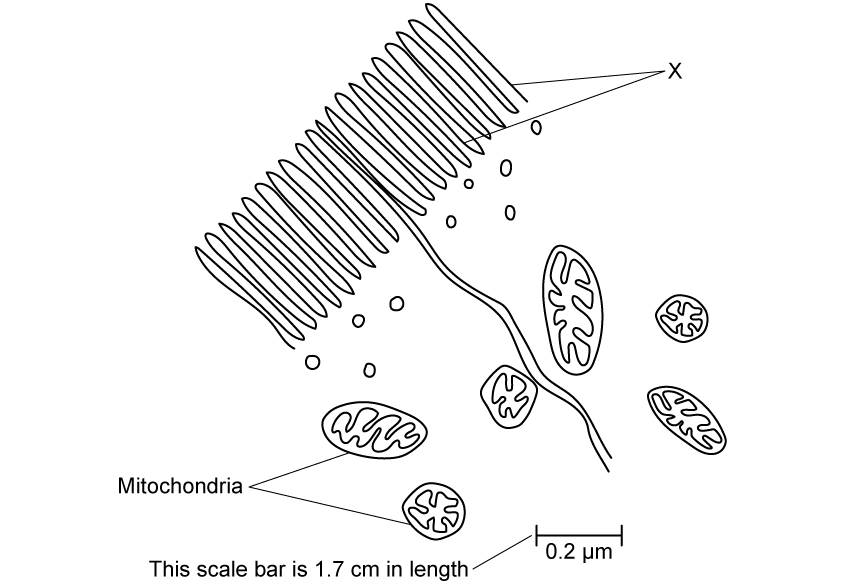
Fig. 1
Name the structures labelled X.
Use the scale bar to calculate the magnification of the drawing in Fig. 1.Show your working.
Extract:
Fig. 1 shows an electron micrograph of part of an intestinal epithelial cell.
The two mitochondria identified in Fig. 1 appear to be different in shape.
Suggest two reasons for this difference.
Fig. 1 shows the structure of the single-celled organism Chlamydomonas.
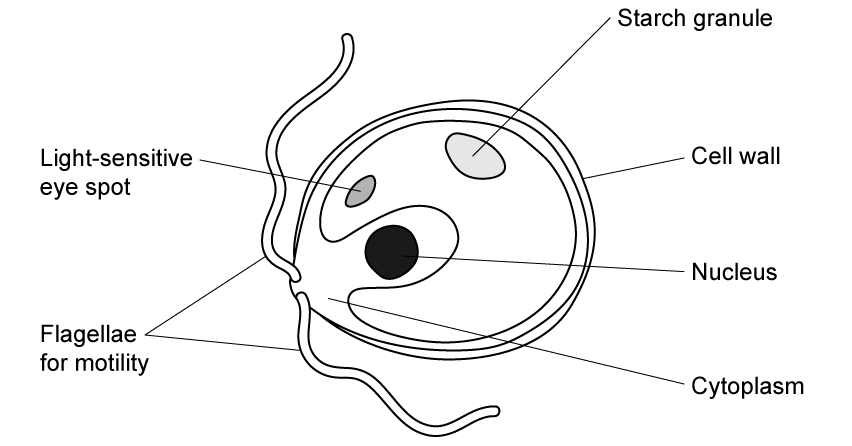
Fig. 1
State whether *Chlamydomonas *is a eukaryotic cell or a prokaryotic cell. Give a reason for your answer.
Chlamydomonas is a genus of green algae that contain chloroplasts.
Describe the function of chloroplasts and the structural features that enable them to carry out this function.
Extract:
Fig. 1 shows the structure of the single-celled organism Chlamydomonas.
Chlamydomonas is a genus of green algae that contain chloroplasts.
The function of chloroplasts is to absorb/capture/use light energy for photosynthesis to produce carbohydrates/sugars/lipids/proteins.
Suggest the role of the light-sensitive spot and flagella shown in Fig. 1.
A group of students carried out a series of tests on a liquid solution obtained from a plant. The table below shows the results of their tests:
| reagent | observation |
|---|---|
| Benedict's solution biurets ethanol and water | orange lilac clear |
Which of the following biological molecules were found in the plant liquid solution?
Choose your answer
Fatty acids and reducing sugars
Non-reducing sugars and protein
Non-reducing sugars and fatty acids
Protein and reducing sugars
The names of four biological molecules are given below:
| 1 | glucose |
|---|---|
| 2 | fructose |
| 3 | maltose |
| 4 | sucrose |
Which of the following combinations contains a disaccharide that would act as a reducing agent when mixed with copper (II) sulfate ions, and a disaccharide that wouldn't?
Choose your answer
1 and 3
1 and 4
2 and 3
3 and 4
Which of the following facts about collagen explain its role in muscles and tendons?
| 1 | Collagen is insoluble |
|---|---|
| 2 | Collagen chains form a helical structure |
| 3 | Different collagen molecules are bonded together by covalent bonds |
| 4 | Collagen is made of amino acids with small R groups |
Choose your answer
1 and 2
1, 2 and 3
2, 3 and 4
All
Gerridae lacustris, more commonly known as pond skaters, are able to rest on the surface of a pond.
Which of the following properties of water enables this?
Choose your answer
Ability to hold a lot of heat
Ability to form hydrogen bonds
Less dense when frozen
Colourless and odourless
Describe the test for non-reducing sugars.
Give the name of a non-reducing sugar.
The presence of other molecules can also be tested for with a range of biochemical reagents.
Complete Table 1 to show which reagents are used for which molecule.
Table 1
| reagent | biological molecule |
|---|---|
| potassium iodide | |
| Benedict's | |
| biuret | |
| ethanol |
Extract:
The presence of other molecules can also be tested for with a range of biochemical reagents.
Complete Table 1 to show which reagents are used for which molecule.
Table 1
| reagent | biological molecule | | potassium iodide | | | Benedict's | | | biuret | | | ethanol | |
Some of the biological molecules identified in Table 1 can be described as polymers.
Define the term polymer.
Fig. 1 shows the components of a triglyceride.
Draw out the molecular structure of the triglyceride that forms from these two components. Show clearly and label the molecular structure of the bond(s) that form(s) between the molecules, and any by-products formed.
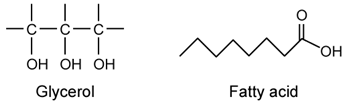
Fig. 1
Triglycerides are not referred to as polymers.
State why this is the case.
The recommended energy intake for adult males in the UK is 8,400 kJ day-1.
Given that 30 % of a typical day’s energy intake comes from fat, calculate the energy content of fat, assuming that an adult male consumes 55 g of fat in one day.
State your answer to the nearest whole number and suggest the appropriate units.
Chylomicrons are molecular assemblies that include phosphate ‘heads’ of phospholipids and proteins on their surface. Within the interior of the assembly are triglycerides, lipoproteins and cholesterol.
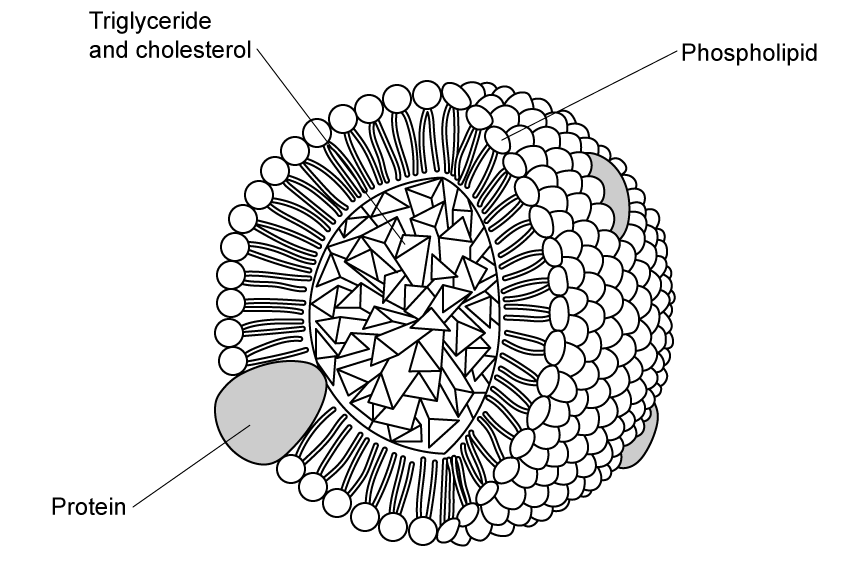
With reference to their structure, suggest a possible function of chylomicrons.
Ustilago maydis is a fungal pathogen affecting maize. They secrete toxins, known as killer toxins, with the best-characterised one being the KP6 toxin. This particular toxin consists of two small polypeptides that are not linked by covalent bonds. Fig. 1 shows the ribbon structure of one of these polypeptides of the KP6 toxin.
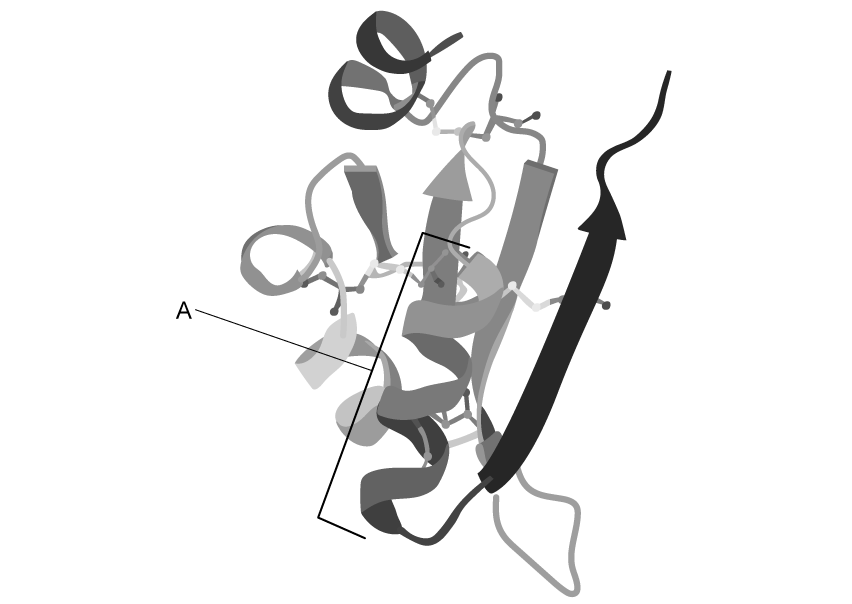
Fig. 1
Describe what is shown by the part of the polypeptide labelled A.
Certain enzymes, such as dipeptidase, are involved with protein digestion in the body. Fig. 2 shows a diagram of a dipeptide that can be broken down by dipeptidase.

Fig. 2
Describe how dipeptidase will break down this dipeptide by indicating the peptide bond on Fig. 2 and drawing the amino acid products that will form.
Proteins are very sensitive to changes in the pH of their surroundings as it may affect their tertiary and quaternary structure.
Explain why a decrease in pH could change the structure of a protein.
Give the name of the interaction between water molecules that determines the properties of water.
Explain how the properties of cohesion and adhesion are useful to living organisms.
Extract:
Explain how the properties of cohesion and adhesion are useful to living organisms.
State two other properties of water that are essential for sustaining life.
The HIV virus produces a long polypeptide that is hydrolysed by a protease enzyme to producing several smaller peptides. The smaller peptides help the virus to successfully invade their host, so this viral protease is the target of many anti-AIDS drugs.
Which feature is important if this drug is to be successful in preventing AIDS?
Choose your answer
The ability to inhibit many types of bacterial enzyme.
The ability to competitively inhibit protease enzymes
The ability to disrupt only specific viral protease enzymes
The ability to non-competitively inhibit protease enzymes.
Km is the concentration of substrate which permits the enzyme to achieve half Vmax.
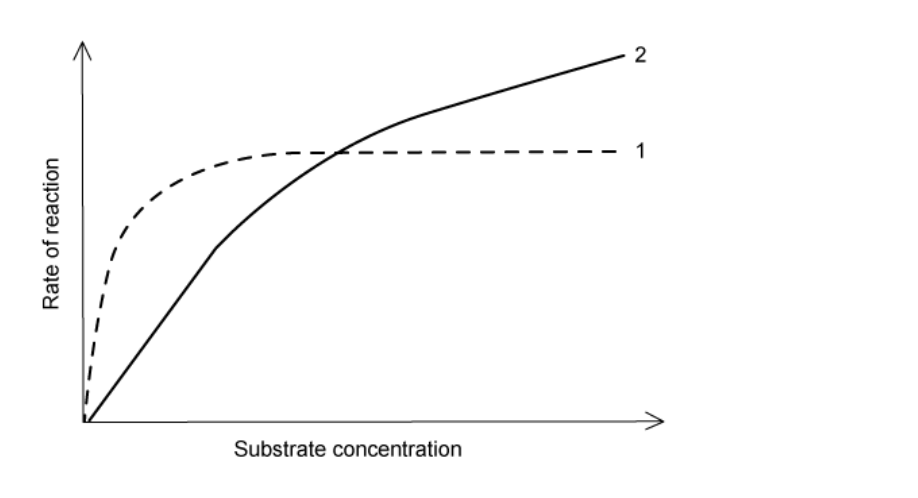
Which of the following statements is incorrect?
Choose your answer
Enzyme 2 has a greater affinity for its substrate than enzyme 1
Enzyme 1 reaches its Vmax
The Km value of enzyme 2 is greater than the Km value of enzyme 1
The Vmax value of enzyme 2 is greater than the Vmax value of enzyme 1
Explain how the levels of protein structure enable enzyme specificity.
Carbonic anhydrase is an enzyme that has a Zn2+ ion within its active site.
State the name given to this kind of structure in a protein and identify the level of protein structure that this affects.
Carbonic anhydrase catalyses the conversion of carbon dioxide and water into carbonic acid, as well as the reverse of this reaction as follows:
CO2 + H2O ⟶ H2CO3
H2CO3 ⟶ CO2 + H2O
Suggest how one enzyme is able to catalyse two different reactions.
When it is not catalysed by an enzyme, the rate at which carbon dioxide combines with water to produce carbonic acid is 0.067 reactions per second. With the addition of carbonic anhydrase, and in optimal conditions, the same reaction is 107 times faster.
Calculate the rate at which carbonic acid is produced when the reaction is catalysed by carbonic anhydrase. Give your answer in standard form.