A student wants to determine whether a sample of food contains lipids.
Describe the test the student should carry out and include the positive result.
Extract:
A student wants to determine whether a sample of food contains lipids.
Describe the test the student should carry out and include the positive result.
The test for lipids is...
- Add ethanol to the sample;
- Shake to mix the sample and the ethanol;
- Add to a test tube of water;
- A positive result is a milky emulsion;
Describe how the student could determine the concentration of the lipid in the sample.
Extract:
A student wants to determine whether a sample of food contains lipids.
The test for lipids is...
- Add ethanol to the sample;
- Shake to mix the sample and the ethanol;
- Add to a test tube of water;
- A positive result is a milky emulsion;
State one health and safety precaution the student should take when using the reagent to test for a lipid.
Fig. 1 shows the structure of a lipid, also known as a triglyceride.
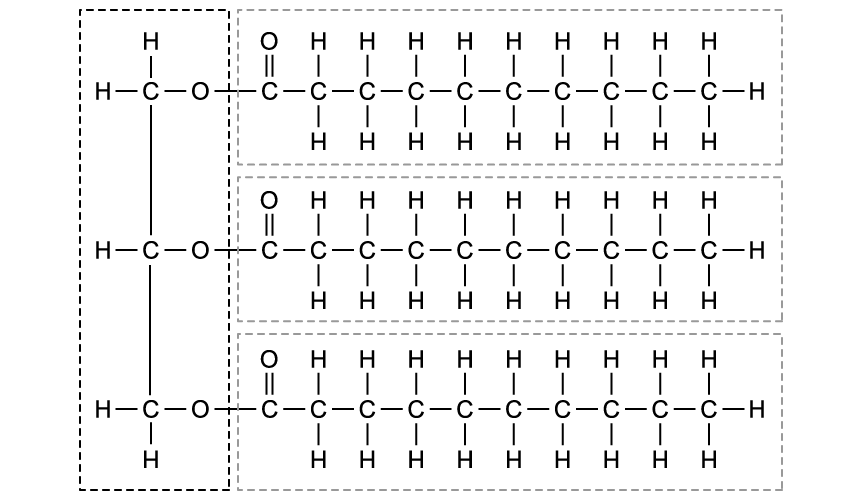
Fig. 1
Lipids cannot cross the cell-surface membranes of cells lining the gut during the absorption of nutrients.
Suggest why it cannot cross cell-surface membranes.