Half-Life (Cambridge International A-Level Physics)
Half-Life Definition
- Half-life is defined as:
The time taken for the initial number of nuclei to reduce by half
- This means that when a time equal to the half-life has passed, the activity of the sample will also halve
- This is because the activity is proportional to the number of undecayed nuclei, A ∝ N
Determining half-life from a graph
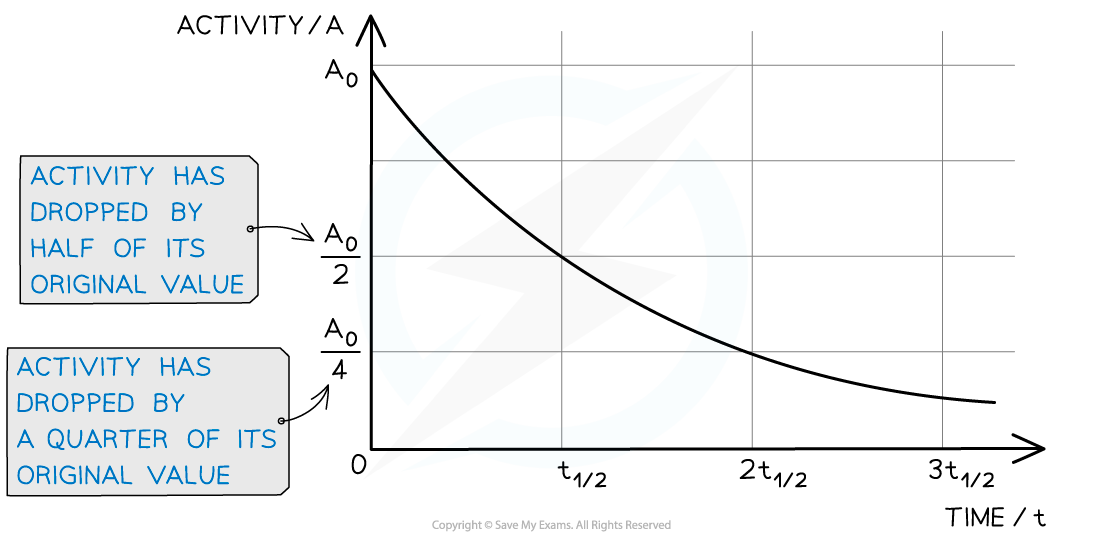
When a time equal to the half-life passes, the activity falls by half, when two half-lives pass, the activity falls by another half (which is a quarter of the initial value)
Calculating Half-Life
- The half-life of a radioactive sample can be calculated using the equation:
-
Where:
- t½ = half-life of the sample (s)
- λ = decay constant of the sample (s-1)
-
This equation shows that:
- the half-life and the decay constant of a sample are inversely proportional
- the shorter the half-life, the larger the decay constant and the faster the rate of decay
Derivation of the half-life equation
- To find an expression for half-life, start with the equation for exponential decay:
N = N0e–λt
-
Where:
- N = number of nuclei remaining in a sample
- N0 = the initial number of undecayed nuclei (when t = 0)
- λ = decay constant (s-1)
- t = time interval (s)
-
When time t is equal to the half-life t½, the activity N of the sample will be half of its original value, so N = ½ N0
- First, divide both sides by N0:
- Then, take the natural log of both sides:
- Finally, apply the properties of logarithms:
- Therefore, half-life t½ can be calculated using the equation:
Worked Example Strontium-90 is a radioactive isotope with a half-life of 28.0 years. A sample of strontium-90 has an activity of 6.4 × 10⁹ Bq.
Calculate the decay constant λ, in s–1, of strontium-90.
Answer:
Step 1: Convert the half-life into seconds
28 years = 28 × 365 × 24 × 60 × 60 = 8.83 × 10⁸ s
Step 2: Write the equation for half-life
Step 3: Rearrange for λ and calculate
Was this revision note helpful?
Build on this topic