Magnetic Flux Density (Cambridge International A-Level Physics)
Force on a Current-Carrying Conductor
-
A current-carrying conductor produces its own magnetic field
- When interacting with an external magnetic field, it will experience a force
-
The force due to a magnetic field can be observed by
- placing a copper rod in a uniform magnetic field
- connecting the copper rod to a circuit
-
When current is passed through the copper rod, it experiences a force
- This causes it to accelerate in the direction of the force
Observing the force on a current-carrying conductor
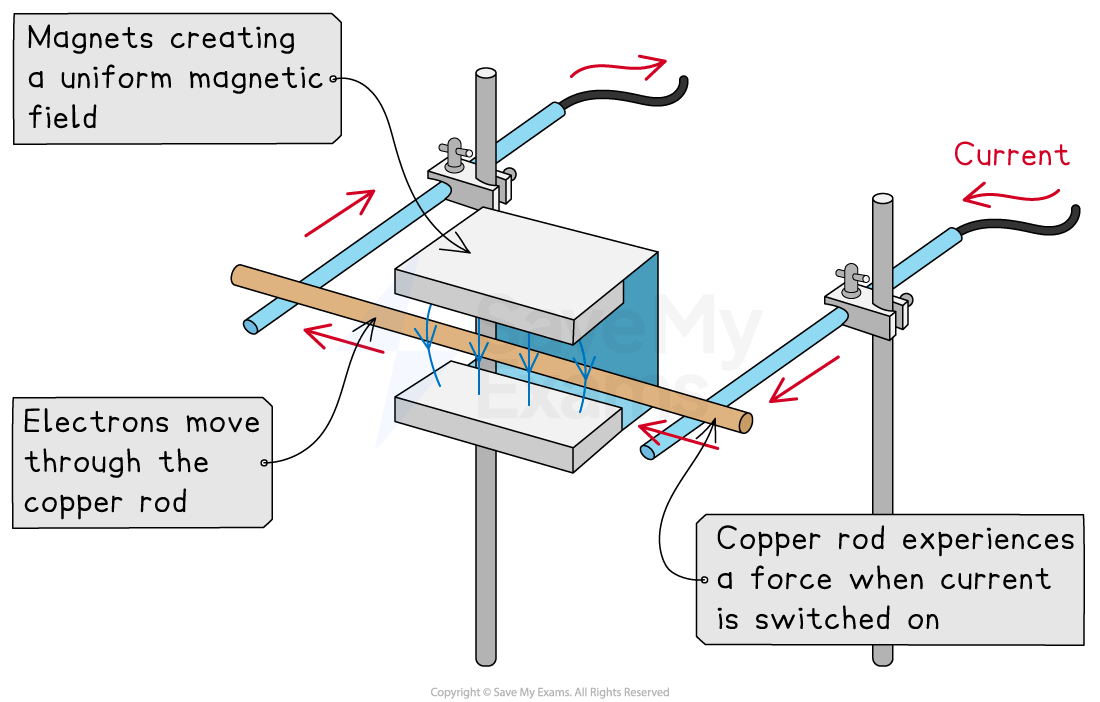
A copper rod moves within a magnetic field when current is passed through it
Magnetic Flux Density Definition
-
The strength of a magnetic field can be described by the density of its field lines
- The higher the flux density, the stronger the magnetic field i.e. regions where field lines are closer together
- The lower the flux density, the weaker the magnetic field i.e. regions where field lines are further apart
-
This is described by the magnetic flux density B of a field, which is defined as: The force exerted per unit current per unit length on a straight current-carrying conductor placed perpendicular to the magnetic field
-
Magnetic flux density is measured in teslas(T)
-
One tesla, 1 T, is defined as: The flux density that causes a force of 1 N on a 1 m wire carrying a current of 1 A at right angles to the field
-
To put this into perspective, the Earth's magnetic flux density is around 0.032 mT and an ordinary fridge magnet is around 5 mT
Was this revision note helpful?