Internal energy (Cambridge International A-Level Physics)
Defining Internal Energy
-
The internal energy U of a system is determined by the state of the system
- For a given mass of a substance at its melting or boiling point, the liquid has more internal energy than the solid, and the gas has more than the liquid
-
The molecules of all substances have both kinetic and potential energies
- Kinetic energy is due to the speed of the molecules
- Potential energy is due to the intermolecular forces between the molecules and varies with the separation of particles
-
The internal energy of a substance is defined as:
The sum of the random distribution of kinetic and potential energies within a system of molecules
Internal energy of water molecules
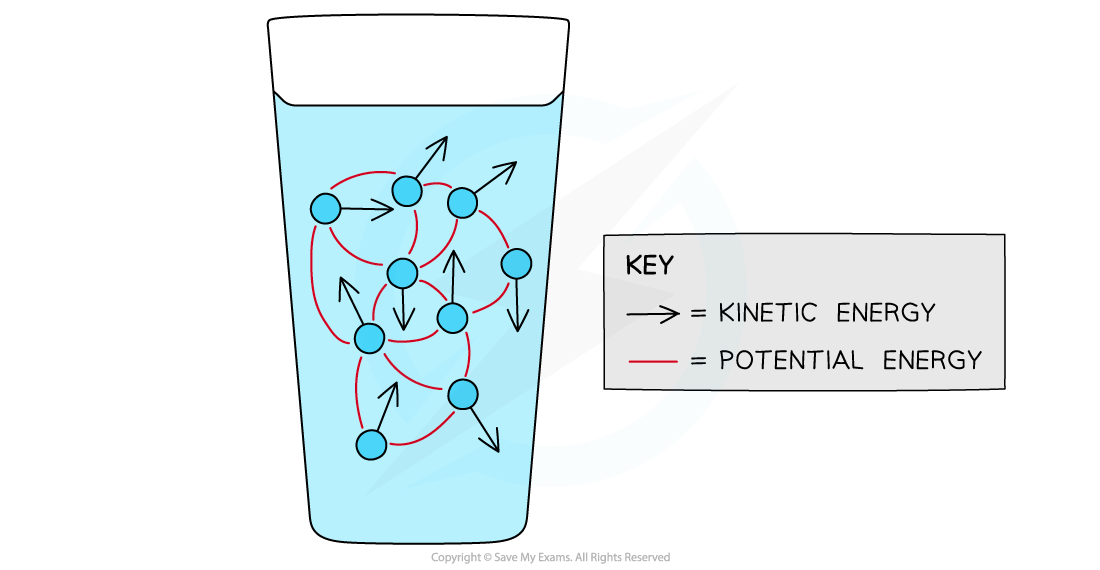
All molecules in a substance possess both kinetic and potential energies
-
The internal energy of a system can increase by:
- doing work on it
- adding thermal energy to it (heating it)
-
The internal energy of a system can decrease by:
- losing thermal energy to its surroundings
- it doing work on the surroundings (e.g. a gas pushing a piston)
Exam Hint When an exam question asks you to define “internal energy”, you can lose a mark for not mentioning the “random motion” of the particles or the “random distribution” of the energies, so make sure you include one of these in your definition!
Internal Energy & Temperature
-
The rise in temperature of an object is related to an increase in its internal energy
-
Molecules in solids and liquids are close together and bound by intermolecular forces, so they have kinetic and potential energy
- Molecules in solids and liquids are tightly packed, so they begin to vibrate more when heated
-
Molecules in a real gas also have intermolecular forces, so they have potential energy, as well as kinetic energy
- When a gas is heated, the molecules begin to move around faster, increasing their kinetic energy
- At a given temperature, the total potential energy of all of the molecules will remain constant
-
The change in internal energy of an ideal gas is proportional to the change in temperature, and can be written as:
ΔU ∝ ΔT
-
Where:
- ΔU = change in internal energy (J)
- ΔT = change in temperature (K)
-
Since an ideal gas has zero potential energy, its internal energy is directly proportional to its thermodynamic temperature, U ∝ T, where T is in kelvin
Molecular movement at low and high temperatures
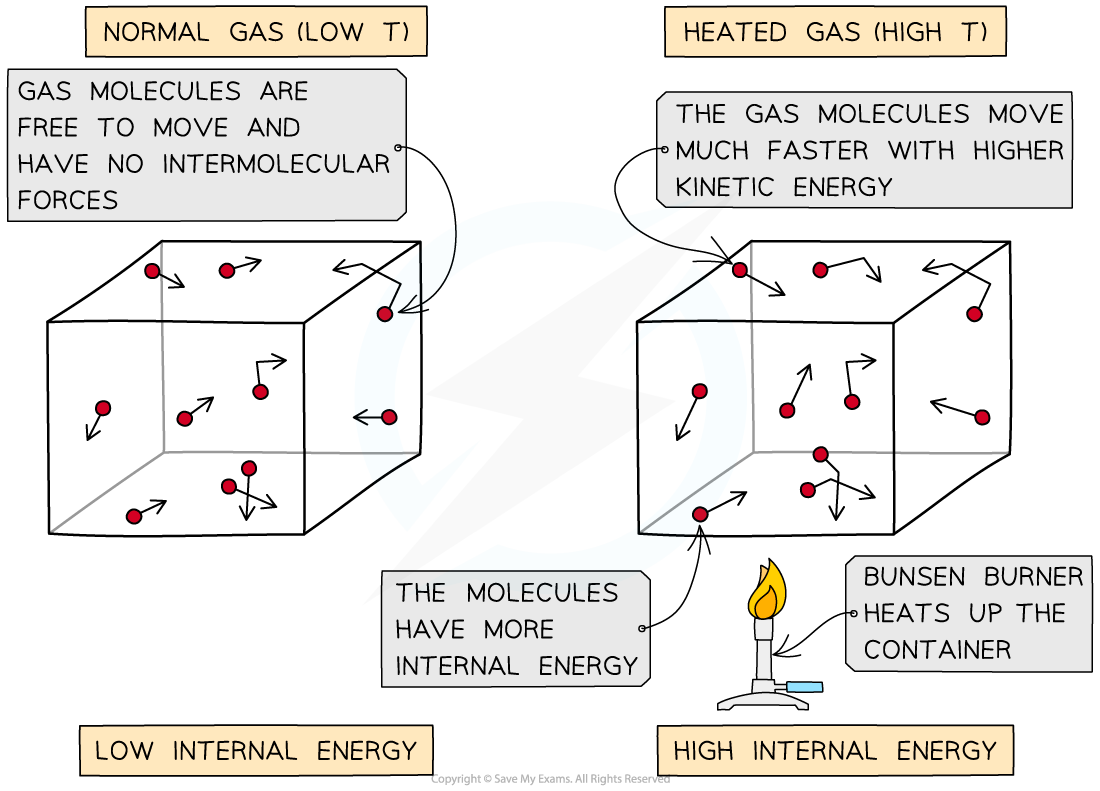
As the container is heated up, the gas molecules move faster with higher kinetic energy and therefore higher internal energy
Worked Example A student suggests that, when an ideal gas is heated from 50 °C to 150 °C, the internal energy of the gas is tripled.
Explain whether the student’s suggestion is correct.
Answer:
Step 1: Write down the relationship between internal energy and temperature
- The internal energy of an ideal gas is directly proportional to its temperature
U ∝ T
Step 2: Determine whether the thermodynamic temperature (in K) triples
- The temperature must be the thermodynamic temperature, in kelvin
- The Celsius temperature triples from 50 °C to 150 °C
- In kelvin, the temperatures are:
50 °C + 273.15 = 323.15 K
150 °C + 273.15 = 423.15 K
- Therefore, the thermodynamic temperature increases by a factor of 1.3, not three
Step 3: Write a concluding statement relating the temperature change to the internal energy
The internal energy is directly proportional to the temperature. The thermodynamic temperature has not tripled; therefore, neither has the internal energy. Therefore, the student is incorrect.
Exam Hint If an exam question about an ideal gas asks for the total internal energy, remember that this is equal to the total kinetic energy since an ideal gas has zero potential energy
Was this revision note helpful?
Build on this topic