Kinetic Energy (Cambridge International A-Level Physics)
Derivation of KE = 1/2mv2
Derivation of KE = 1/2mv2
-
Kinetic energy is energy an object has due to its motion (or velocity)
-
Resultant forces make objects accelerate as described by Newton's second law F = ma
-
Work is done by that force and energy is transferred to the object
-
Using this concept of work done and an equation of motion, the extra work done due to an object's speed can be derived
-
Consider a mass, m, at rest which accelerates to a velocity, v, over a displacement, s
-
The work done in accelerating the mass is:
- Newton's Second Law states that:
-
The suvat equation for velocity is:
- If the initial velocity is zero, u = 0
- And displacement, s
- Then:
- Rearranging to make a the subject:
- Substituting this expression for a into Newton's Second Law gives:
- Substituting this expression for F into the work done equation gives:
-
The mass is now able to do extra work due to its speed
- The amount of extra work is equal to
-
The mass now has:
Kinetic Energy
-
The faster an object is moving, the greater its kinetic energy
-
When an object is falling, it is gaining kinetic energy since it is gaining speed
-
This energy transferred from the gravitational potential energy it is losing
-
An object will maintain this kinetic energy unless its speed changes
-
The amount of kinetic energy an object has is determined by its mass and its speed:
-
Where:
- Ek = kinetic energy in joules (J)
- m = mass in kilograms (kg)
- v = velocity in metres per second (m s-1)
A car travelling forwards
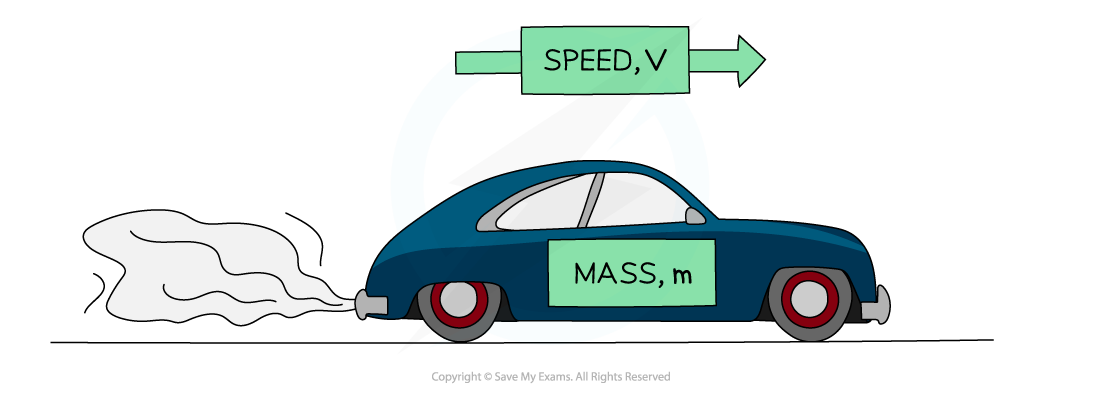
Kinetic energy is the energy an object has when it is moving, determined by its mass and its speed
Worked Example A body travelling with a speed of 12 m s-1 has kinetic energy 1650 J. The speed of the body is increased to 45 m s-1. Determine the body's new kinetic energy.
Answer:
Step 1: List the known quantities
- Initial speed, vi = 12 m s-1
- Initial kinetic energy, Ek i = 1650 J
- Final speed, vf = 45 m s-1
Step 2: State the kinetic energy equation
Step 3: Determine the object's mass
- The mass will not change
- Therefore, mass can be calculated from the initial kinetic energy
Step 4: Substitute the known values to calculate the final kinetic energy
Was this revision note helpful?
Build on this topic