Alpha-particle Scattering Experiment (Cambridge International A-Level Physics)
Alpha-particle scattering experiment
- Evidence for the structure of the atom was discovered by Ernest Rutherford in the beginning of the 20th century from the study of α-particle scattering
- The experimental setup consists of alpha particles fired at thin gold foil and a detector on the other side to detect how many particles deflected at different angles
Alpha particle scattering experiment
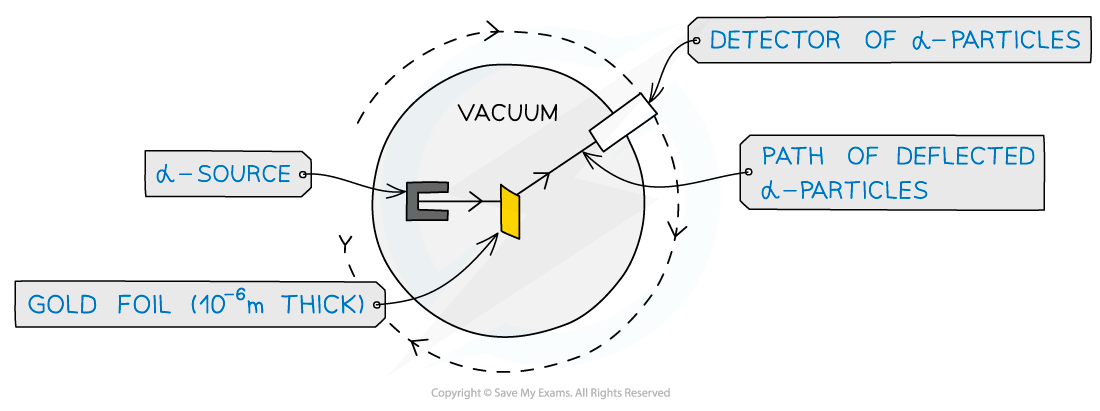
α-particles are fired at a thin gold foil and a detector records the deflection of the particles
- α-particles are the nucleus of a helium atom and are positively charged
Deflection patterns of the alpha particles
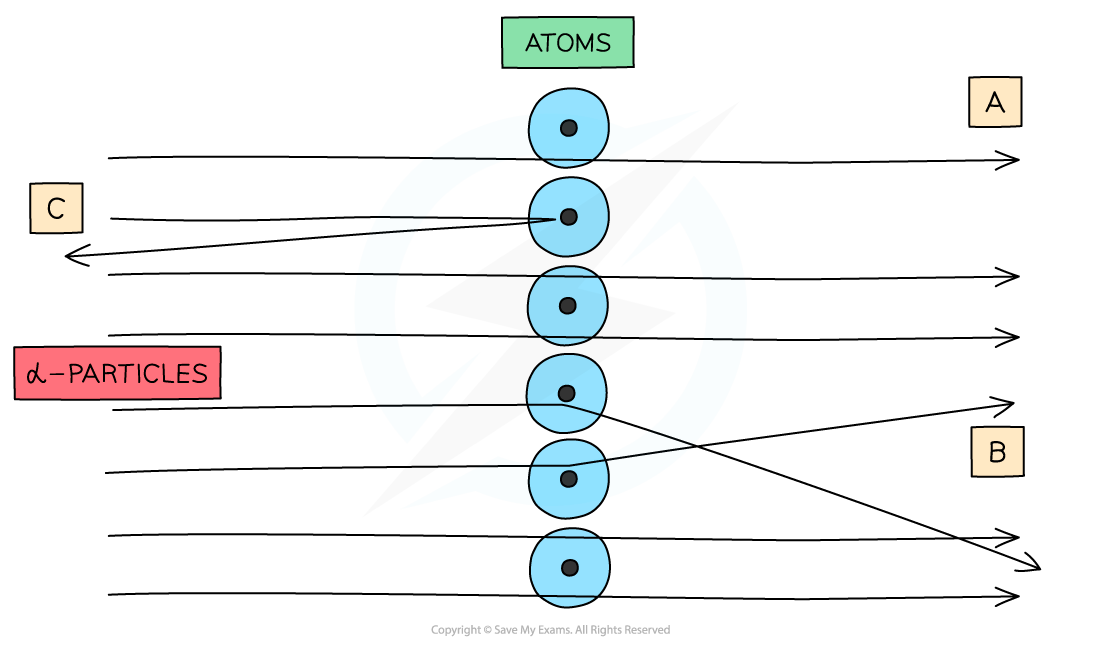
When α-particles are fired at thin gold foil, most of them go straight through but a small number bounce straight back
-
From this experiment, Rutherford results were:
-
The majority of α-particles went straight through
- This is shown by process A in the image above
- This suggested the atom is mainly empty space
-
Some α-particles deflected through small angles of < 10o
- This is shown by process B in the image above
- This suggested there is a positive nucleus at the centre (since two positive charges would repel)
-
Only a small number of α-particles deflected straight back at angles of > 90o
- This is shown by process C in the image above
- This suggested the nucleus is extremely small and this is where the mass and charge of the atom is concentrated
- It was therefore concluded that atoms consist of small dense positively charged nuclei, surrounded by negatively charged electrons
Structure of an atom as determined by the alpha particle experiment
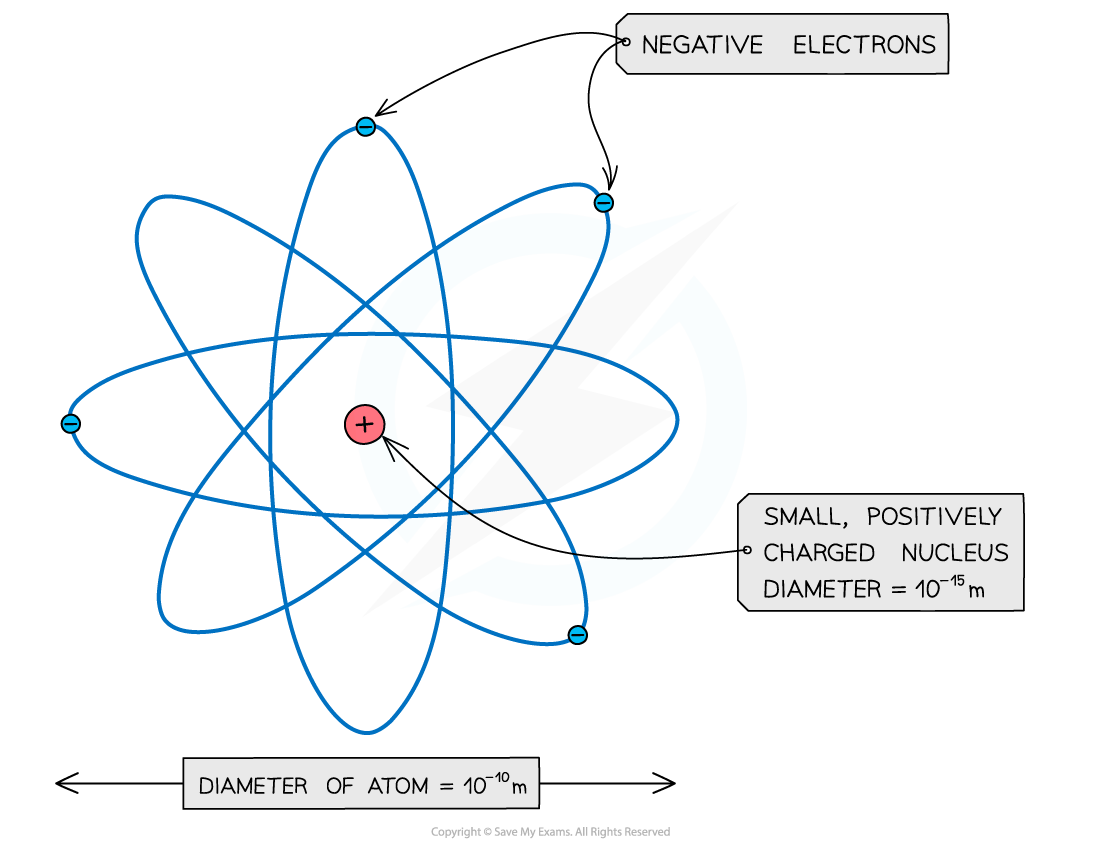
An atom: a small positive nucleus, surrounded by negative electrons
- (Note: The atom is around 100,000 times larger than the nucleus!)
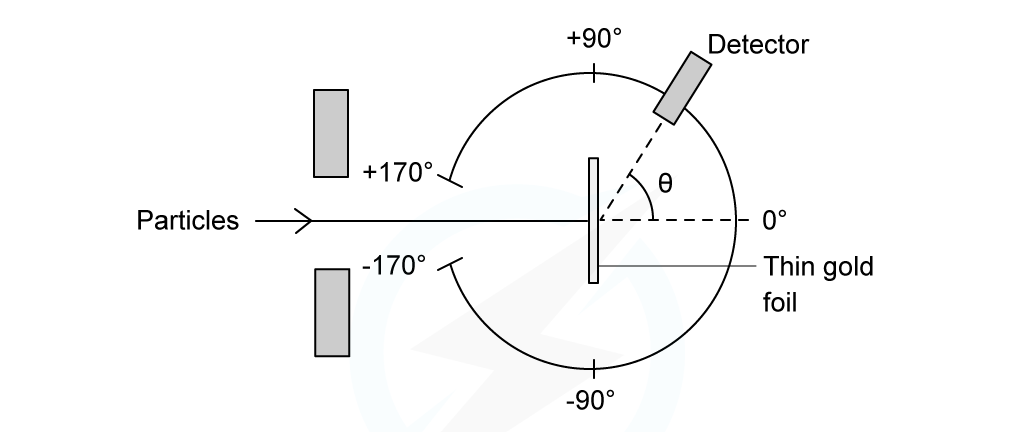
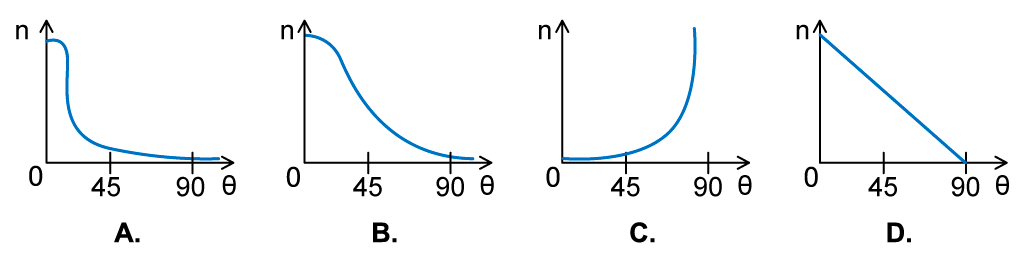
Worked Example In an α-particle scattering experiment, a student set up the apparatus below to determine the number n of α-particle incident per unit time on a detector held at various angles θ.
Which of the following graphs best represents the variation of n with θ from 0 to 90°?
Answer: A
The Rutherford scattering experience directed parallel beams of α-particles at gold foil
The observations were:
- Most of the α-particles went straight through the foil
- The largest value of n will therefore be at small angles
- Some of the α-particles were deflected through small angles
- n drops quickly with increasing angle of deflection θ
These observations fit with graph A
Was this revision note helpful?
Build on this topic