Fundamental Particles (Cambridge International A-Level Physics)
Fundamental Particles: Quarks
-
Quarks are fundamental particles that make up other subatomic particles such as protons and neutrons
-
Protons and neutrons are in a category of particles called hadrons
- Hadrons are defined as any particle made up of quarks
-
Fundamental means that the particles are not made up of any other particles
-
Quarks have never been observed on their own, they are either in pairs or groups of three
-
There are six flavours (types) of quarks that exist:
- up
- down
- charm
- strange
- top
- bottom
The six flavours of quarks
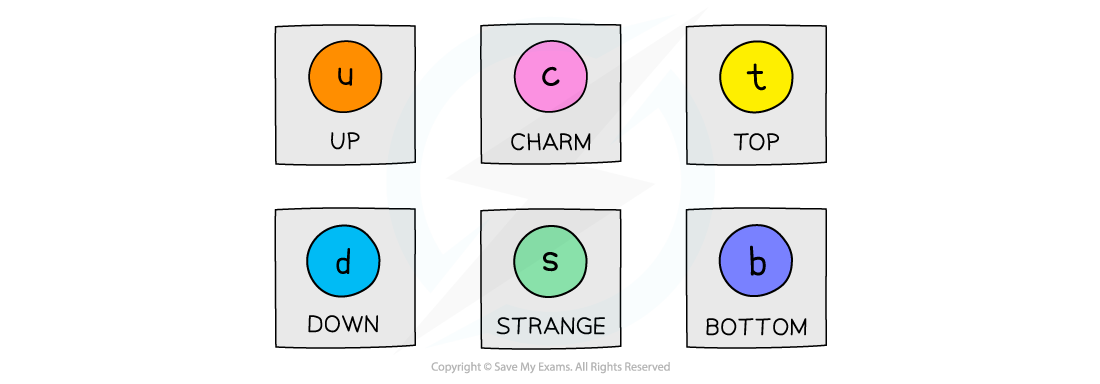
The six flavours of quarks are up, down, charm, strange, top and bottom
Fundamental Particles: Leptons
-
Leptons are also a group of fundamental (elementary) particles
-
This means they are not made up of any other particles (no quarks)
-
There are six leptons altogether:
- electron
- electron neutrino
- muon
- muon neutrino
- tau
- tau neutrino
The six leptons
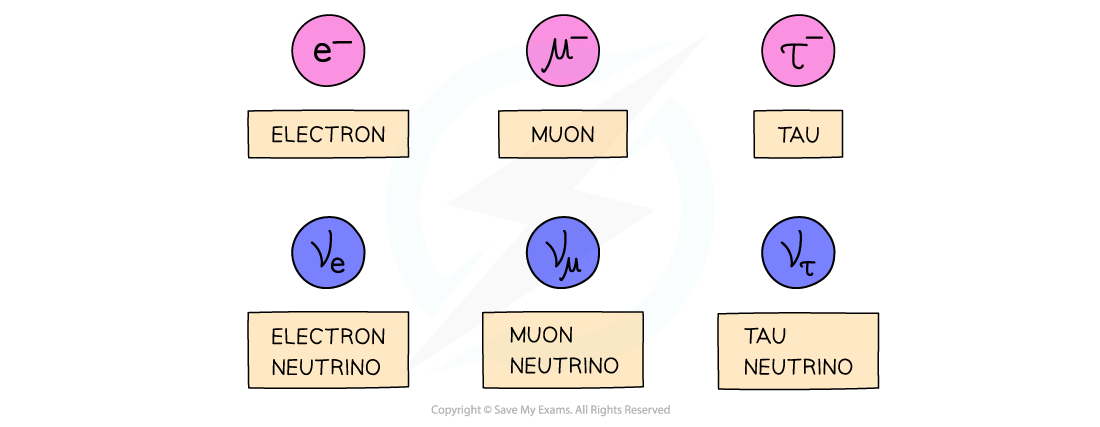
The six leptons are all fundamental particles
-
The muon and tau particle are very similar to the electron but with slightly larger mass
-
Electrons, muon and tau particles all have a charge of -1e
-
There are three flavours (types) of neutrinos (electron, muon, tau)
-
Neutrinos are the most abundant leptons in the universe
- They have no charge and negligible mass (almost 0)
-
Leptons interact with the weak interaction, electromagnetic and **gravitational **forces
-
However, they do** not** interact with the strong force
-
Although quarks are fundamental particles too, they are not classed as leptons
-
Leptons do not interact with the strong force, whilst quarks do
Worked Example State all the anti-leptons in the following decay equation.
Answer:
The pion (π+) is a meson (a type of hadron) and is made up of quarks
- Therefore it is not a fundamental particle and hence not a lepton
The anti-muon (μ+) is the anti-particle of the muon
- Therefore it is an anti-lepton
The muon neutrino is a lepton, not an anti-lepton
- The anti-lepton would be the anti-muon neutrino
Therefore, the only anti-lepton is an anti-muon (μ+)
Was this revision note helpful?
Build on this topic