Stefan-Boltzmann Law & Stellar Radii (Cambridge International A-Level Physics)
Stefan-Boltzmann Law
-
A star’s luminosity depends on its:
- surface temperature
- radius
-
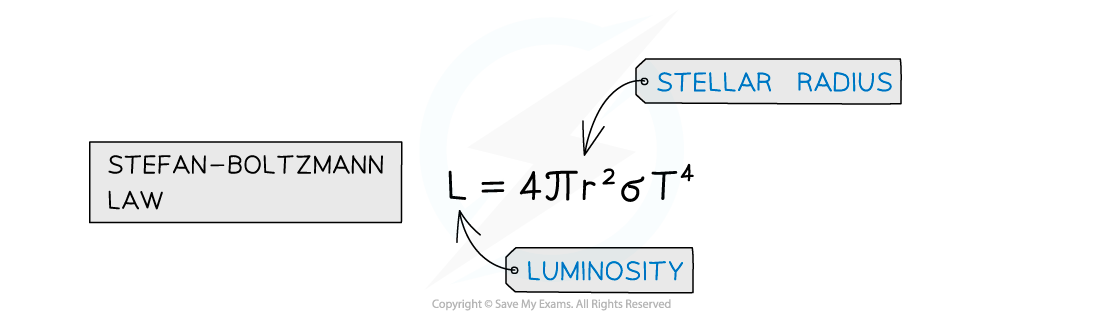
The relationship between these is known as the Stefan-Boltzmann law, which states: The total energy emitted by a black body per unit area per second is proportional to the fourth power of the absolute temperature of the body
-
It is equal to:
-
Where:
- L = luminosity of the star (W)
- r = radius of the star (m)
- σ = the Stefan-Boltzmann constant
- T = surface temperature of the star (K)
Estimating the Radius of Stars
-
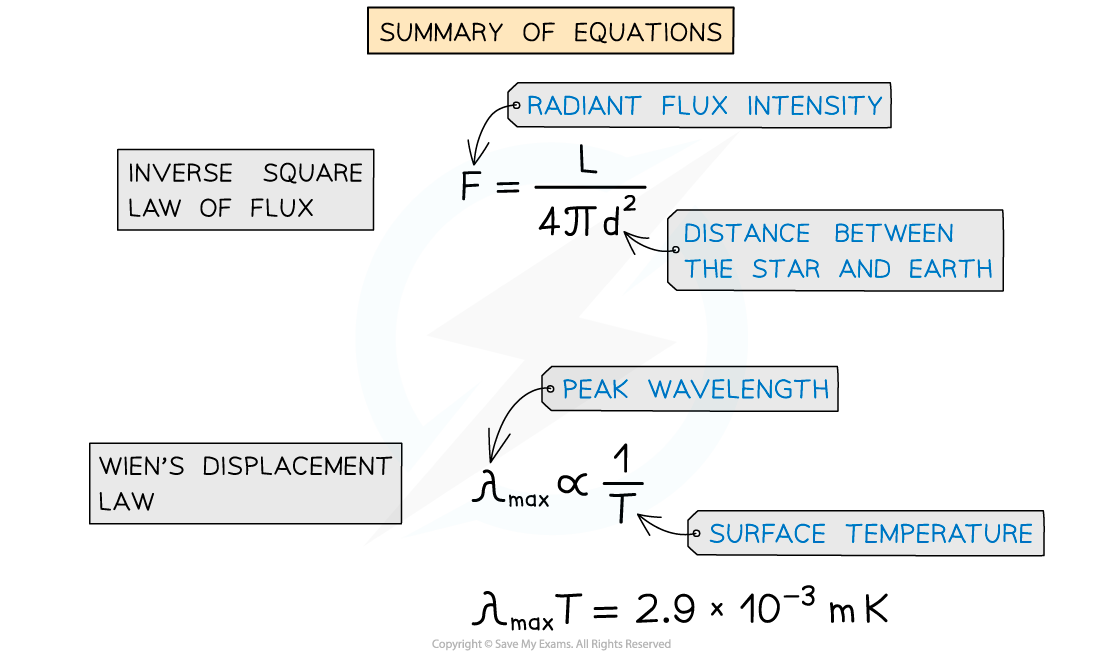
The radius of a star can be estimated by combining Wien’s displacement law and the Stefan–Boltzmann law
-
The procedure for this is as follows:
- Use Wien’s displacement law to find the surface temperature of the star
- Use the inverse square law of flux equation to find the luminosity of the star (if given the radiant flux and stellar distance)
- Then, use the Stefan-Boltzmann law to calculate the radius of the star
Worked Example Betelgeuse is our nearest red giant star.
It has a luminosity of 4.49 × 1031 W and emits radiation with a peak wavelength of 850 nm.
Calculate the ratio of the radius of Betelgeuse rB to the radius of the Sun rs.
Radius of the sun rs = 6.95 × 10⁸ m.
Answer:
Step 1: Write down Wien’s displacement law
Step 2: Rearrange Wien’s displacement law to find the surface temperature of Betelgeuse
Step 3: Write down the Stefan-Boltzmann law
Step 4: Rearrange for r and calculate the stellar radius of Betelgeuse
Step 5: Calculate the ratio
- Therefore, the radius of Betelgeuse is about 1000 times larger than the Sun’s radius
Was this revision note helpful?
Build on this topic