Hooke's Law (Cambridge International A-Level Physics)
Spec point —
6.1.3
Hooke's law
- A material demonstrating elastic behaviour obeys Hooke’s Law if its extension is directly proportional to the applied force (load)
- The Force-extension graph of an object obeying Hooke's law is a straight line through the origin
- This linear relationship is represented by the Hooke’s law equation
-
Where:
- F is force applied in N
- k is the spring constant in N m−1
- x is the extension of the spring
The Spring Constant
Spec point —
6.1.4
-
k is the spring constant of the spring and is a measure of the stiffness of a spring
- A stiffer spring will have a larger value of k
-
k is defined as the force per unit extension up to the limit of proportionality
-
The SI unit for the spring constant is N m-1
-
Rearranging the Hooke’s law equation shows the equation for the spring constant is
- Therefore, the spring constant k is the gradient of the linear part of a force-extension graph
Gradient of force-extension graph
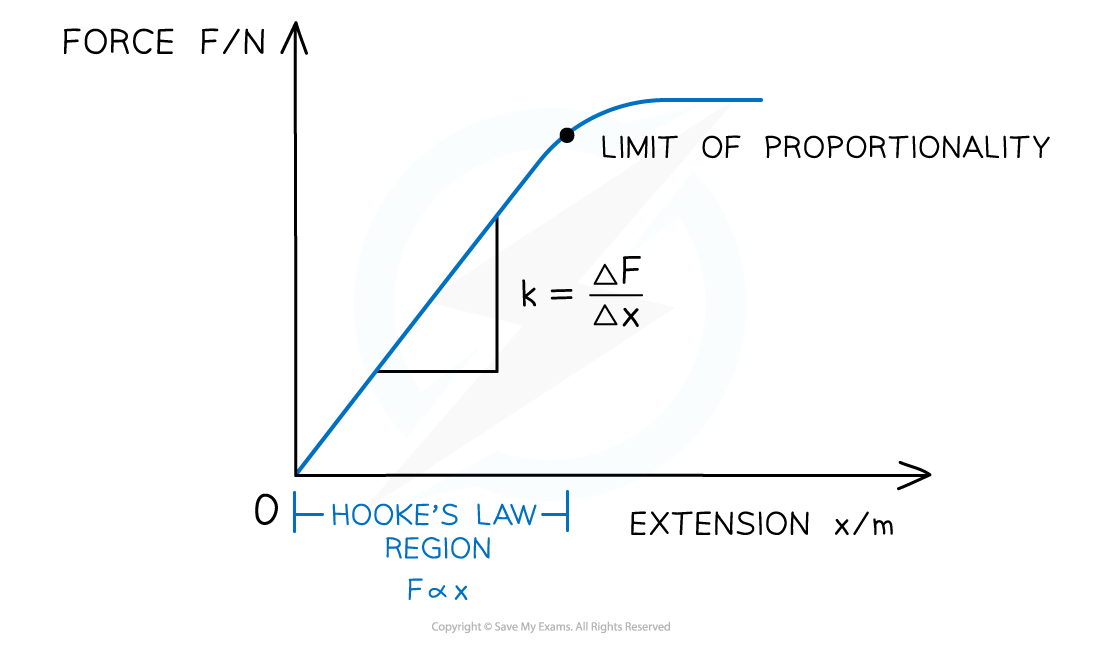
Spring constant is the gradient of a force vs extension graph
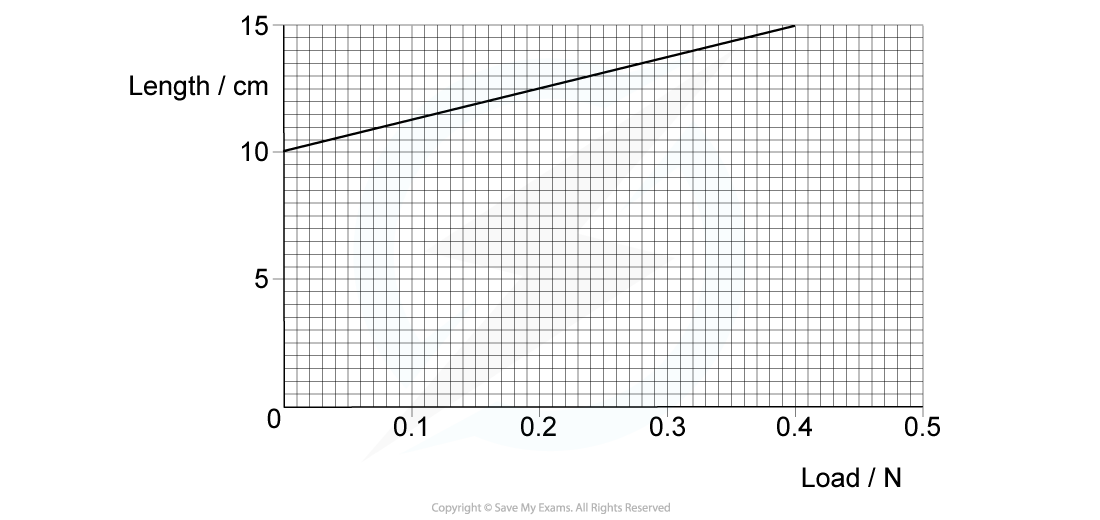
Worked Example A spring was stretched with increasing load.
The graph of the results is shown below.
Determine the value of the spring constant.
Answer:
Step 1: Rearrange Hooke's Law:
- Spring constant, k, is:
Step 2: Relate the gradient of this graph to k :
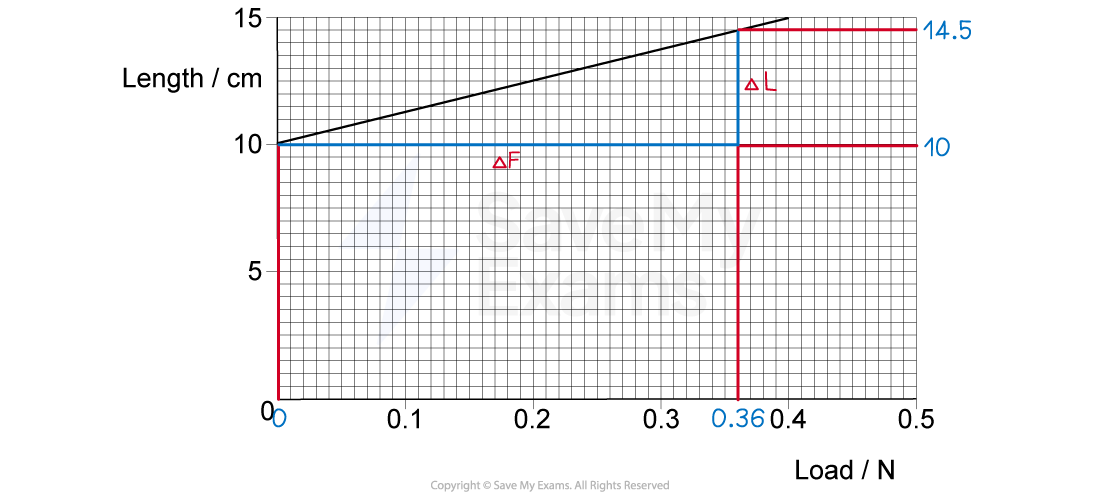
- The y axis of this graph is length L and the x axis is load F
- Gradient is change in y over change in x:
- The change in length is the extension x
- Therefore:
Step 3: Determine the gradient of the graph:
- Choose a large section of the graph line to determine the changes in the x and y axes
- Convert the extension from cm to m
Step 4: Calculate the spring constant:
- The spring constant is
Exam Hint Double check the axes before finding the spring constant as the gradient of a force-extension graph. Exam questions often swap the load onto the x-axis and length on the y-axis. In this case, the spring constant is and not the spring constant.
Was this revision note helpful?
Build on this topic