Drag Force & Air Resistance (Cambridge International A-Level Physics)
Drag Forces
Spec point —
3.2.1
-
Drag forces are forces acting in the opposite direction to an object moving through a fluid(either gas or liquid)
-
Examples of drag forces are fluid resistance (viscous drag) and air resistance
-
A key component of drag forces is that the magnitude of the drag force increases with the speed of the object
- As an object speeds up, the drag force increases
- As an object slows down, the drag force decreases
- This will be explored further in Terminal Velocity
-
Therefore, drag forces have the greatest effect at high speeds
-
Consider a car traveling forward on a straight road
-
When the car is accelerating:
- The driving force is greater than the frictional force
- The resultant force is acting in the same direction as the direction of motion
- Therefore, the car speeds up
-
When the car is traveling at a constant velocity:
- The driving force is equal to the frictional force
- There is no resultant force acting on the car
- Therefore, the motion of the car remains the same (continues traveling at a constant velocity)
-
When the car is decelerating:
- The driving force is less than the frictional force
- The resultant force is acting in the direction that opposes the motion of the car
- Therefore, the car slows down
Driving force and frictional force acting on a car at different accelerations
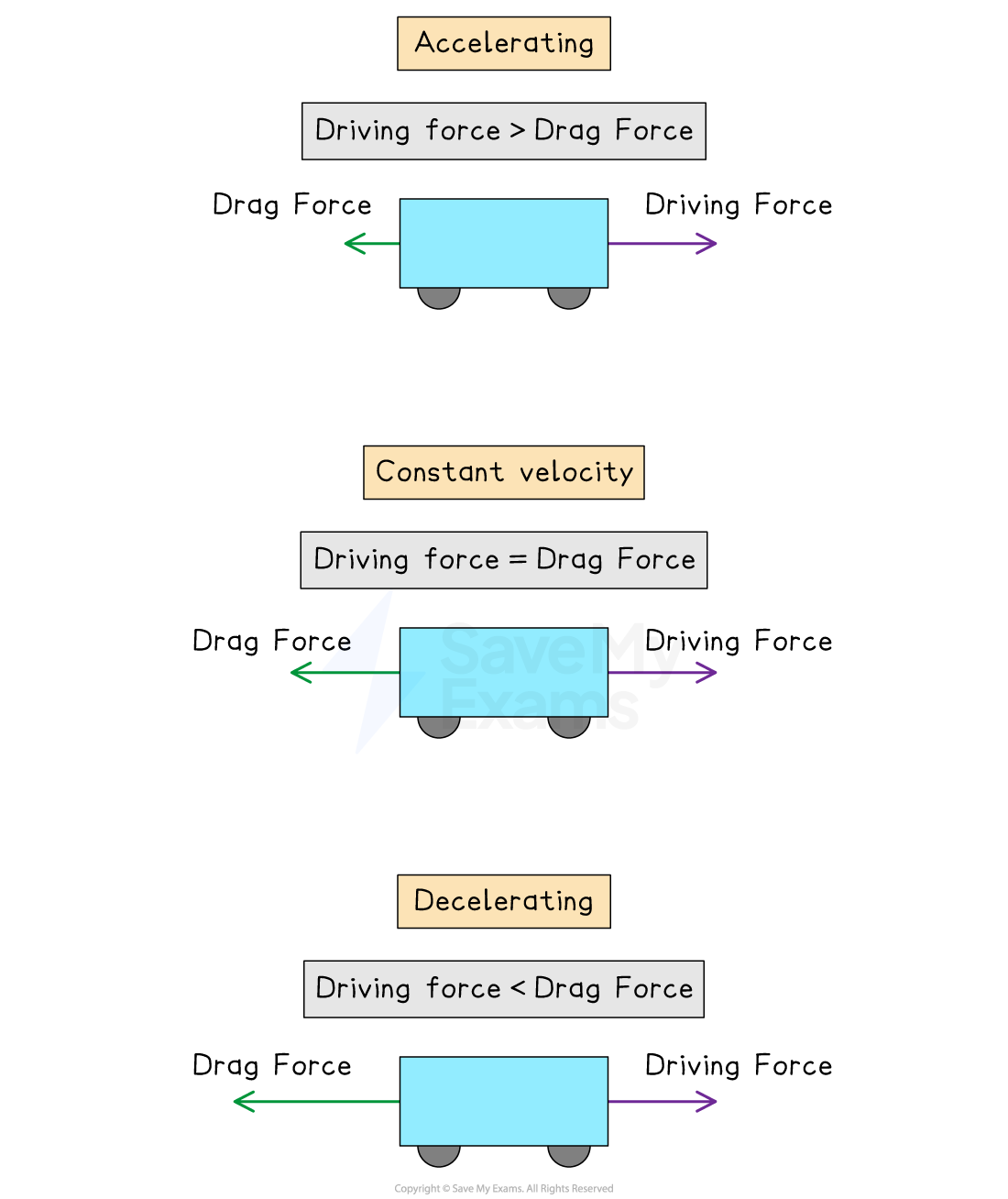
For the car to accelerate, the driving force must be larger than the frictional force; for the car to travel at a constant velocity, the driving force and frictional force must be balanced; for the car to decelerate, the driving force must be less than the frictional force
Worked Example A car of mass 800 kg has a horizontal forward driving force of 3 kN acting on it. The car accelerates at 2.0 m s-2.
Determine the magnitude of the frictional force acting on the car.
Answer:
Step 1: List the known quantities and convert to SI units
- Mass, m = 800 kg
- Driving force, FD = 3000 N
Step 2: Calculate the resultant force acting on the car using Newton's Second Law
Step 3: Equate the resultant force to the driving force and frictional force
Resultant force = driving force − frictional force
Step 4: Calculate the magnitude of the frictional force
Frictional force = driving force − resultant force

Exam Hint The key to answering this question correctly is remembering to consider drag forces in your calculation for the resultant force.
Air Resistance
- Air resistance is an example of a drag force
- Objects experience friction when moving through the air
- Air resistance depends on the shape of the object and the speed at which it is travelling
- Since drag force increases with speed, air resistance becomes important when objects move faster
Features of a Cyclist that Reduce Air Resistance
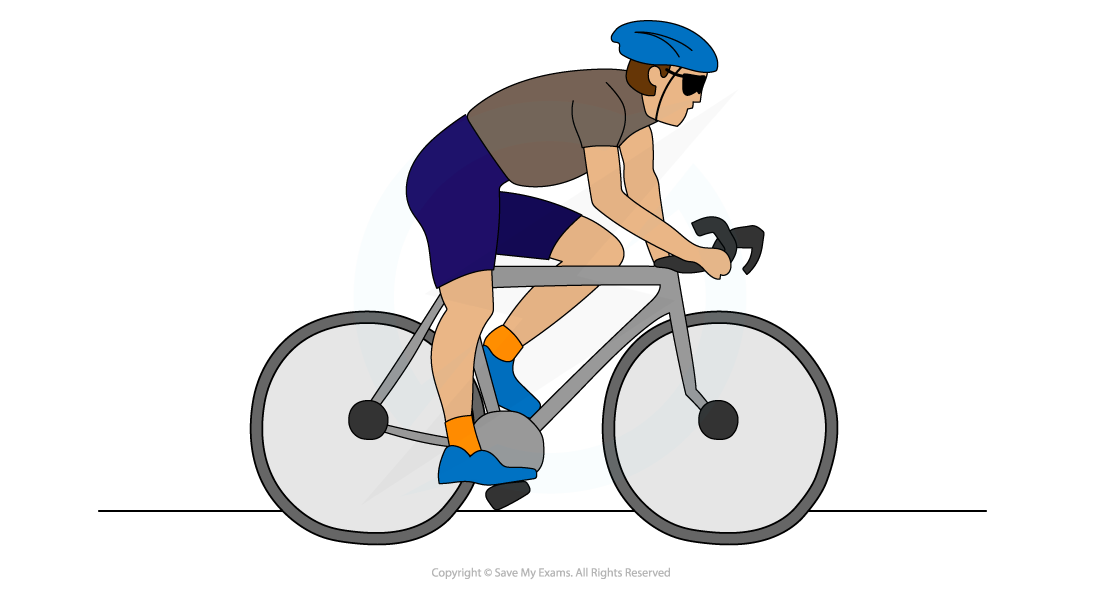
A racing cyclist adopts a more streamlined posture to reduce the effects of air resistance. The bicycle, clothing and helmet are designed to reduce air resistance to allow them to go as fast as possible
Falling objects with air resistance
-
When objects fall through a fluid, the fluid exerts a frictional force on the object as it falls
- Fluids are liquids or gases
-
Frictional forces oppose the motion of an object
- They act to slow it down
-
When an object falls through air, it experiences air resistance
-
Air resistance occurs as the object moving through the air collides with the air particles
-
Air resistance increases as the speed of the object increases
-
When objects fall through air, two forces are exerted on the object:
- The force of weight
- The force of air resistance
-
When the force of air resistance becomes equal to the force of weight, then the object stops accelerating and falls at a constant speed
- This constant speed is called terminal velocity
Exam Hint If a question considers air resistance to be ‘negligible’ this means in that question, air resistance is taken to be so small it will not make a difference to the motion of the body. You can take this to mean there are no drag forces acting on the body.
Was this revision note helpful?
Build on this topic