Hall Voltage (Cambridge International A-Level Physics)
Spec point —
20.3.3
Hall voltage
-
When an external magnetic field is applied perpendicular to the direction of current through a conductor, the electrons experience a magnetic force
-
As a result, the electrons drift to one side of the conductor, causing it to become more negatively charged
- This causes the opposite side to become more positively charged
-
As a result of the separation of charge, a potential difference is set up across the conductor
-
This is called the Hall voltage, which is defined as:
The potential difference produced across an electrical conductor when an external magnetic field is applied perpendicular to the current through the conductor
- It is described by the expression:
-
Where:
- = magnetic flux density (T)
- = charge of the electron (C)
- * *= current (A)
- = number density of electrons (m-3)
- = thickness of the conductor (m)
-
This equation shows that the smaller the electron density of a material, the greater the magnitude of the Hall voltage
- This is why a semiconducting material is often used for a Hall probe
-
Note: if the electrons were replaced by positive charge carriers, the direction of the Hall voltage would reverse
- This happens because positive charges experience a magnetic force in the opposite direction to that experienced by electrons (provided the direction of the current is unchanged)
Hall voltage
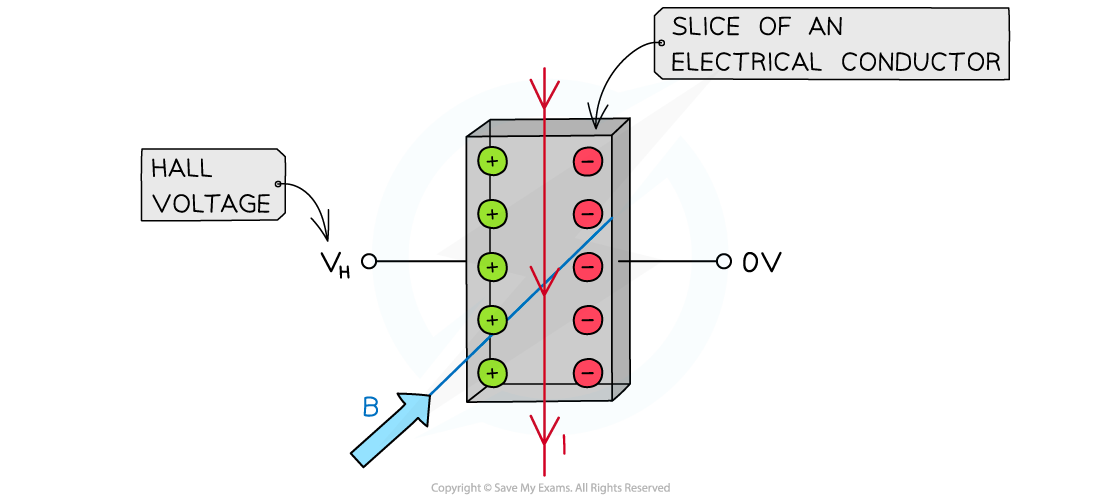
The positive and negative charges drift to opposite ends of the conductor, producing a Hall voltage when a magnetic field is applied
Derivation of the Hall voltage equation
-
An equation for the Hall voltage can be derived from the electric and magnetic forces on the charges
- The voltage arises from the electrons accumulating on one side of the conductor slice
- As a result of the charge separation, an electric field is set up between the two opposite sides of the conductor
-
The two sides can be treated as oppositely charged parallel plates, where the electric field strength is equal to:
-
Where:
- = Hall voltage (V)
- = width of the conductor slice (m)
-
The charge carriers have an average drift velocity within the conductor
-
The magnetic field is into the plane of the page, so the magnetic force on the electron acts to the right:
- This is equal to the electric force acting to the left:
- Substituting and cancelling the charge
- Recall that current is related to the drift velocity by the equation:
-
Where:
- = cross-sectional area of the conductor (m2)
- = number density of electrons (m-3)
-
Rearranging this for and substituting it into the equation gives:
- The cross-sectional area of the slice is equal to the product of the width * *and thickness :
- Substituting and rearranging for the Hall voltage leads to the equation:
Electric and magnetic forces creating a Hall voltage
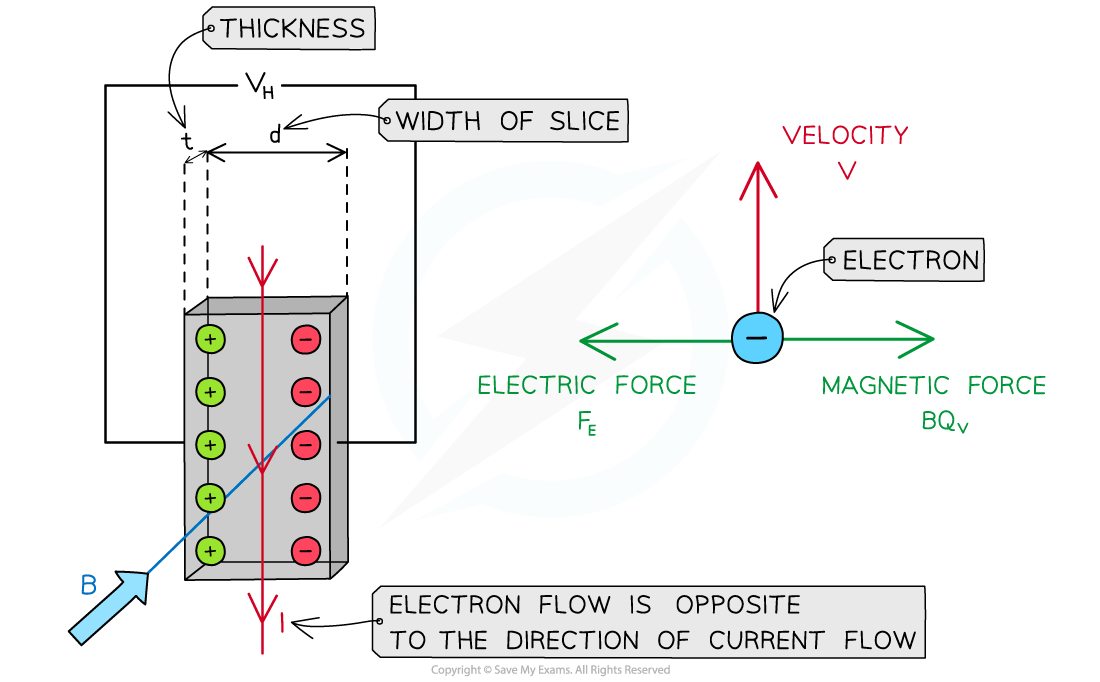
The electric and magnetic forces on the electrons are equal and opposite
Exam Hint Remember to use Fleming’s left-hand rule to obtain the direction the electrons move due to the magnetic force created by the magnetic field.
Was this revision note helpful?
Build on this topic