The Kelvin Scale (Cambridge International A-Level Physics)
Scale of Thermodynamic Temperature
Spec point —
14.2.2
-
Temperature is a scalar quantity measured in degrees Celsius (°C) or kelvin (K)
- Kelvin is the SI base unit for temperature
The Kelvin scale
-
The scale of thermodynamic temperature does not depend on the property of any particular substance
- The thermodynamic temperature scale is also known as the Kelvin scale
-
The thermodynamic scale is an absolute scale because it is not defined in terms of the properties of any particular substances
- This is unlike the degrees Celsius (oC) temperature scale which is based on the properties of water
The degrees Celsius scale
-
When the degrees Celsius (oC) temperature scale was created
- The freezing point of water was taken as 0 oC
- The boiling point was taken as 100 oC
-
The Celsius scale measures the temperature in a liquid-in-glass thermometer
- The expansion of the liquid is not always linear
Using the Kelvin Scale
- Temperatures in the Celsius scale, θ, and temperatures in the Kelvin scale, T, can be converted using the equation:
θ/ oC = T / K − 273.15
T / K = θ /oC + 273.15
Conversion chart for Kelvin and Celsius
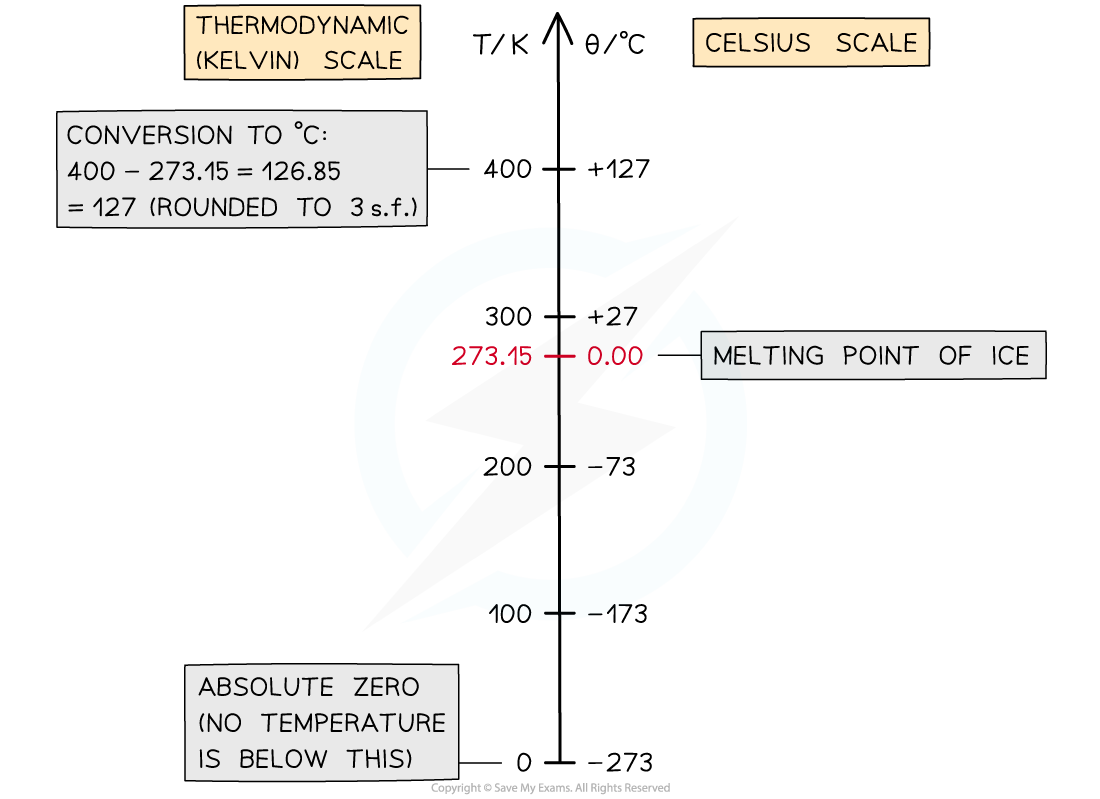
Conversion chart relating the temperature on the Kelvin and Celsius scales.
- The divisions on both scales are equal which means that:
A change in a temperature of 1 K is equal to a change in temperature of 1oC
Worked Example In many ideal gas problems, room temperature is considered to be 300 K.
What is this temperature in Celsius?
Answer
Step 1: Kelvin to Celsius equation
θ / oC = T / K − 273.15
Step 2: Substitute in value of 300 K
300 K − 273.15 = 26.85 oC
Exam Hint If you forget in the exam whether it’s +273.15 or −273.15, just remember that 0 oC = 273.15 K. This way, when you know that you need to +273.15 to a temperature in degrees to get a temperature in Kelvin. For example: 0 oC + 273.15 = 273.15 K.
Absolute Zero
Spec point —
14.2.4
-
The lowest possible temperature on the thermodynamic temperature scale, known as absolute zero, is zero Kelvin
- It is not possible to have a temperature lower than 0 K
- So a temperature in Kelvin will never be a negative value
-
Absolute zero corresponds to the temperature at which the average kinetic energy of the molecules is at its minimum
- It is not possible to remove any more energy from a system with a temperature of 0 K
- Even in space, the temperature is roughly 2.7 K, just above absolute zero
-
The absolute temperature of a body is directly proportional to the average kinetic energy of the molecules within the body
Temperature-kinetic energy graph
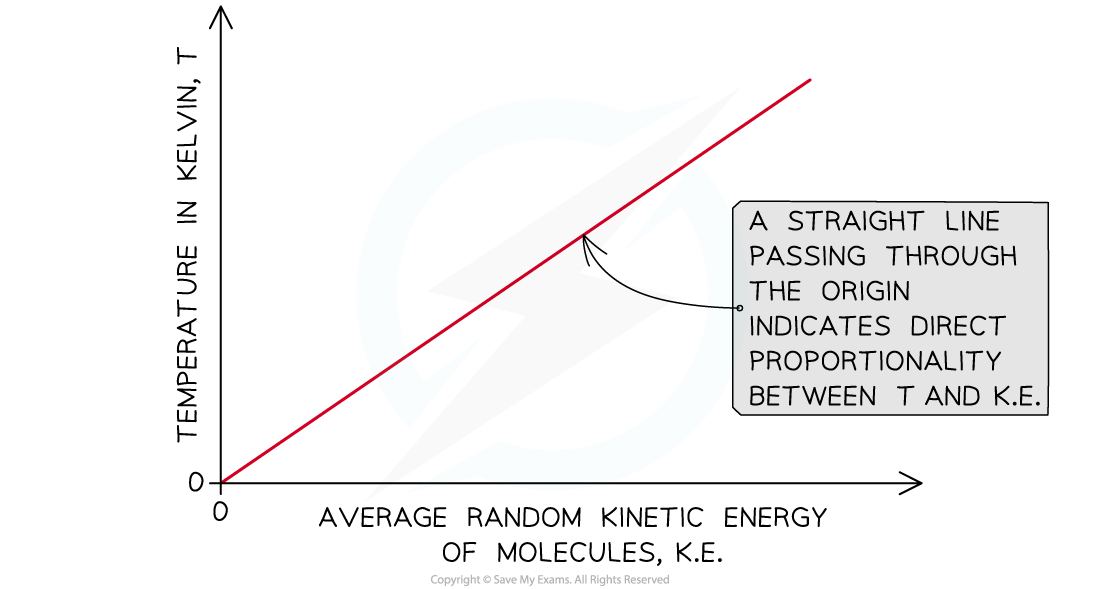
At absolute zero, the temperature is zero Kelvin and the kinetic energy of the molecules is zero
Was this revision note helpful?
Build on this topic