Specific Acoustic Impedance (Cambridge International A-Level Physics)
Spec point —
24.1.4
Specific acoustic impedance
- The acoustic impedance, Z, of a medium is defined as: The product of the speed of the ultrasound in the medium and the density of the medium
- This quantity describes how much resistance an ultrasound beam encounters as it passes through a tissue
- Acoustic impedance can be calculated using the equation:
-
Where:
- Z = acoustic impedance (kg m-2 s-1)
- ρ = the density of the material (kg m-3)
- c = the speed of sound in the material (m s-1)
-
This equation tells us:
- The higher the density of a tissue, the greater the acoustic impedance
- The faster the ultrasound travels through the material, the greater the acoustic impedance also
-
This is because sound travels faster in denser materials
- Sound is fastest in solids and slowest in gases
- This is because the closer the particles in the material, the faster the vibrations can move through the material
-
At the boundary between media of different acoustic impedances, some of the wave energy is reflected and some is transmitted
-
The greater the difference in acoustic impedance between the two media, the greater the reflection and the smaller the transmission
- Two materials with the same acoustic impedance would give no reflection
- Two materials with a large difference in values would give much larger reflections
-
Air has an acoustic impedance of Zair = 400 kg m-2 s-1
-
Skin has an acoustic impedance of Zskin = 1.7 × 10⁶ kg m-2 s-1
- The large difference means ultrasound would be significantly reflected, hence a coupling gel is necessary
- The coupling gel used has a similar Z value to the skin, meaning that very little ultrasound is reflected
Light travelling through two materials with different acoustic impedance
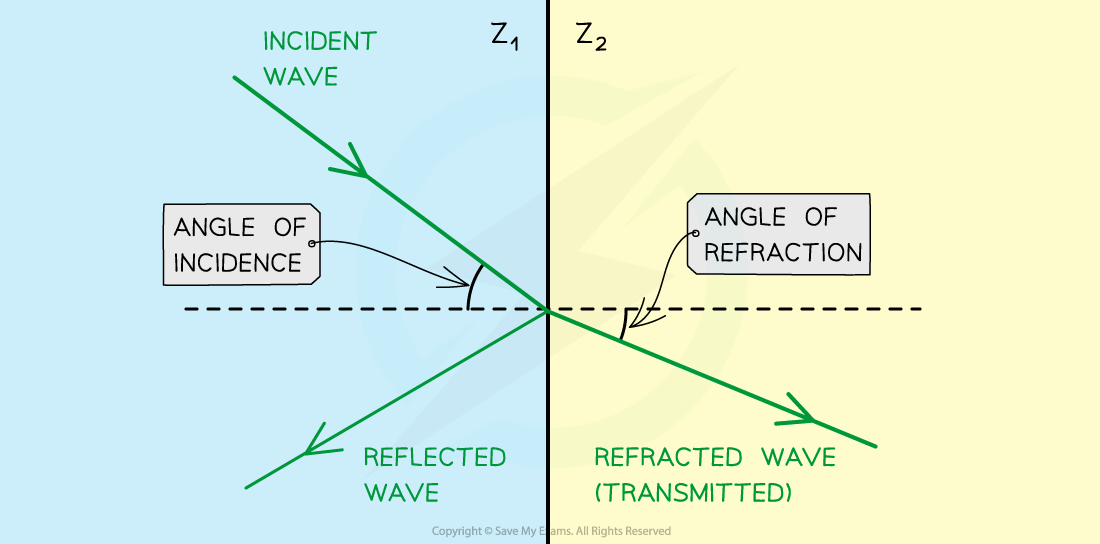
Refraction and reflection of ultrasound waves at a boundary between two materials with different acoustic impedances (in this case, Z1< Z2 )
Worked Example The table shows the speed of sound acoustic impedance in four different materials.
medium speed of ultrasound / m s–1 acoustic impedance / kg m–2s–1 air 330 4.3 × 10² gel 1500 1.5 × 10⁶ soft tisuse 1600 1.6 × 10⁶ bone 4100 7.0 × 10⁶ Use this information to calculate the value for the density of bone.
Answer:
Step 1: Write down known quantities
- Acoustic impedance of bone, Z = 7.0 × 10⁶ kg m-2 s-1
- Speed of ultrasound in bone, c = 4100 m s-1
Step 2: Write out the equation for acoustic impedance
Step 3: Rearrange for density and calculate
Exam Hint A common mistake is to confuse the c in the acoustic impedance equation for the speed of light - don’t do this!
Was this revision note helpful?