The Photoelectric Effect: Basics (Cambridge International A-Level Physics)
Exam board Cambridge International · A-LevelUpdated 2026-10-07
The photoelectric effect: basics
The photoelectric effect
-
The photoelectric effect is the phenomenon in which electrons are emitted from the surface of a metal upon the absorption of electromagnetic radiation
-
Electrons removed from a metal in this manner are known as photoelectrons
-
The emission of photoelectrons is known as photoelectric emission
-
The photoelectric effect provides important evidence that light is quantised
- Each photon has energy hf, and each electron can absorb only a single photon
- An electron is emitted only if hf is at least the work function , so there is a minimum (threshold) frequency , whatever the intensity
The photoelectric effect
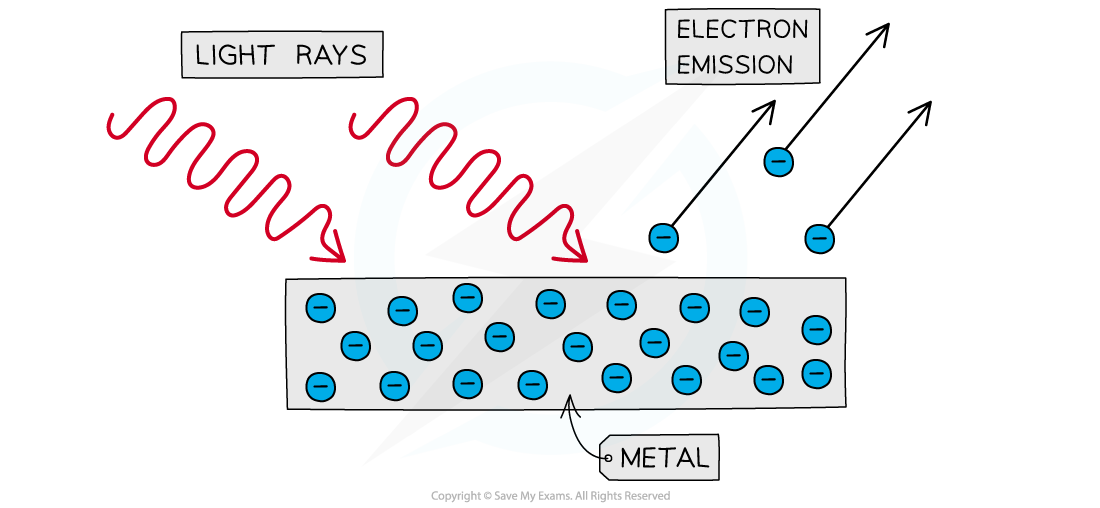
Photoelectrons are emitted from the surface of metal when light shines onto it
Exam Hint Make sure to brush up on common misconceptions:
- The electrons are already in the metal, they are not produced in any way by the incoming light rays
- Each electron can absorb only one photon
Was this revision note helpful?
Build on this topic