The Value of g on Earth (Cambridge International A-Level Physics)
The value of g on earth
-
Gravitational field strength g is approximately constant for relatively small changes in height near the Earth’s surface
- Close to the Earth's surface, within the Earth's atmosphere, g = 9.81 N kg−1
-
g can be approximated as constant because the Earth's radius, R is much larger than the distance between the Earth's surface and the position of an object in the Earth's atmosphere, h
-
Where small changes in height do not affect the total height of an object, h
- Consider an object orbiting at a height, h of 150 km (1.5 × 10⁵ m) above the Earth's surface
- The radius of the Earth, R is 6400 km = 6.4 × 10⁶ m
- So the total orbital radius, r is (6.4 × 10⁶) + (1.5 × 10⁵) = 6.55 × 10⁶ m
- Hence 6.4 × 10⁶ ≅ 6.55 × 10⁶
Diagram of orbital height
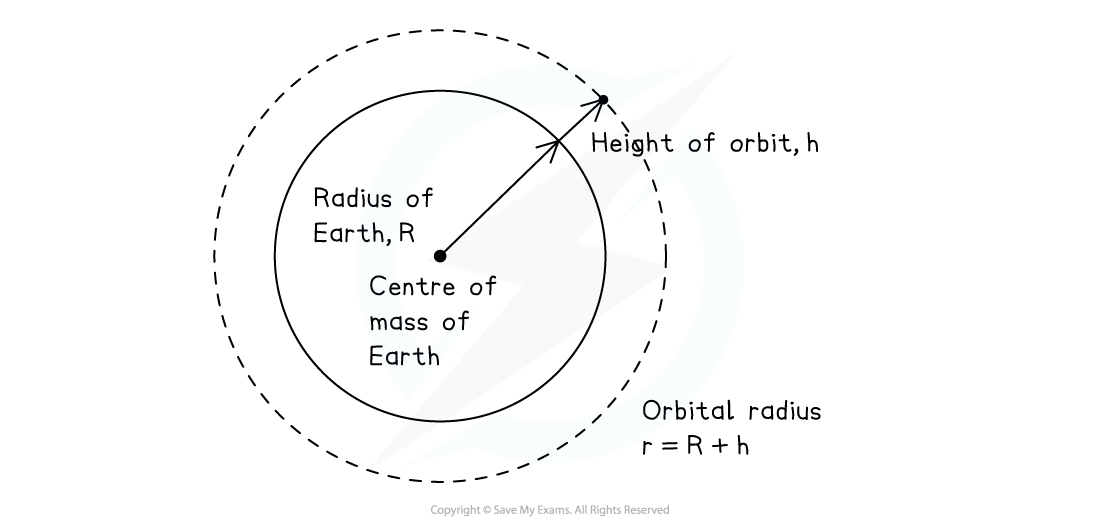
Orbital radius, r is roughly equal to the Earth's radius for an object within the Earth's atmosphere
- From the equation for Gravitational field strength due to a point mass:
- Gravitational field strength, g, and orbital radius, r, have an inverse square law relationship:
- Therefore, small changes in r result in small changes in g
Worked Example The highest point above the Earth's surface is at the peak of Mount Everest, a distance of 8850 m above the Earth's surface.
Show that the value of g at the top of Everest is about 0.3% less than the value of g at the Earth's surface.
Mass of the Earth = 5.97 × 1024 kg
Radius of the Earth = 6370 km
Answer:
Step 1: Gravitational field strength equation
Step 2: Determine the value of r
Step 3: Substitute the known values to calculate
- At the Earth's surface:
- At the height of Mt Everest:
Step 4: Calculate the percentage decrease
Was this revision note helpful?
Build on this topic