Principle of Moments (Cambridge International A-Level Physics)
The Principle of Moments
Spec point —
4.2.1
- The principle of moments states: For a system to be in equilibrium, the sum of clockwise moments about a point must be equal to the sum of the anticlockwise moments (about the same point)
Moments acting on a balanced beam
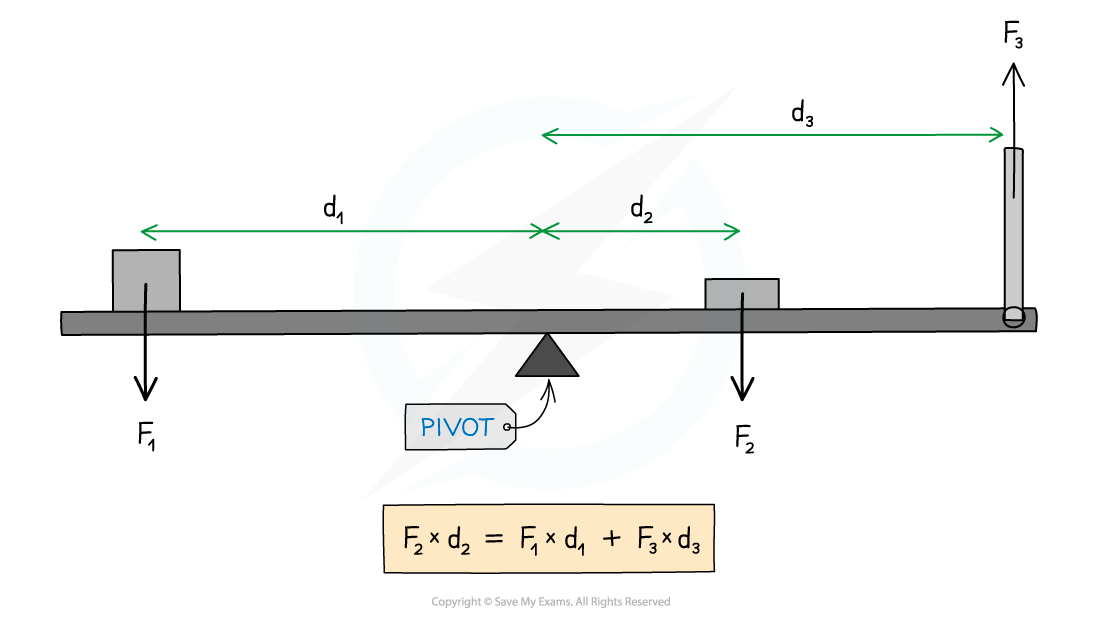
The sum of the anticlockwise moments of forces F1and F3are equal to the clockwise moment of force F2
-
In the above diagram:
- Force F2 is supplying a clockwise moment;
- Forces F1 and F3 are supplying anticlockwise moments
- The clockwise and anticlockwise moments are equal because the beam is in equilibrium
F_ 2d_ 2=(F_ 1d_ 1)+(F_ 3d_ 3)
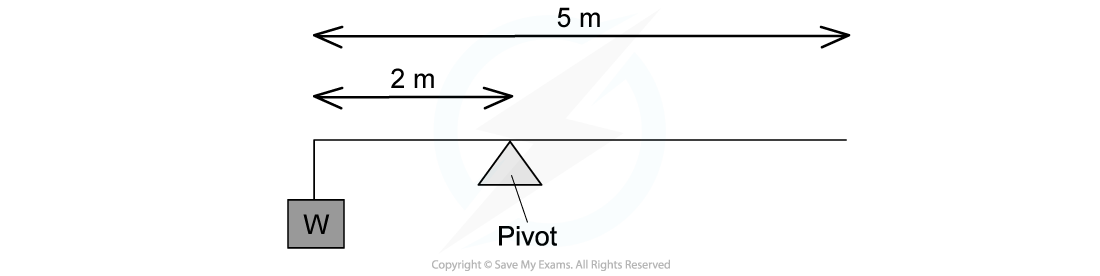
Worked Example A uniform beam of weight 40 N is 5 m long and is supported by a pivot situated 2 m from one end.
When a load of weight W is hung from that end, the beam is in equilibrium as shown in the diagram.
What is the value of W?
A. 10 N
B. 50 N
C. 25 N
D. 30 N
Answer:
Step 1: List the known quantities
- Weight acting on beam, WB = 40 N
- Weight acting on mass = W
- Length of beam = 5 m
- Distance to pivot (from end of beam), dW = 2 m
Step 2: Recall the principle of moments
clockwise moments = anticlockwise moments
Step 3: Calculate the clockwise moment
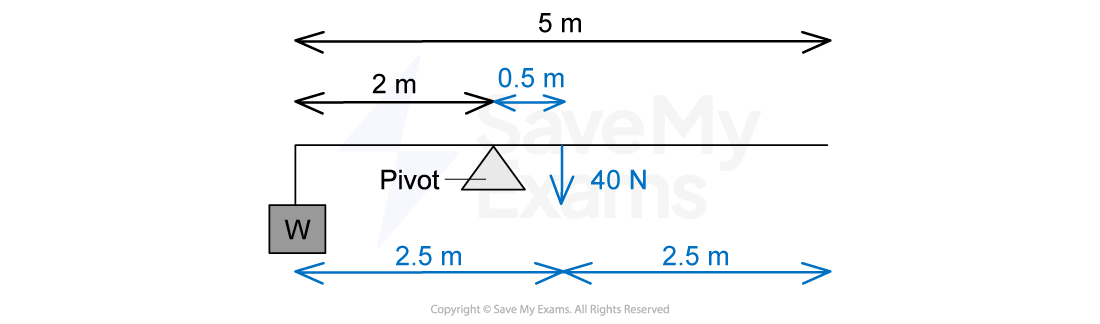
- Because the beam is uniform, the force of weight acting upon it will be exerted from its centre of gravity
- This will be the middle of the beam
(from the end of the beam)
- The pivot is 2 m from the end of the beam
- Therefore, the force acts at a distance of 2.5 − 2 = 0.5 m from the pivot
Step 4: Calculate the anticlockwise moment
Step 5: Equate the clockwise and anticlockwise moments to calculate
- Therefore, the answer is A
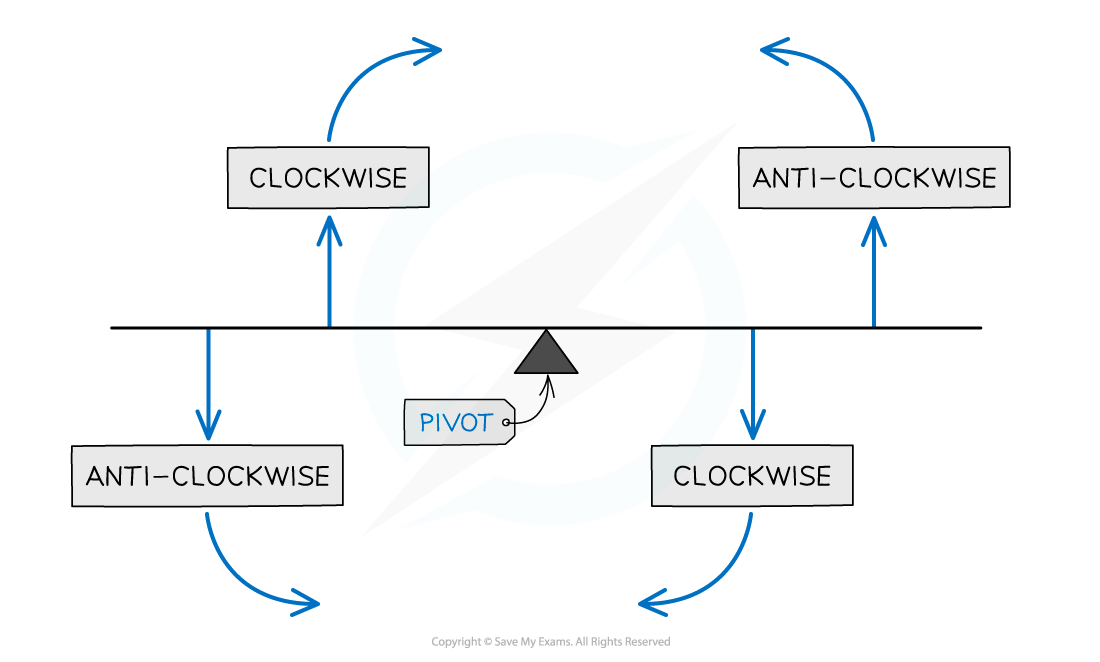
Exam Hint Make sure that all the distances are in the same units and you’re considering the correct forces as clockwise or anticlockwise, as seen in the diagram below
Was this revision note helpful?
Build on this topic