Attenuation of Ultrasound in Matter (Cambridge International A-Level Physics)
Spec point —
24.1.6
Attenuation of ultrasound in matter
-
Attenuation of ultrasound is defined as: The reduction of energy due to the absorption of ultrasound as it travels through a material
-
The attenuation coefficient of the ultrasound is expressed in decibels per centimetre lost for every incremental increase in megahertz frequency
- Generally, 0.5 dB cm–1 is lost for every 1 MHz
-
The intensity I of the ultrasound decreases with distance x, according to the equation:
-
Where:
- I0 = the intensity of the incident beam (W m-2)
- I = the intensity of the reflected beam (W m-2)
- μ = the absorption coefficient (m-1)
- x = distance travelled through the material (m)
-
The absorption coefficient μ, will vary from material to material
-
Attenuation is not a major problem in ultrasound scanning as the scan relies on the reflection of the ultrasounds at the boundaries of materials
Intensity-depth graph showing attenuation
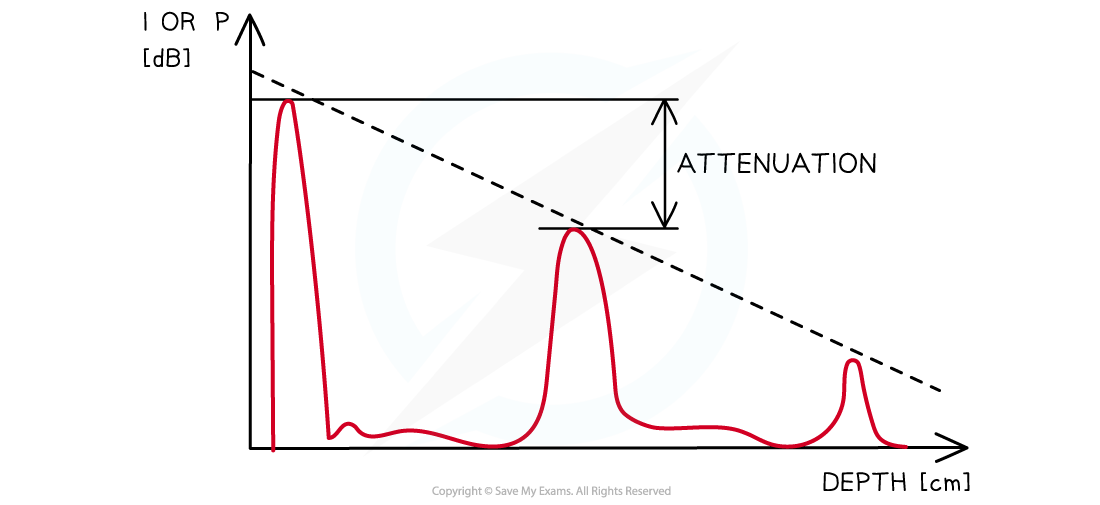
When the intensity is expressed in decibels, the amplitudes of the echoes can be seen to decrease linearly
Worked Example The thickness x of the layer of fat on an animal, as shown in the diagram, is to be investigated using ultrasound.
The intensity of the parallel ultrasound beam entering the surface S of the layer of fat is .
The beam is reflected from the boundary between fat and muscle.
The intensity of the reflected ultrasound detected at the surface S of the fat is .
Medium Z / kg m–2s–1 μ / m–1 Fat 1.3 × 10⁶ 48 Muscle 1.7 × 10⁶ 23 Using the information in the table, calculate:
(a) The intensity reflection coefficient at the boundary between the fat and the muscle.
(b) The thickness of the layer of fat.
Answer:
Part (a)
Step 1: Write down the equation for intensity reflection coefficient α
Step 2: Calculate the intensity reflection coefficient
- This means that 0.018 of the intensity is reflected at the interface between fat and muscle
- This reflected intensity will move back through the fat towards surface S
Part (b)
Step 1: Write out the known quantities
The intensity of the ultrasound pulse is affected 3 times:
- Attenuation from the surface S to the fat-muscle boundary
- Reflection at the boundary
- Attenuation from the boundary back to the surface S
After being transmitted in the fat, the intensity at surface S is given to be .
Therefore, the intensity is at the fat-muscle boundary, and as the ultrasound moves through the fat, it gets attenuated and the new intensity at the surface S is now
incident intensity = intensity of the reflected pulse
- Transmitted intensity =
- Absorption coefficient, = 48 m-1
- Thickness of fat =
Step 2: Write out the equation for attenuation
Step 3: Substitute in values for intensity and simplify
Step 4: Rearrange and take the natural log of both sides
Step 5: Rearrange and calculate the thickness x

Exam Hint The intensity equation will not be provided for you on your exam datasheet, so make sure you remember this!
Was this revision note helpful?