Gravitational Fields (Cambridge International A-Level Physics)
Defining Gravitational Field
-
There is a force of attraction between all masses
- This force is known as the ‘force due to gravity’ or the weight
-
The Earth’s gravitational field is responsible for the weight of all objects on Earth
-
A gravitational field is an example of a field of force and is defined as:
A region of space where a mass experiences a force
-
The direction of the gravitational field is always towards the centre of the mass
- Gravitational forces are always attractive, and never repulsive
Gravitational field strength
- The gravitational field strength at a point is defined as:
The force per unit mass acting on a small mass at that point
- The strength of a gravitational field at a point can be calculated using:
-
Where:
- g = gravitational field strength (N kg-1)
- Fg = force due to gravity, or weight (N)
- m = mass (kg)
-
This equation tells us:
- On planets with a large value of g, the gravitational force per unit mass is greater than on planets with a smaller value of g
- This means objects will have a larger weight with a larger value of g
Weight of a person on Earth and Jupiter
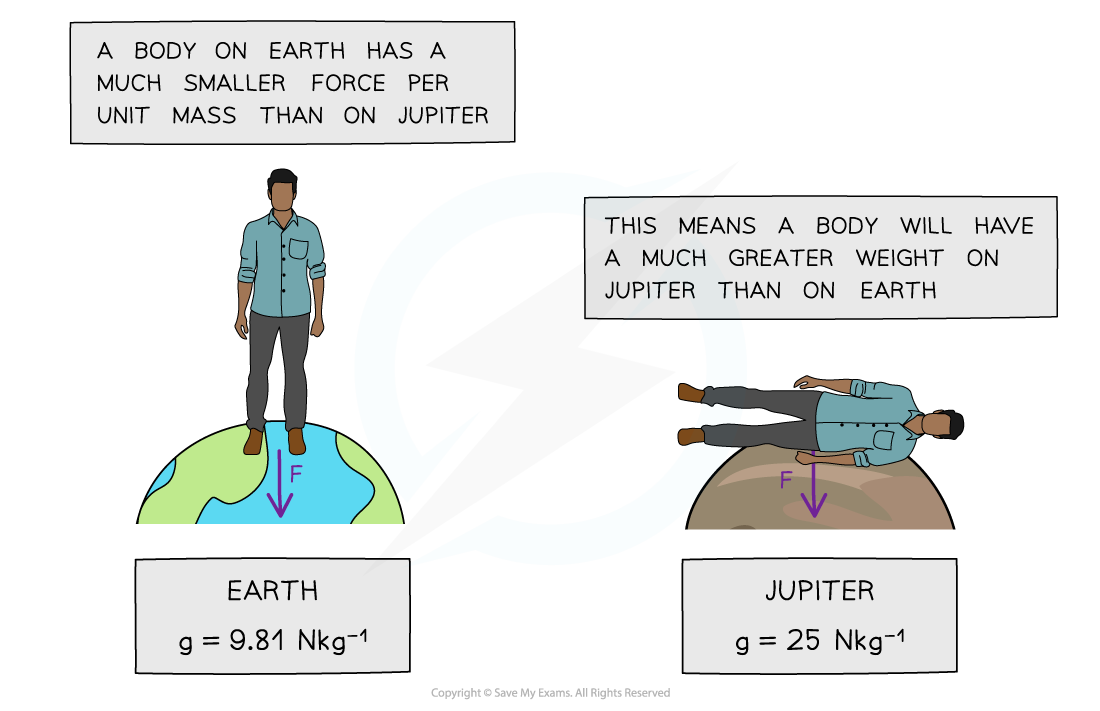
A person’s weight on Jupiter would be so large a human would be unable to fully stand up
Worked Example Calculate the mass of an object with a weight of 10 N on Earth.
Answer:
Step 1: State the gravitational field strength equation
Step 2: Rearrange to make mass the subject
Step 3: Substitute in the known values to calculate
Exam Hint There is a big difference between g and G (sometimes referred to as ‘little g’ and ‘big G’ respectively), g is the gravitational field strength and G is Newton’s gravitational constant. Make sure not to use these interchangeably!
Representing Gravitational Fields
-
The direction and magnitude of a gravitational field is represented by gravitational field lines
- Gravitational fields can be uniform or non-uniform
-
Radial fields are non-uniform fields
- The gravitational field strength g decreases with distance from the centre of the object
- The gravitational field lines around a point mass are directed radially inwards
-
Parallel field lines represent a uniform field
- The gravitational field strength g is the same throughout the field
- The gravitational field lines of a uniform field, where the field strength is the same at all points, is represented by equally spaced parallel lines
- The Earth's gravitational field near the surface is almost uniform; therefore, it can be approximated as uniform
Gravitational field lines for a point mass and for a uniform gravitational field
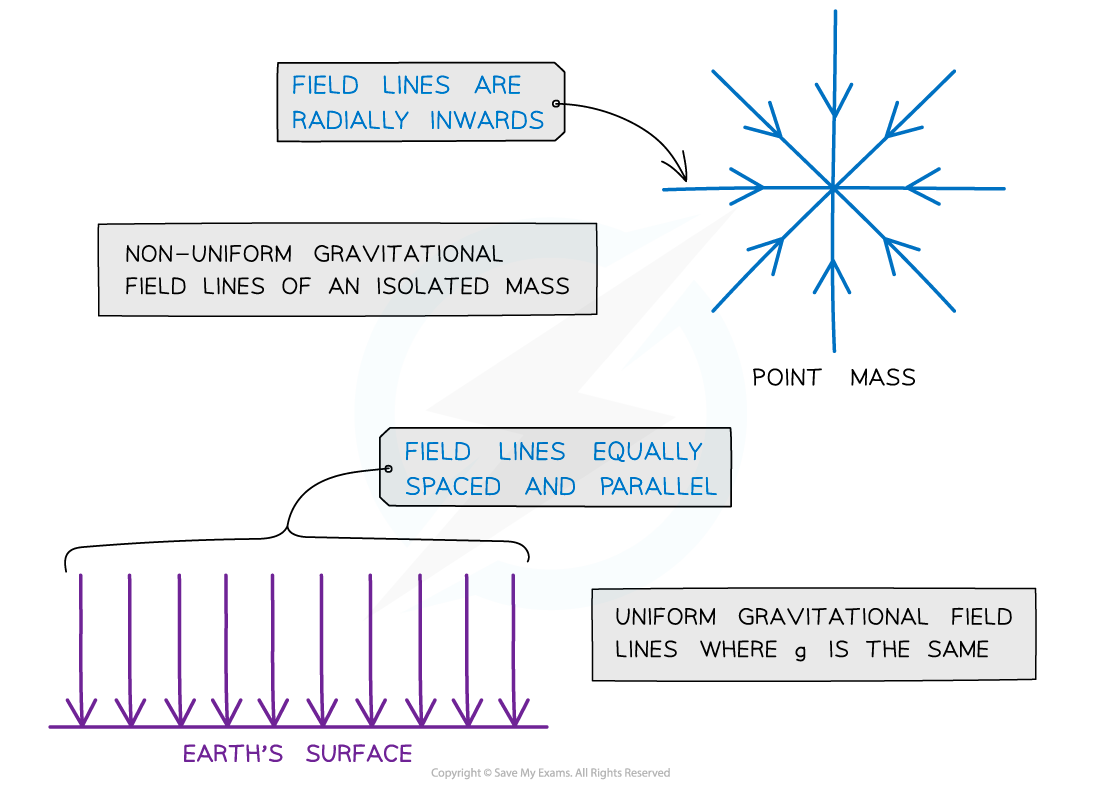
Gravitational field lines for a point mass are radial and, for a uniform gravitational field, are parallel
Exam Hint Always add the arrows on the field lines! Gravitational forces are attractive only. Remember:
- For a radial field: it is towards the centre of the sphere or point charge
- For a uniform field: towards the surface of the object e.g. Earth
Was this revision note helpful?
Build on this topic