Energy & Momentum of a Photon (Cambridge International A-Level Physics)
Calculating Photon Energy
- The energy of a photon can be calculated using the formula:
-
Where:
- E = energy of a photon (J)
- h = Planck's constant(J s)
- f = frequency (Hz)
Photon representation

A photon in a particle of light carrying discrete packets of energy
- Using the wave equation , energy can also be equal to:
-
Where:
- c = the speed of light (m s-1)
- λ = wavelength (m)
-
This equation tells us:
- The higher the frequency of EM radiation, the higher the energy of the photon
- The energy of a photon is inversely proportional to the wavelength
- Therefore, a long-wavelength photon of light has a lower energy than a shorter-wavelength photon
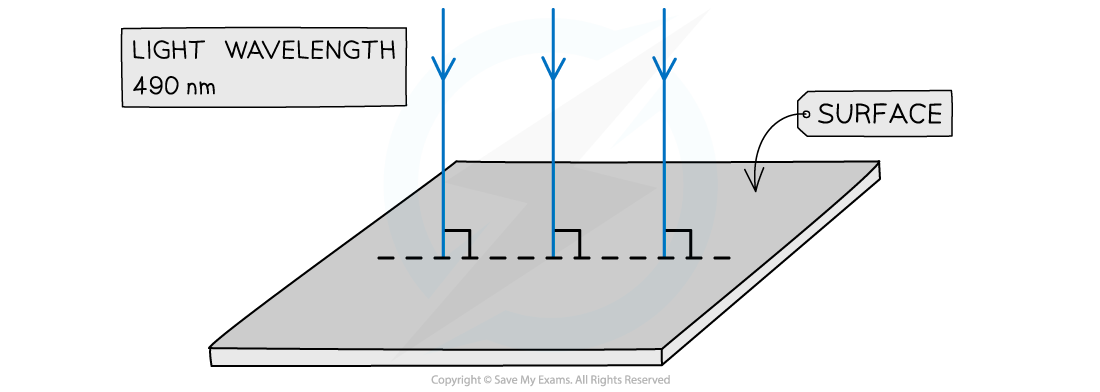
Worked Example Light of wavelength 490 nm is incident normally on a surface, as shown in the diagram.
The power of the light is 3.6 mW. The light is completely absorbed by the surface.
Calculate the number of photons incident on the surface in 2.0 s.
Answer
Step 1: Write down the known quantities
- Wavelength, λ = 490 nm = 490 × 10-9 m
- Power, P = 3.6 mW = 3.6 × 10⁻³ W
- Time, t = 2.0 s
Step 2: Write the equation for photon energy in terms of wavelength
Step 3: Calculate the energy of one photon
Step 4: Calculate the number of photons hitting the surface every second
Step 5: Calculate the number of photons that hit the surface in 2 s
Exam Hint The values of Planck’s constant and the speed of light are both given on your data sheet, however, it helps to memorise them to speed up calculation questions.
Remember this equation for E is only for the energy of a photon, not the energy for any other particle!
Photon Momentum
- Einstein showed that a photon travelling in a vacuum has momentum, despite it having no mass
- The momentum of a photon is related to its energy by the equation:
-
Where:
- p = momentum (kg m s–1)
- E = energy of a photon (J)
- c = speed of light
Worked Example A 5.0 mW laser beam is incident normally on a fixed metal plate. The cross-sectional area of the beam is 8.0 × 10⁻⁶ m2. The light from the laser has a frequency of 5.6 × 10¹⁴ Hz.
Assuming that all the photons are absorbed by the plate, calculate the momentum of the photon, and the pressure exerted by the laser beam on the metal plate.
Answer:
Step 1: Write down the known quantities
- Power, P = 5.0 mW = 5.0 × 10⁻³ W
- Frequency, f = 5.6 × 10¹⁴ Hz
- Cross-sectional area, A = 8.0 × 10⁻⁶ m2
Step 2: Write the equations for photon energy and momentum
Step 3: Calculate the photon momentum
p = \frac{ h f}{c} = \frac{( 6.63 \times 10^{- 34} ) \times ( 5.6 \times 10^{14 ) }{3.0 \times 10^{8} } = 1.24 \times 10^{-27} } \mathrm{N} \mathrm{s}
Step 4: Calculate the number of photons incident on the plate every second
Step 5: Calculate the force exerted on the plate in a 1.0 s time interval
- Force is the rate of change in momentum
F = number of photons per second × momentum of each photon
Step 6: Calculate the pressure
- Pressure (P) is the force per unit area
Exam Hint It's not unusual for multiple equations to be required for a question involving the photon momentum.
Always watch out of the units! For the momentum p to be in kg m s–1, the energy must be in J and the speed of light in m s–1.
Was this revision note helpful?