Derivation of the Kinetic Theory of Gases Equation (Cambridge International A-Level Physics)
Derivation of the kinetic theory of gases equation
-
Molecular movement causes the pressure exerted by a gas
- When molecules rebound from their container wall, the change in momentum gives rise to a force exerted by the particles on the wall
- Many molecules moving in random motion exert forces on the walls, which creates an average overall pressure (since pressure is the force per unit area)
Setting up the model
- Take a single molecule in a cube-shaped box with sides of equal length
- The molecule has mass and moves with speed parallel to one side of the box
- It collides at regular intervals with the sides of the box, exerting a force and contributing to the pressure of the gas
- By calculating the pressure this one molecule exerts on one end of the box, the total pressure produced by a total of molecules can be deduced
Modelling a gas molecule in a container
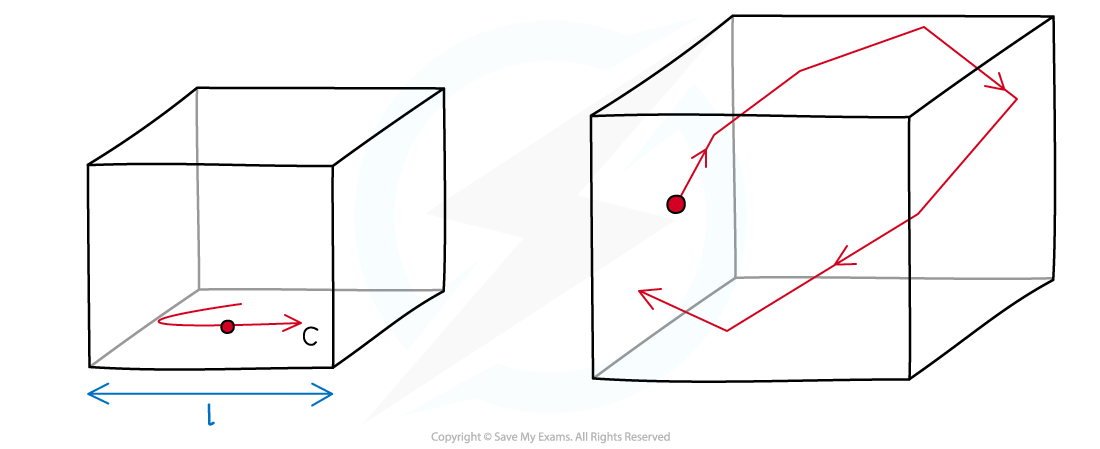
A single molecule in a box collides with the walls and exerts a pressure
Deriving the equation step-by-step
1. Find the change in momentum as a single molecule hits a wall perpendicularly
-
One assumption of the kinetic theory is that molecules rebound elastically
- This means there is no kinetic energy lost in the collision
-
If a molecule rebounds in the opposite direction to its initial velocity , its final velocity will be
-
The change in momentum is therefore:
2. Calculate the number of collisions per second by the molecule on a wall
- The time between collisions of the molecule travelling to one wall and back is calculated by travelling a distance of with speed :
Time between collisions =
- Note: is not taken as the speed of light in this scenario
3. Find the change in momentum per second
- The average force the molecule exerts on one wall is found using Newton’s second law of motion:
- The change in momentum is since the force on the molecule from the wall is in the opposite direction to its change in momentum
4. Calculate the total pressure from N molecules
- The area of one wall is
- The pressure is defined as the force per unit area:
- This is the pressure exerted on the container wall by one molecule
- To account for the large number of N molecules, the pressure can now be written as:
- Each molecule has a different velocity and they all contribute to the pressure
- The mean square speed is written with left and right-angled brackets
< c ^2 > - The pressure is now defined as:
5. Consider the effect of the molecule moving in 3D space
- The pressure equation still assumes all the molecules are travelling in the same direction and colliding with the same pair of opposite faces of the cube
- In reality, all molecules will be moving in three dimensions equally and randomly, with different velocities :
-
Where , , and are the -, -, and - components of the velocity
- This equation is a result of Pythagoras' theorem in 3D
-
Since pressure is due to the force exerted on one face of the cube, only the component of velocity perpendicular to that face (e.g. the -direction) matters
-
For a gas with molecules moving randomly in all directions, the mean square speed is evenly distributed among all three directions:
< c _ x ^ 2 > = < c _ y ^ 2 > = < c _ z ^ 2 >
- Therefore, the mean square speed in the -direction accounts for a third of the total mean square speed
< c ^2 >
- This is why only one-third of the total mean square speed contributes to the pressure on one wall
6. Re-write the pressure equation
-
The box is a cube, and all the sides are of length
- This means the volume of the cube is equal to
-
Substituting the new values for
< c ^2 >and back into the pressure equation obtains the final equation:
-
Where:
- = pressure (Pa)
- = volume (m3)
- = number of molecules
- = mass of one molecule (kg)
< c ^2 >= mean square speed of the molecules (m2 s–2)
-
This can also be written using the density ρ of the gas:
- Rearranging the pressure equation for and substituting the density :
Worked Example An ideal gas has a density of 4.5 kg m-3 at a pressure of 9.3 × 10⁵ Pa and a temperature of 504 K.
Determine the root-mean-square (r.m.s.) speed of the gas atoms at 504 K.
Answer:
Step 1: Write out the equation for the pressure of an ideal gas with density
Step 2: Rearrange for mean square speed
Step 3: Substitute in values
< c^{2} > = \frac{3 \times ( 9.3 \times 10^{5 ) }{4.5} = 6.2 \times 10^{5} \mathrm{m}^{2} \mathrm{s}^{-2} }
Step 4: To find the r.m.s value, take the square root of the mean square speed
Root-Mean-Square Speed
Spec point —
15.3.1
- The equation for the kinetic theory of ideal gases contains the mean square speed of the molecules:
< c ^2 >
-
Where
- = velocity of one gas molecule (m s-1)
- = average velocity of the molecules in a gas (m s-1)
< c ^2 >= average of the square of the speeds of the molecules in a gas (m2 s-2)
-
Since there are a large number of molecules in a gas, travelling in all directions in 3D space, this results in a large range of values of
-
The average velocity of all the molecules in a gas gives a net zero value overall
- This is because velocity is a vector, so some molecules will have a negative direction and others a positive direction
-
Squaring the velocities gives positive values only
-
Averaging the values of gives
< c ^2 >, the mean square speed -
Then, taking the square root of the mean square speed gives:
-
is known as the root-mean-square speed and has units of m s-1
- The root-mean-square speed is not the same as the mean speed
Was this revision note helpful?
Build on this topic