Calculating Uncertainties (Cambridge International A-Level Physics)
Exam board Cambridge International · A-LevelUpdated 2026-10-07
Calculating Uncertainty
What is uncertainty?
-
When measurements are taken, there is always a degree of uncertainty in those measurements due to errors in the experimental technique
-
Uncertainties are not the same as errors
- Errors can be thought of as the difference between the actual reading taken and the true value
- The uncertainty is a range of values around a measurement within which the true value is expected to lie, and is an estimate
-
For example, if the length of a box is measured multiple times as 12.55 cm, 12.45 cm and 12.51 cm, we can say the length is 12.50 cm with an uncertainty of 0.05 cm
- This is often written as 12.50 ± 0.05 cm
Calculating uncertainty
-
Uncertainties can be represented in a number of ways:
- Absolute uncertainty: where uncertainty is given as a fixed quantity (as above)
- Fractional uncertainty: where uncertainty is given as a fraction of the measurement
- Percentage uncertainty: where uncertainty is given as a percentage of the measurement
-
To find uncertainties in different situations:
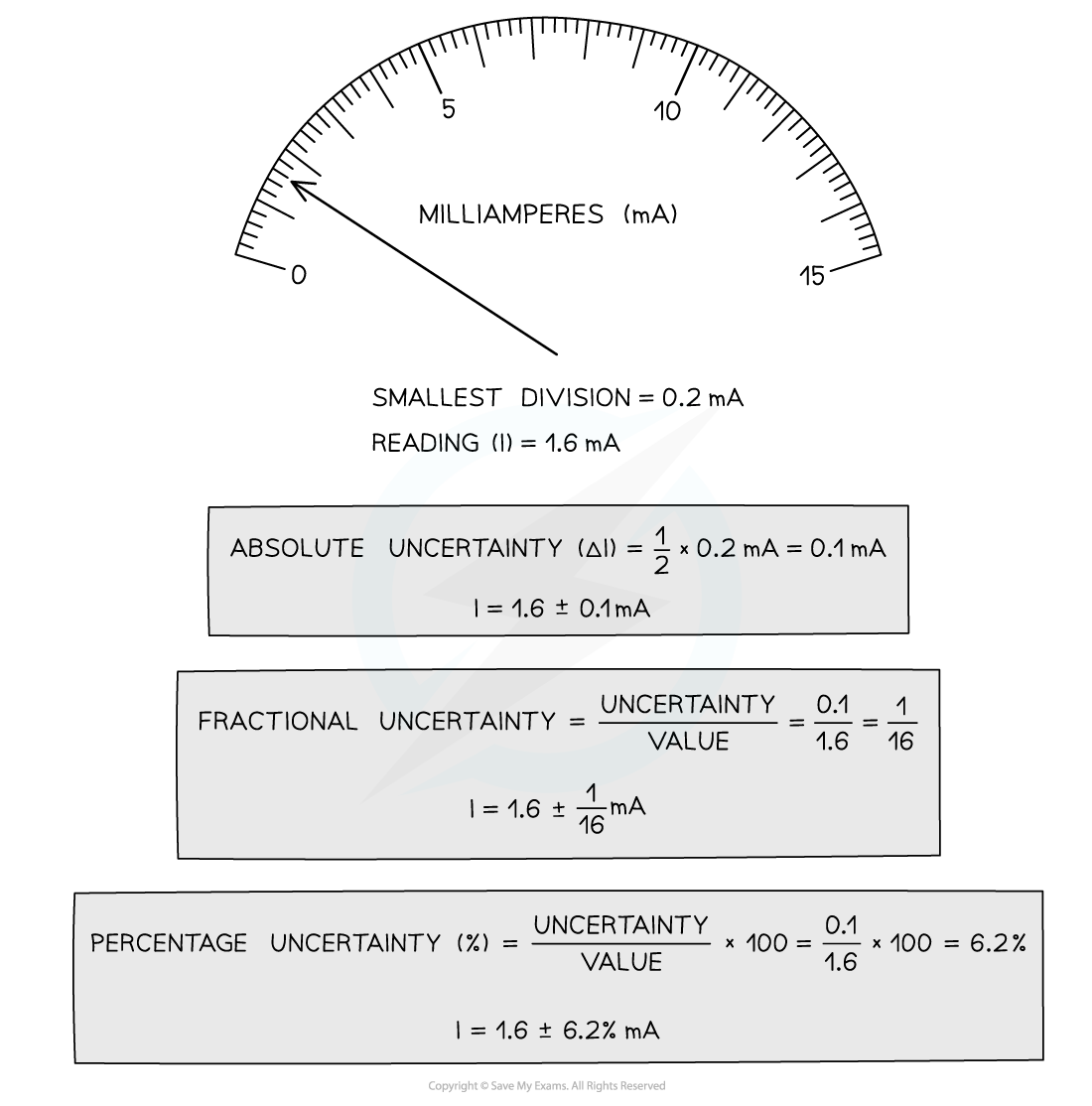
- The uncertainty in a reading (e.g. from a voltmeter): ± half the smallest division
- The uncertainty in a measurement (e.g. from a ruler): at least ±1 smallest division
- The uncertainty in repeated data: half the range i.e. ± ½ (largest - smallest value)
- The uncertainty in digital readings: ± the last significant digit unless otherwise quoted
Diagram showing a reading from an ammeter
Combining uncertainties
- When combining two measurements that both have uncertainties, the uncertainties have to be combined too
Adding or subtracting data
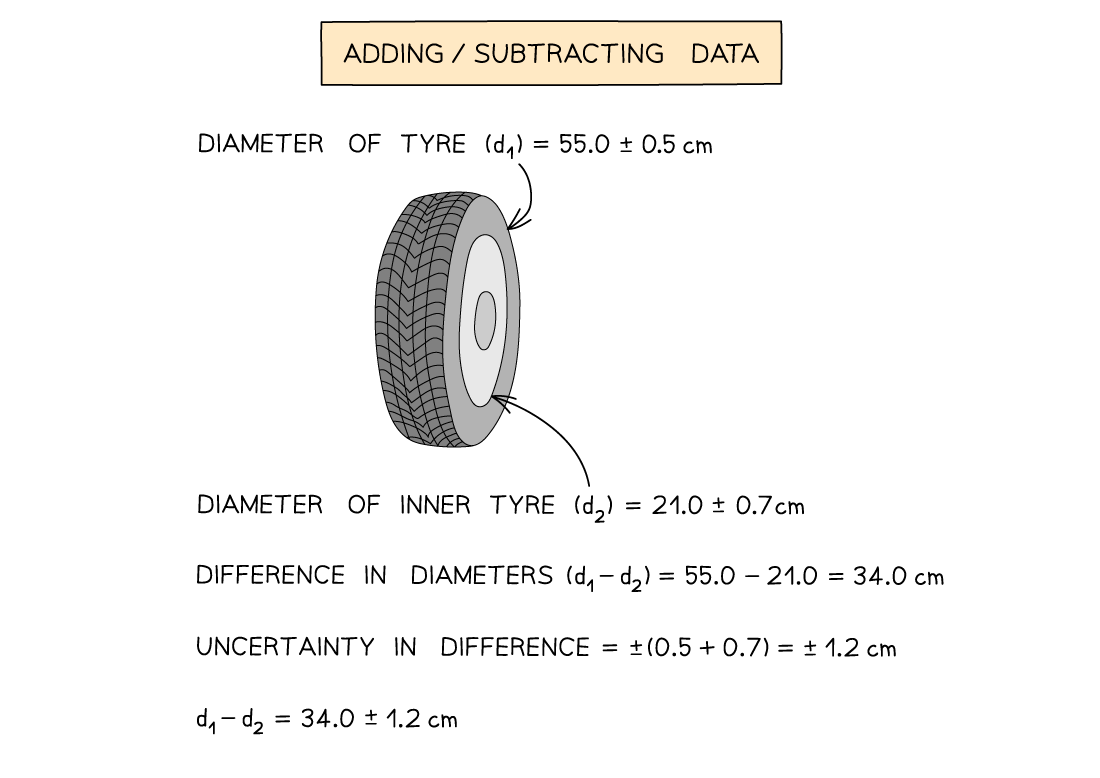
- When adding or subtracting two values with uncertainties, just add the absolute uncertainties
Adding or subtracting data example
Multiplying or dividing data
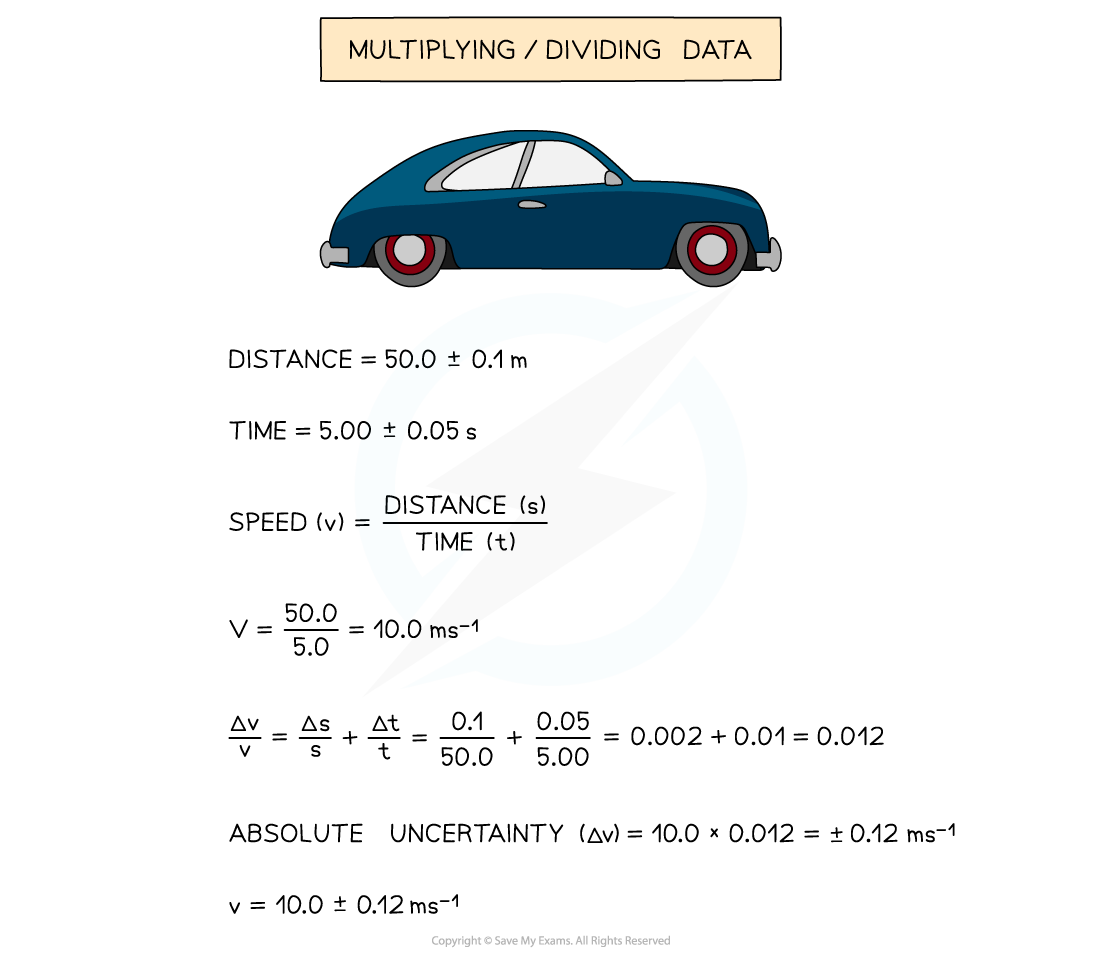
- When multiplying or dividing measurements with uncertainties, add their percentage uncertainties
Multiplying or dividing data example
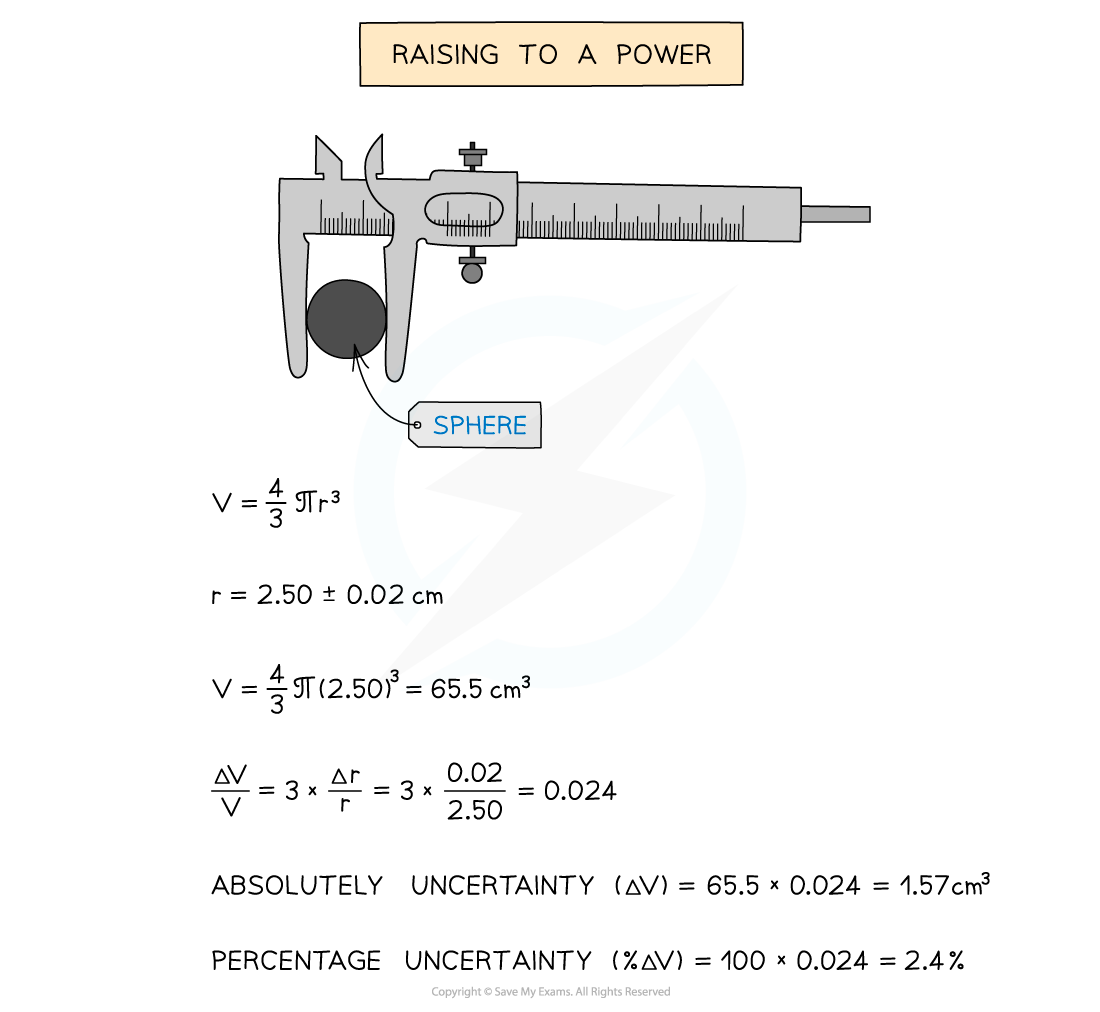
- When the measurement is raised to a power, multiply the fractional or percentage uncertainty by the power
Raising to a power example
Was this revision note helpful?
Build on this topic