Detecting Gamma-Rays from PET Scanning (Cambridge International A-Level Physics)
Calculating Energy of Gamma-Ray Photons
- In the annihilation process, mass, energy and momentum are conserved
- The gamma-ray photons have an energy and frequency that is determined solely by the mass-energy of the positron-electron pair
- The energy of a photon is given by:
- The momentum of a photon is given by
-
Where:
- me = mass of the electron or positron (kg)
- h = Planck's constant (J s)
- f = frequency of the photon (Hz)
- c = the speed of light in a vacuum (m s–1)
Worked Example Fluorine-18 decays by β+ emission. The positron emitted collides with an electron and annihilates producing two γ-rays.
(a) Calculate the energy released when a positron and an electron annihilate.
(b) Calculate the frequency of the γ-rays emitted.
(c) Calculate the momentum of one of the γ-rays.
Answer:
Part (a)
Step 1: Write down the known quantities
- Mass of an electron = mass of a positron, me = 9.11 × 10⁻³¹ kg
- Total mass is equal to the mass of the electron and positron = 2me
Step 2: Write out the equation for mass-energy equivalence
Step 3: Substitute in values and calculate energy
Part (b)
Step 1: Determine the energy of one photon
- Planck's constant, h = 6.63 × 10⁻³⁴ J s
- Two photons are produced, so, the energy of one photon is equal to half of the total energy from part (a):
Step 2: Write out the equation for the energy of a photon
Step 3: Rearrange for frequency and calculate
Part (c)
Step 1: Write out the equation for the momentum of a photon
Step 2: Substitute in values and calculate momentum
Detecting Gamma-Rays from PET Scanning
-
The patient lays stationary in a tube surrounded by a ring of detectors
-
Images of slices of the body can be taken to show the position of the radioactive tracers
-
The detector consists of two parts:
- A crystal scintillator
- A photomultiplier
Crystal scintillator
- When the gamma-ray (γ-ray) photon is incident on a crystal, an electron in the crystal is excited to a higher energy state
- As the excited electron travels through the crystal, it excites more electrons
- When the excited electrons move back down to their original state, the lost energy is transmitted as visible light photons
Photomultiplier
- The photons produced by the scintillator are very faint
- Therefore, they need to be amplified and converted to an electrical signal by a photomultiplier tube
PET scanner
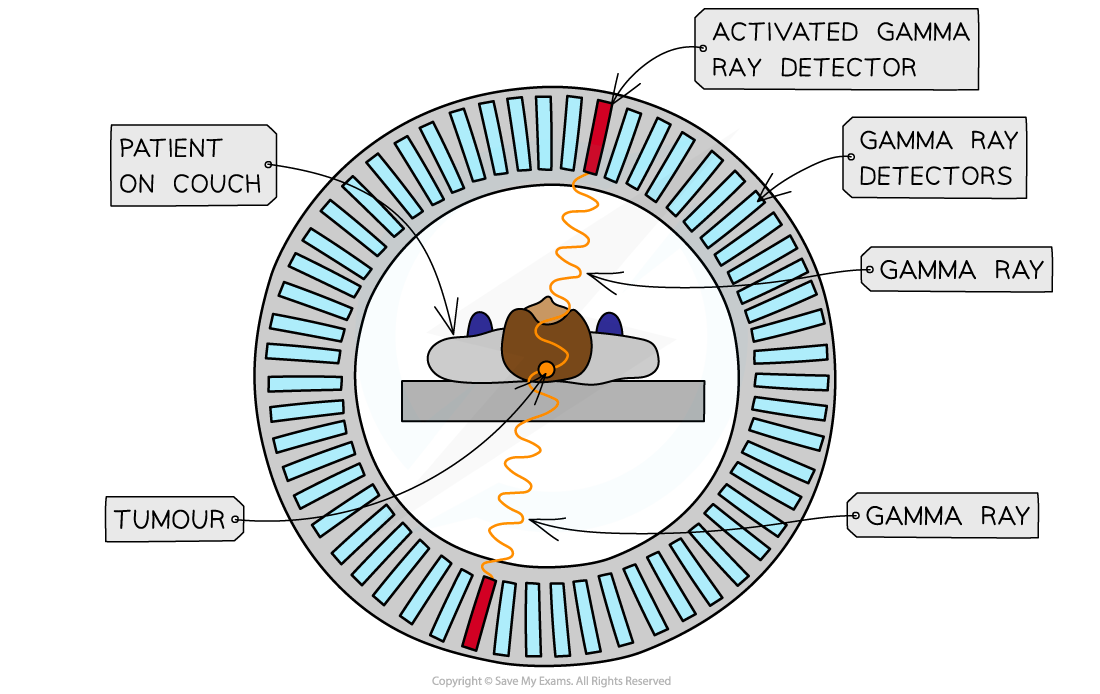
Detecting gamma rays with a PET scanner
Creating an image from PET scanning
-
The γ rays travel in straight lines in opposite directions when formed from a positron-electron annihilation
- This is due to the conservation of momentum
-
They hit the detectors in a line – known as the line of response
-
The tracers will emit lots of γ rays simultaneously, and the computers will use this information to create an image
-
The more photons formed at a particular point, the more tracer that is present in the tissue being studied, and this will appear as a bright point on the image
-
An image of the tracer concentration in the tissue can be created by processing the arrival times of the gamma-ray photons
Was this revision note helpful?
Build on this topic